


Bend has a way of turning a weekend visit into a life decision. People come for a ski trip or a summer float down the Deschutes, and somewhere between the third brewery and the fourth trailhead, they start quietly checking home prices on their phones.
I’ve spent years helping those people make the move – and helping a few realize it wasn’t the right fit before they spent a fortune finding out. This guide is the honest version of the conversation I have with almost every client relocating here: what Bend is genuinely great at, what it costs, where you might actually want to live, and what to expect once the moving truck pulls away.
No tourism-board gloss. Just what you’d want a local in the business to tell you before you commit.

Is Bend, Oregon a Good Place to Live? (The Honest Answer)
Yes – for the right person. Bend consistently lands on “best places to live” lists, and the reasons are real. But it’s not for everyone, and pretending otherwise does you no favors.
What makes Bend special:
- Sunshine in a state famous for grey. Bend gets around 300 days of sun a year. If you’re escaping the Willamette Valley or Seattle drizzle, this alone can change your quality of life.
- Recreation at your doorstep. Mt. Bachelor – one of the largest ski resorts in the country – is about 30 minutes away. The Deschutes River runs through town. Phil’s Trail, Shevlin Park, and hundreds of miles of trails are minutes from most neighborhoods.
- No sales tax. Oregon charges none. Every car, appliance, and grocery run costs exactly what the price tag says.
- A genuine food and beer culture. Bend punches far above its weight on craft breweries, coffee, and farm-to-table dining.
- A safe, small-town feel with a real downtown and a strong sense of community.
The honest trade-offs:
- Housing is expensive. This is the number-one barrier for newcomers, and we’ll cover it in detail below.
- The “Big Dark” is real. Late winter brings stretches of grey, cold days. Bend is sunnier than western Oregon, but it isn’t immune.
- You’ll drive. Bend is car-dependent. There’s no commuter rail and limited transit – most people drive for groceries, errands, and getting gear to the mountain.
- The “mountain tax.” Bend is geographically isolated in Central Oregon. Goods travel a long way to get here, which nudges up prices on groceries and fuel.
- Real winters. This is high desert. Summers can hit triple digits; winters bring snow and shoveling.

One thing worth understanding: the kind of person moving to Bend has shifted. A generation ago, this was a timber and manufacturing town. Today the workforce is largely remote, tech, healthcare, and service-oriented. As one local appraiser put it, those make for different buyers – and it’s a big reason the housing market behaves the way it does now.
Bend at a Glance (2026)
| Bend, Oregon | 2026 Snapshot |
|---|---|
| Population | ~109,000 (growing ~1.6% / year) |
| Median household income | ~$96,400 |
| Median age | ~41 years |
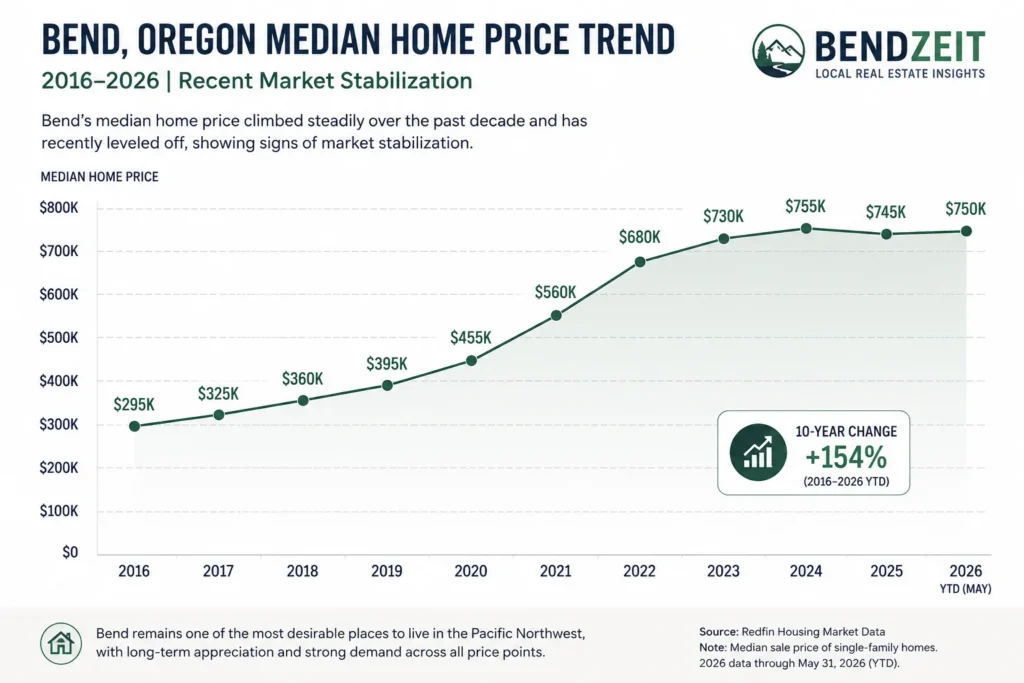
| Median home price | ~$725,000–$749,000 (single-family) |
| Cost of living index | ~134 (national avg = 100) |
| State sales tax | None |
| State income tax | Up to 9.9% |
| Days of sun | ~300 / year |
| Nearest airport | Redmond (RDM), ~20 minutes |
| Drive to Portland | ~3 hours |
Figures reflect early-to-mid 2026 data and are updated quarterly.
The Cost of Living in Bend (The Short Version)
Let’s be direct: Bend is not a cheap place to live. The overall cost of living sits around 34% above the national average, with a single person spending roughly $2,778 a month and a family of four closer to $6,117 before housing extremes are factored in.
But here’s the nuance most guides miss: housing is the outlier, not everything else. Strip housing out of the equation and your utilities, groceries, and healthcare are only modestly above the national average. It’s the cost of buying in that does the damage.
We go deep on real numbers – including the income you actually need – in the dedicated guide:
Also Read About: Review the complete cost of living in Bend before setting your relocation budget.
The Bend Housing Market in 2026
If you’re relocating, the housing market is the thing that will shape your decision most. Here’s where it stands.
As of early-to-mid 2026, the median single-family home price sits in the $725,000–$749,000 range, depending on the data source and month. After years of explosive, double-digit appreciation, the market has done something healthy: it stabilized. Year-over-year price growth is hovering around flat to low single digits – not a crash, not a frenzy.
A few signals worth knowing as a buyer:
- You can negotiate again. Homes are now closing at roughly 98% of list price, down from the 105% bidding-war days. On a $700,000 home, that often means $10,000–$20,000 in negotiating room or closing-cost concessions.
- Inventory has loosened. There’s roughly 3.5–3.8 months of supply – more choice than buyers have had in years, though still under the 5–6 months that defines a truly balanced market.
- Homes sit a little longer, giving you time to make a considered decision rather than a panic offer.
The “Westside Premium” – what every Bend buyer learns fast
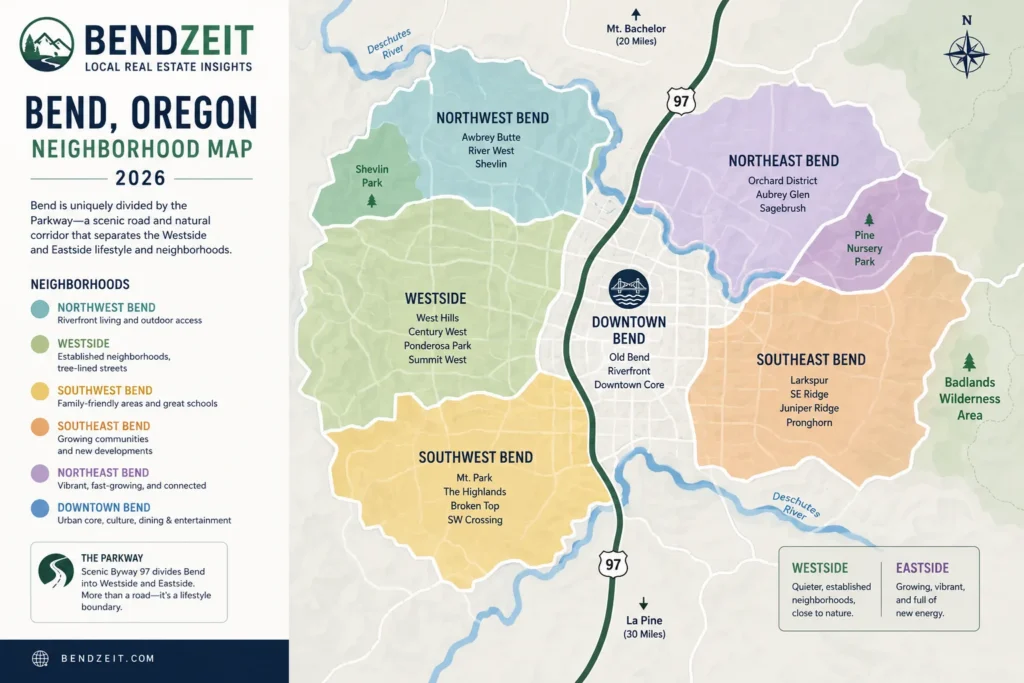
There’s an invisible line in Bend: the Parkway (Highway 97). Homes west of it – near downtown, the Old Mill, and the Galveston corridor – command a noticeable premium. The Westside is where most transplants want to be: walkable, close to trails, and established.
The value play, if your budget is tighter, is newer construction in Southeast Bend or established Northeast Bend neighborhoods, where your dollar stretches further. And if you’re willing to look 20 minutes north, Redmond offers a roughly $499,000 median – more home, more land, lower prices, same Central Oregon lifestyle.
There’s an old local line for buyers agonizing over interest rates: “Marry the house, date the rate.” If you find the right home now, it’s usually wiser to secure it than to wait for rates to drop – because lower rates typically just bring more competition and push prices back up.
Choosing Your Bend Neighborhood
Bend isn’t one place – it’s a collection of distinct neighborhoods, and locals will tell you no two feel alike. Your choice comes down to a trade between walkability, space, price, and vibe.
A quick orientation:
- Westside (walkable, premium): NorthWest Crossing, River West, Old Bend, Discovery West. Trails, character, and a village feel – and the highest prices.
- Awbrey Butte (views, luxury): Large lots, Cascade views, privacy. Not walkable. Luxury tier ($1M–$2.5M+).
- Eastside & Southeast Bend (value): A Bend address for less. Newer construction, strong community, more car-dependent.
- Golf & luxury communities: Tetherow, Broken Top, Awbrey Glen. The high end has softened lately, meaning more negotiating room than in years.
For the full breakdown – prices, walkability, schools, and which area fits your life – start with the neighborhood hub:
Use the Bend neighborhood guide to compare location, housing, and lifestyle options.
Jobs & the Bend Economy
Bend’s economy has diversified well beyond its timber-town roots. The region’s growing industries now include software and high tech, bioscience, outdoor-recreation products, aviation, manufacturing, and craft brewing.
The largest employers in and around Bend include:
- St. Charles Health System – the region’s largest employer (~3,500+ employees)
- Bend-La Pine Schools
- Deschutes County and the City of Bend
- Mt. Bachelor (major seasonal and year-round hospitality employer)
- OSU-Cascades – Central Oregon’s four-year university, still growing
- Lonza (formerly Bend Research) in bioscience
Two things relocating professionals should know. First, remote work is a major driver here – a large share of recent arrivals brought their jobs with them. Second, if you’re job-hunting locally, healthcare, education, tourism/hospitality, and a growing tech and outdoor-products sector are your strongest bets.
A reality check on income: to live comfortably in Bend – owning a home, a car, dining out occasionally, enjoying the recreation – most households need somewhere in the $90,000–$130,000+ range. To buy a median-priced home without becoming house-poor, a combined income of $150,000+ is often what it takes to qualify and manage the monthly costs.
Schools in Bend
Families relocating here are generally well served. Bend-La Pine Schools is the district, and several Westside schools are consistently among the highest-rated in Central Oregon – High Lakes Elementary and Summit High School come up again and again from parents.
School boundaries are one of the biggest factors in where families ultimately buy, so if you have school-age kids, map your target schools before you settle on a neighborhood. (We’ll be publishing a dedicated Bend schools guide soon – it’ll link here.)
Weather & the Four Seasons
Bend sits in the high desert on the eastern slope of the Cascades, and the climate is a genuine four-season experience:
- Summer: Warm to hot, sometimes triple digits, but low humidity and cool evenings. Peak season for rivers, trails, and lakes.
- Fall: Many locals’ favorite – crisp, golden, quiet.
- Winter: Real winter. Snow, shoveling, and ski season. Cold but bright on the good days.
- Spring: Variable, with the tail end of the “Big Dark” before summer arrives.
Two honest notes newcomers appreciate: the “Big Dark” stretch of grey late-winter days is real (still milder than western Oregon), and wildfire smoke can affect air quality during parts of the summer. Neither is a dealbreaker for most – but you should know going in.
Getting Around – Transportation & Access
Bend is car-dependent, full stop. Plan on a vehicle for daily life. The upside is that distances within town are short, and you’re rarely far from a trailhead.
For travel, Redmond Municipal Airport (RDM) is about 20 minutes away with direct flights to several Western hubs. Portland is about a 3-hour drive west over the mountains (check pass conditions in winter), and the Cascade lakes and Mt. Bachelor are 30–45 minutes from most neighborhoods.
Your Bend Relocation Timeline
A condensed version of the plan I walk clients through:
6+ months out
- Define your budget honestly (revisit the income numbers above).
- Get pre-approved with a lender familiar with the Central Oregon market.
- Start narrowing neighborhoods using the guides linked above.
3–6 months out
- Visit in more than one season if you can – Bend in July and Bend in February are different experiences.
- Set up listing alerts so you learn the market before you need to act.
- Line up a local agent who knows neighborhood-level nuances.
1–3 months out
- Tighten your search to two or three neighborhoods.
- Book movers early (summer is peak and fills up).
- Sort out the logistics of selling or leasing your current home.
Moving month
- Transfer utilities, register vehicles, update your license (Oregon has specific timelines).
- Lean on your agent for the trusted-local-vendor list – inspectors, contractors, and the rest.
Frequently Asked Questions
For a comfortable lifestyle in Bend, most households aim for an income of $90,000–$130,000 or more. To buy a median-priced home (~$725,000–$749,000) without being house-poor, a combined income of around $150,000+ is often necessary. A single person renting should target at least $75,000–$85,000 to live comfortably.
For people who value sunshine, outdoor recreation, a safe small-town feel, and no sales tax, Bend is an excellent place to live. The main trade-offs are high housing costs, a car-dependent lifestyle, and really high-desert winters. It tends to suit remote workers, active families, and retirees especially well.
Yes, relative to the national average, the cost of living runs about 34% higher, driven almost entirely by housing. Utilities, groceries, and healthcare are only modestly above average. Oregon’s lack of a sales tax helps offset some of the higher costs.
It depends on your priorities. NorthWest Crossing is popular for walkability and schools; Old Bend for historic character and downtown access; River West for the close-in brewery-and-trail lifestyle; Awbrey Butte for views and privacy; and Southeast Bend or Redmond for better value. See our neighborhood guide for a full comparison.
Bend is about 160 miles and roughly a 3-hour drive southeast of Portland, over the Cascade Mountains. Winter pass conditions can lengthen the trip.
Bend has real winters with regular snowfall and shoveling, but it’s far sunnier than western Oregon — around 300 days of sun a year. Summers are warm and dry with low humidity.
Ready to Make the Move?
Relocating to Bend is a big decision, and the right local guidance makes all the difference – from understanding what your budget buys to knowing which neighborhood actually fits your life.