

Internet service is one of those things that rarely makes it onto a moving checklist until there is a problem. You arrive at your new home, unpack the laptop, connect the router, and then discover that the provider you had in mind does not actually serve the address.
That situation is worth avoiding in Bend.
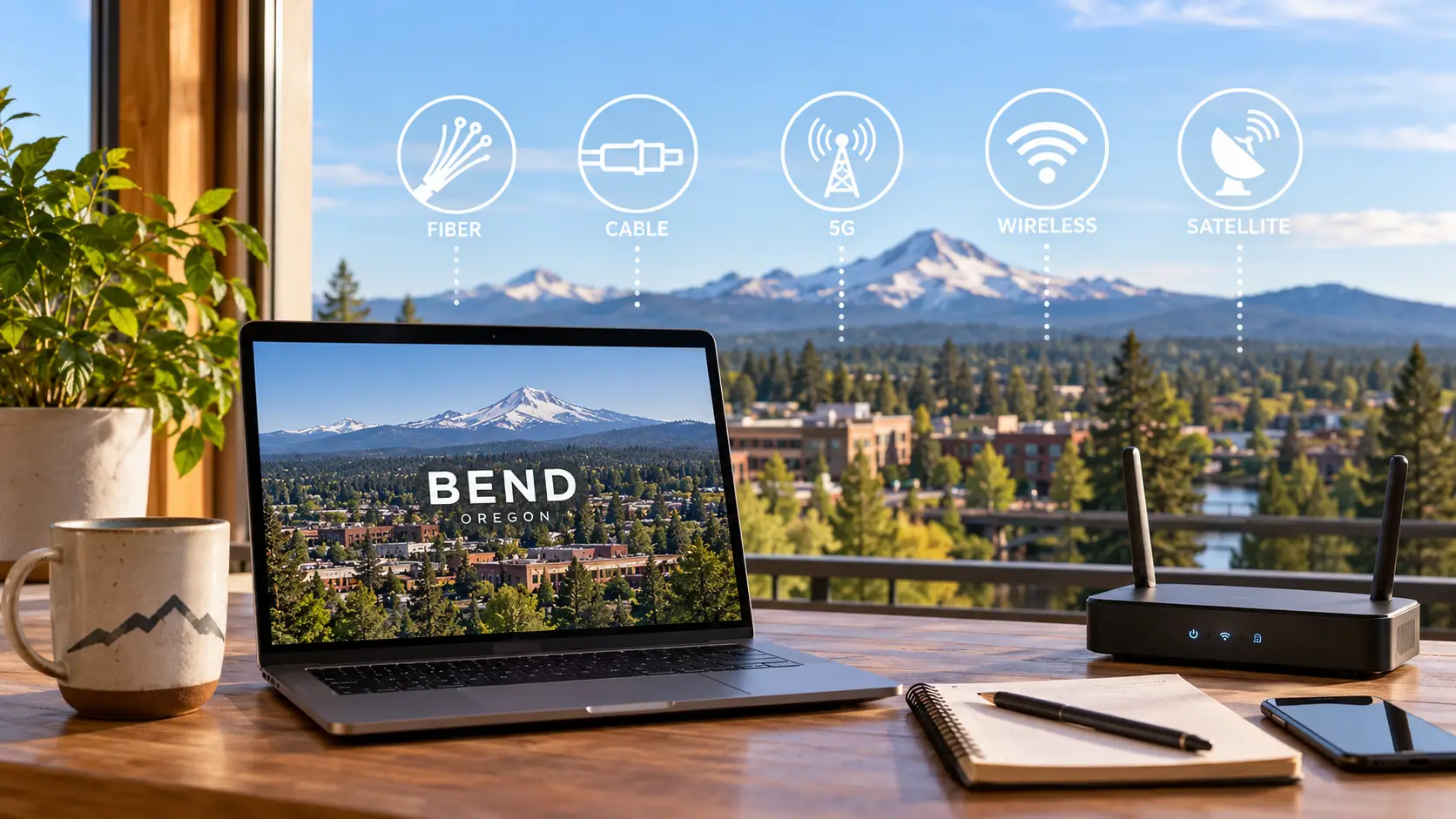
Internet providers in Bend, Oregon offer several types of service, including fiber, cable, 5G home internet, fixed wireless, and satellite. The catch is that availability can change from one neighborhood to another and, in some cases, from one street to the next. A provider that works well for a home on one side of town may not be an option at another address.
For someone moving to Bend, internet service is therefore more than a monthly utility. It can influence which home you choose, how comfortably you can work from home, and whether a property is practical for your household.
Internet Service in Bend Can Vary by Address
One of the biggest mistakes people make when comparing internet service is assuming that a provider’s presence in Bend means that the provider serves every Bend address.
It does not work that way.
Internet companies build networks in stages, and different parts of a city can have different infrastructure. One property may have access to fiber while a nearby home relies on cable. An apartment building may have different options from a single-family house across the street. Homes farther from established neighborhoods may have to rely on wireless or satellite service.
That is why checking the exact address should be the first step.
If you’re still deciding where in Bend you want to live, it is also worth looking at the bigger relocation picture. BendZeit’s Bend relocation guide covers the housing, lifestyle, transportation, and practical considerations that come with moving to Central Oregon.

What Types of Internet Are Available in Bend, Oregon?
The best internet connection for your home depends partly on what has been built in your area and partly on how you use the service. Someone who checks email, watches a few shows, and occasionally joins a video call has very different requirements from a household with two remote workers and several children gaming or streaming at the same time.
Here are the main types of service you are likely to encounter.
Fiber Internet
Fiber is usually the first option worth checking when it is available at your address.
The biggest advantage is not simply a high download speed. Fiber connections can also provide strong upload performance, which becomes important when you are sending large files, using cloud applications, joining video meetings, backing up photos, or working with other data-heavy services.
That makes fiber particularly appealing to people who work from home. It can also be useful for larger households where several people are using the connection at the same time.
The downside is simple: fiber is not available everywhere. Seeing fiber construction in a nearby neighborhood does not necessarily mean the service is ready to be ordered at your home.
Cable Internet
Cable remains a practical choice for many Bend households.
For everyday activities such as streaming, browsing, online shopping, schoolwork, video calls, and general home use, a good cable connection can be more than sufficient. It is also widely established in many communities, which can make it a dependable option when fiber is not available.
The main thing to watch is upload speed. Internet plans are often advertised using their download speeds, but that number only tells part of the story. If you regularly upload large files or work from home, the difference between download and upload performance can become noticeable.
When comparing a cable plan with a fiber plan, look at both numbers.
5G Home Internet
5G home internet has become another option for Bend residents, particularly renters and people who want a simpler setup.
Instead of a traditional wired connection running into the home, 5G home internet uses a cellular network and a home gateway. That can make installation easier in some situations, and it can be appealing to someone who does not want to commit to a long-term wired setup.
Performance is more dependent on local conditions, though. Signal strength, network congestion, the position of the home, and the equipment provided can all affect the experience.
A strong 5G signal on your phone is encouraging, but it is not a guarantee that a 5G home internet plan will perform exactly the same way.
Fixed Wireless
Fixed wireless can be useful for homes that sit outside the strongest fiber and cable coverage.
The service generally uses a wireless connection between the property and a nearby network point. This can make it a practical alternative in areas where running a traditional wired connection is difficult or unavailable.
Terrain matters here. Trees, hills, buildings, and the position of the receiving equipment can all affect service quality. If you’re looking at a home on the outskirts of Bend or in a more rural area, ask the provider whether the property has been specifically checked for service rather than relying on a general coverage map.
Satellite Internet
Satellite service can become important when other options are limited.
For a home in a remote location, satellite may provide connectivity where fiber, cable, and fixed wireless are not practical. It can also be useful as a backup option for certain households.
The tradeoffs are different from those of a wired connection, so compare the plan carefully. Look at equipment costs, installation requirements, expected performance, data policies, and the conditions around the service rather than choosing it simply because it is available.
Which Internet Option Is Best for a Bend Home?
There is no single answer because the right connection depends on the household.
A remote worker may care most about stable service and upload speed. A family with several heavy users may want enough capacity to avoid slowdowns during busy evenings. A renter might prefer a flexible plan that is easy to install and cancel. Someone buying acreage outside the city may have to start with whatever connection can actually reach the property.
This is why internet speed alone can be a misleading way to compare plans.
A plan advertising a very high download speed may not be the best fit if the upload performance is weak or the connection is inconsistent. Conversely, a moderately priced plan may work perfectly well for a household with fairly simple internet needs.
The goal is to match the service to the way you actually live.
Best Internet Options for Working From Home in Bend
Remote work makes internet quality much more important than it used to be.
A person who spends most of the day in video meetings, works through a cloud-based system, transfers large files, or uses a company VPN may notice connection problems that another household never encounters.
Upload speed deserves particular attention. Video meetings and ordinary browsing depend heavily on download performance, but many work-from-home activities also require the connection to send information back to the internet consistently.
Reliability matters just as much. A connection that occasionally becomes unstable during a client call can be more frustrating than one that is slightly slower but consistently available.
If you’re choosing a Bend home specifically for remote work, check internet service before you become committed to the property. It is much easier to change your mind about a house than to persuade a provider to build a new network for it.
Internet for Families and Multiple Users
Families often underestimate how quickly internet usage adds up.
A couple of laptops may not seem demanding on their own, but add phones, televisions, gaming consoles, tablets, security cameras, smart-home devices, and several people streaming or working at the same time, and the household’s requirements change.
This is where both the internet plan and the home’s Wi-Fi setup matter.
Sometimes a household buys a much faster plan when the real problem is poor Wi-Fi coverage. A router placed at one end of a large house may leave bedrooms, offices, or upstairs spaces with a weak signal. In that situation, a better router or mesh system may make a bigger difference than upgrading the internet package.
Before paying for more speed, make sure you know whether the problem is the connection coming into the home or the Wi-Fi distribution inside it.
Internet Options for Renters in Bend
Renters should check internet availability before signing a lease, particularly when working from home is involved.
Apartment buildings can have their own infrastructure, and some properties may have limited provider choices. Others may include internet as part of the rent or have building-specific arrangements that affect which service you can order.
Ask the property manager or landlord which providers have served the unit before, but do not stop there. Confirm the address directly with the provider.
This is especially important for apartments because a provider may serve the neighborhood without being able to connect a particular building or unit.
If you are comparing rental costs across Bend, our average rent in Bend by neighborhood guide can help put internet costs into the larger monthly housing budget.
Check Internet Before Buying a Home in Bend
Home buyers have one extra reason to verify internet service: they may be living with the decision for years.
A property may check every other box. The location may be right, the house may have the space you need, and the neighborhood may be a perfect fit. If you work remotely and discover after closing that your preferred internet service is unavailable, however, that otherwise minor detail can become a daily frustration.
The internet should be checked alongside other practical aspects of a property, particularly when comparing homes outside established neighborhoods.
Ask what service is available now, what type of connection it is, and whether the provider has plans to upgrade the area. Most importantly, verify the information yourself.
A listing description saying “high-speed internet available” is not the same thing as confirming that the exact property can receive the service you want.
How to Check Internet Availability at a Bend Address
The easiest approach is also the most reliable: enter the full property address on the provider’s website and see what it offers.
If you are renting an apartment, include the unit number when the provider’s system allows it. If you are buying a home, check the address before making an offer when possible.
It is worth checking more than one provider because the available options can be surprisingly different.
You should also avoid treating a ZIP code as a service guarantee. A ZIP code covers a much larger area than a single network footprint, and internet infrastructure does not follow postal boundaries perfectly.
The same applies to recommendations from neighbors. Their experience can be useful, but their house may be connected to a different network or located on a different part of the provider’s system.
For a broader look at how different areas of Bend are organized, you can also use BendZeit’s Bend Oregon ZIP code guide.
What Should You Ask an Internet Provider?
Once you know which providers can actually serve the property, compare the plans carefully.
Start with the connection type. Knowing whether you’re getting fiber, cable, fixed wireless, or another technology gives you much more useful information than a headline speed.
Then look at the upload speed as well as the download speed. Ask whether the advertised price is promotional, how long that price lasts, and what the regular rate will be afterward.
Installation is another detail worth asking about. If you’re moving into the home soon, you need to know whether installation requires a technician visit and how far in advance appointments are being scheduled.
Finally, ask about equipment and fees. A plan that looks inexpensive on the first page can become noticeably more expensive once equipment rental, installation charges, or other recurring costs are included.
How Much Internet Speed Do You Need?
More speed is not automatically better.
For a single person who mainly browses, streams occasionally, and checks email, a basic plan may be enough. A couple working from home at the same time will probably want more breathing room, particularly if both regularly use video conferencing.
Larger households have to account for simultaneous use. Several people streaming, gaming, attending online classes, and working from home can create a very different demand from a household where most internet use happens one person at a time.
Upload requirements should also influence the decision. Someone who regularly sends large work files or maintains extensive cloud backups may benefit from a connection with stronger upload performance even if their download requirements are relatively modest.
The best plan is the one that handles your normal usage without paying for capacity you will never use.
Internet Costs and Your Bend Household Budget
Internet is only one recurring expense, but it is easy to overlook when you’re calculating the cost of moving.
The monthly bill sits alongside rent or a mortgage, electricity, water, heating, insurance, transportation, and other household expenses. Promotional internet pricing can also make it difficult to understand what a plan will really cost over a longer period.
When comparing plans, look beyond the first few months. Find out what the regular rate will be and whether equipment or other fees are added to the advertised price.
If you’re working out the broader budget for a move, BendZeit’s Cost of Living in Bend, Oregon guide provides a useful starting point for looking at other household expenses.
Setting Up Internet Before You Move
Once you know your new address, there is little reason to wait until moving day to arrange internet service.
Start by checking which providers serve the property and comparing their plans. If installation is required, schedule it early enough that a delayed appointment does not leave you without service for several days.
This matters even more if you work remotely. A few days without home internet may be manageable for someone on vacation, but it can become a serious problem when you’re expected to be online for work.
A simple backup plan is worth having as well. A mobile hotspot or another temporary connection can give you a way to work if the installation date changes or your primary service has an unexpected problem.
BendZeit’s moving to Bend relocation checklist is also useful for keeping utility transfers, address changes, and other practical tasks organized before moving day.
What If Your Bend Home Does Not Have Fiber?
A lack of fiber should not automatically take a home off your list.
Cable can provide plenty of performance for many households, while 5G home internet can be a convenient alternative where the address qualifies. Fixed wireless can work for homes outside the strongest wired coverage, and satellite can provide another option for properties in more remote locations.
The important thing is to understand what you are actually getting.
If the internet is central to your work, compare upload speeds and reliability carefully. If you mainly stream movies, browse the web, and use social media, your requirements may be much less demanding.
The right question is not whether a property has the fastest connection available in Bend. It is whether the connection available at that property is good enough for the way you intend to use the home.
Does Internet Availability Matter When Choosing a Bend Neighborhood?
It can. Internet service is rarely the only reason someone chooses one Bend neighborhood over another, but it can become an important tie-breaker when two properties otherwise look similar.
A remote worker may place more value on a confirmed fiber connection. A renter may prefer an apartment with several provider choices. Someone looking at a property farther from central Bend may need to investigate wireless or satellite options before deciding whether the location works.
That is one reason it helps to evaluate the property and the neighborhood together rather than treating the internet as something to figure out after moving in.
BendZeit’s Bend neighborhoods guide can help you compare the broader characteristics of different areas while you narrow down where you want to live.
Frequently Asked Questions
Bend residents may have access to fiber, cable, 5G home internet, fixed wireless, and satellite service. The choices depend on the exact property, so checking the address directly with providers is more reliable than assuming a service is available throughout an entire neighborhood.
There is no single provider that is best for every Bend household. Fiber is often worth checking first for people who work from home or need strong upload performance, while cable, 5G, fixed wireless, and satellite can make sense depending on the property’s location and the household’s needs.
Fiber service is available in parts of Bend, but coverage varies by address. A provider may offer fiber on one street without having it available at every nearby property, so buyers and renters should confirm serviceability before choosing a home.
Yes. Cable can be a practical choice for many households, especially when fiber is not available. Before signing up, compare upload speed, regular monthly pricing, equipment costs, and any promotional terms rather than looking only at the advertised download speed.
5G home internet may be available at eligible Bend addresses, but service quality depends on local network conditions and the property’s location. A strong mobile phone signal does not necessarily guarantee the same experience from a home internet gateway.
Remote workers should pay attention to reliability, upload speed, latency, and the ability to handle video meetings and cloud applications. Fiber is often worth considering where available, although a reliable cable or wireless connection can also be suitable depending on the work requirements.
Yes. If the internet is important to your work or daily life, verify the exact address before purchasing. Do not rely solely on a real estate listing, ZIP code, neighborhood coverage map, or a neighbor’s experience because the available network can differ from one property to another.
It is best to start checking providers as soon as you know your new address. If the property requires professional installation, scheduling ahead of your move can help you avoid arriving at the new home without a working connection.