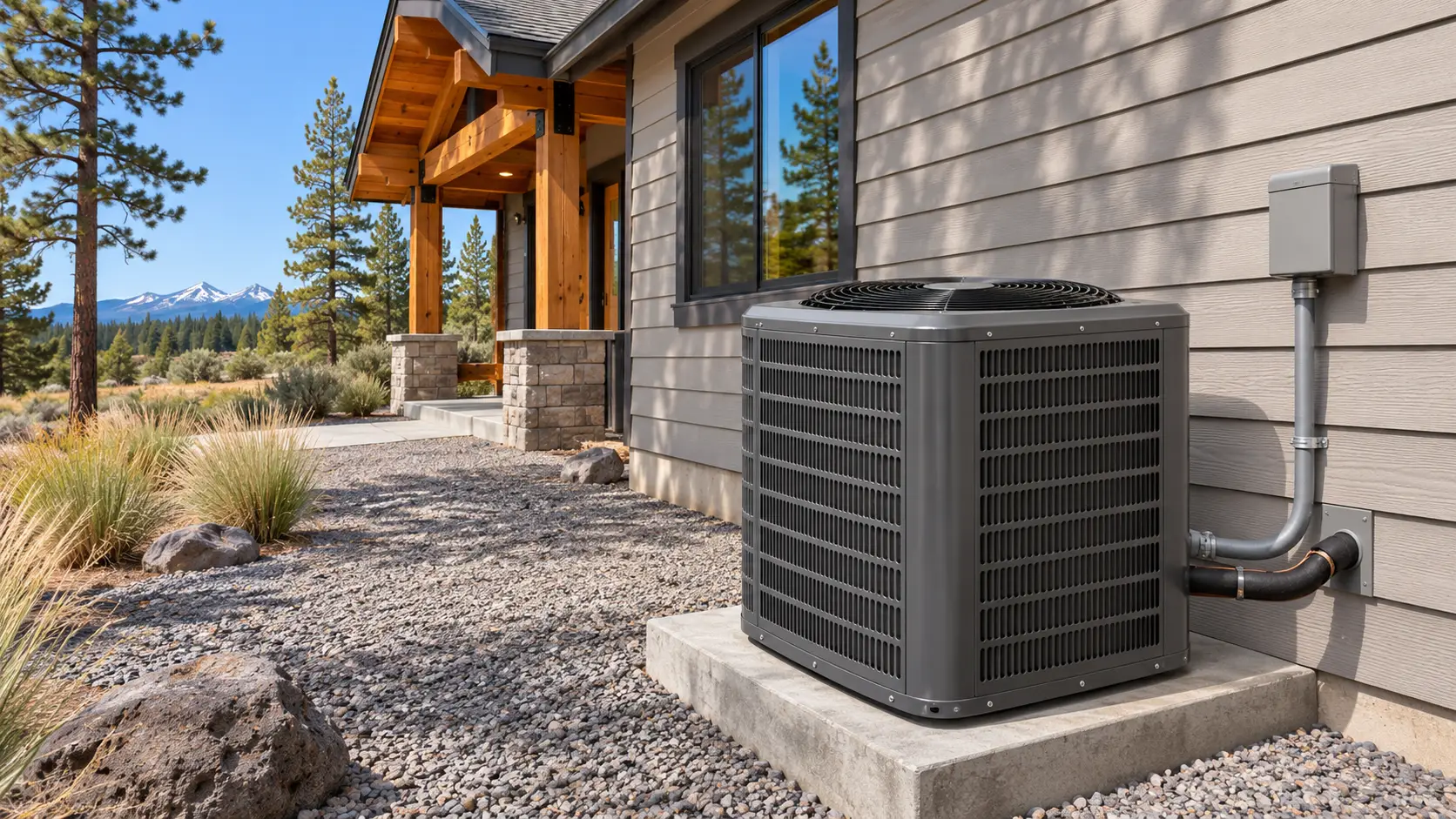


Air conditioning in Bend, Oregon, is worth considering if you want dependable indoor comfort during hot weather. Cool evenings can help, but they do not guarantee that every home will stay comfortable through warm afternoons, consecutive hot days, or periods when outdoor smoke makes opening windows undesirable.
The right choice depends on the home’s insulation, windows, shade, layout, and existing heating equipment. Your daily routine matters, too: an upstairs bedroom or home office may need more attention than a shaded room used only occasionally.
For buyers, the first step is to confirm what cooling equipment a property actually has. For homeowners, it is to compare suitable upgrades based on the building rather than choosing equipment from its advertised capacity alone.
Do You Need AC in Bend?
There is no single answer for every home. A well-shaded, well-insulated house may remain comfortable longer than a property with large west-facing windows and an exposed upper floor. Even within one home, temperatures can vary considerably between rooms.
Treat cooling as a practical requirement to evaluate, especially if you need consistent sleeping or working conditions.
| Your situation | What to investigate |
|---|---|
| Bedrooms become uncomfortable in the evening | Cooling coverage, insulation, shading, and airflow to those rooms |
| You work from home through summer afternoons | Whether the office has its own cooling needs or temperature controls |
| The house has usable ductwork | Compatibility with central AC or a ducted heat pump |
| The home has no ducts | Ductless cooling options and the number of rooms requiring service |
| You want to keep windows closed during smoke events | Cooling that works without open windows, plus a separate filtration plan |
| Existing heating equipment is approaching replacement | Whether a heat pump makes sense as part of a coordinated upgrade |
Our Bend climate and weather guide explains the wider seasonal picture. When making a purchase or installation decision, focus on how the particular home performs during demanding conditions rather than relying only on monthly averages.

Do Homes in Bend, Oregon Have Air Conditioning?
Some homes have central AC, others have heat pumps or ductless systems, and some lack permanent cooling. Confirm the equipment on each property rather than assuming it is included because the home is newer or has forced-air heating.
A furnace provides heat. Its presence does not establish that the house also has an air-conditioning system.
Likewise, a thermostat with a “cool” setting is not sufficient proof that functional cooling equipment serves the entire home.
When reviewing a listing, ask for:
- The type of installed cooling system.
- Equipment model numbers and installation dates, if available.
- The rooms or zones the system serves.
- Recent service records and known performance issues.
- Whether portable or window units are included in the sale.
- Documentation for significant equipment changes.
During a winter purchase, cooling equipment may not be suitable for a full operational test in the prevailing outdoor temperature. Ask the inspector or HVAC technician how that limits the evaluation and what follow-up is appropriate.
Our Bend home inspection guide can help you prepare questions about equipment condition and inspection limitations.
Central AC, Heat Pumps, and Ductless Systems Compared
The main options differ in how they distribute cooling and whether they also provide heat.
| System | How it serves the home | Main advantage | What to check |
|---|---|---|---|
| Central air conditioner | Usually distributes cooled air through ducts | Whole-home cooling where the duct system is suitable | Duct condition, airflow, equipment compatibility, and room coverage |
| Ducted heat pump | Uses ducts for cooling and heating | One system can provide both functions | Heating performance, controls, duct suitability, and any backup heat plan |
| Ductless mini-split heat pump | Uses indoor units connected to outdoor equipment | Can serve homes or zones without conventional ductwork | Indoor-unit placement, closed-room coverage, and condensate routing |
| Window air conditioner | Cools a room from an approved window installation | Can address a limited space | Window fit, electrical requirements, installation security, and applicable rules |
| Portable air conditioner | Usually exhausts heat through a window connection | Can provide temporary or room-specific cooling | Hose arrangement, sealing, noise, drainage, and smoke-related limitations |
A ductless unit in the living room will not necessarily keep closed bedrooms at the same temperature. Ask how the proposed system will serve each room you expect to use.
Is a Heat Pump a Good Option in Bend, Oregon?
A heat pump can provide cooling in summer and heating in colder weather. It moves heat between indoors and outdoors rather than serving only as an air conditioner.
For a heat pump in Bend, Oregon, the heating design deserves as much attention as cooling. Ask the contractor to evaluate the home’s heating load, the equipment’s output at local winter design conditions, and how any backup system would operate.
This is particularly useful when an existing furnace also needs replacement. Comparing a coordinated heating-and-cooling project may produce a different decision from adding AC to equipment you intend to keep.
Questions to Ask About a Heat Pump Proposal
- What are the home’s calculated heating and cooling loads?
- What capacity will this equipment provide in cold weather?
- Is supplemental heat needed, and how is it controlled?
- Can the existing ducts and electrical service support the design?
- Which rooms will be served by each zone?
- What operating-cost assumptions are used in the estimate?
A heat pump does not automatically guarantee lower bills for every household. Results depend on the existing system, energy prices, equipment performance, installation, and usage.
How to Add Air Conditioning to a House
Adding AC starts with evaluating the existing home. The process is different for a house with suitable ducts than for one heated by baseboards or another system without ductwork.
1. Assess the Building
Have the contractor review insulation, air leakage, windows, orientation, shading, and room layout. These features influence how much cooling the home needs.
Discuss planned improvements before equipment selection. If you expect to improve insulation or replace windows, the design should take that into account.
2. Check Existing Equipment and Ducts
Existing ducts may need sealing, repairs, resizing, or airflow adjustments. The contractor should also confirm whether the indoor equipment can work with the proposed cooling system.
For a home without ducts, compare ductless options with the practicality and cost of adding a duct system.
3. Request a Load Calculation
Equipment should be sized for the home’s calculated needs. A recognized residential load calculation, such as Manual J, considers more than floor area.
An oversized unit can cycle too frequently and provide disappointing comfort. Simply buying a larger system is not a reliable solution to uneven room temperatures.
4. Plan Installation Details
Ask about the outdoor unit’s location, required clearances, sound, electrical work, refrigerant lines, condensate drainage, and access for maintenance.
For a heat pump, discuss winter operating conditions and appropriate placement. Also confirm any association approvals or restrictions that apply to exterior equipment.
5. Confirm Permits and Completion Checks
Have the contractor identify required permits and inspections for the address and scope of work. The relevant authority may differ inside and outside Bend city limits.
Our Bend remodeling permits guide explains what to clarify before work begins.
At handover, request operating instructions, warranty details, filter information, and confirmation that the system has been tested and adjusted.
What Does Air Conditioning Installation Cost?
A useful price requires a property-specific assessment. Adding cooling to compatible equipment can involve a different scope from replacing heating equipment, upgrading an electrical panel, or installing several ductless zones.
Ask each contractor to price the same intended outcome so that estimates can be compared fairly.
| Quote item | What should be clear |
|---|---|
| Equipment | Exact outdoor and indoor models |
| Design | Rooms served, calculated loads, and capacity selection |
| Ductwork | Repairs, sealing, modifications, or new ducts included |
| Electrical work | Circuits, disconnects, and any panel work |
| Installation | Equipment support, line routing, drainage, and wall repairs |
| Permits | Who obtains them and whether fees are included |
| Completion | Testing, commissioning, and homeowner instruction |
| Warranty | Parts, labor, registration, and service terms |
| Exclusions | Work or materials you must arrange separately |
If an estimate assumes rebates or incentives, verify current eligibility, funding, and application timing before counting on the discount.
For buyers, cooling work should sit within the complete purchase and ownership budget. Our Bend housing affordability guide provides a framework for evaluating that wider commitment.
Cooling During Wildfire Smoke: AC Is Not an Air Purifier
Cooling and filtration perform different jobs. Air conditioning controls temperature; effective filtration helps reduce airborne particles.
During smoke events, EPA guidance recommends limiting outdoor smoke entry and using appropriate filtration. If your system has an outdoor-air intake or fresh-air setting, follow equipment guidance for reducing smoke entry or using recirculation where available.
For a compatible forced-air system, ask about a MERV 13 filter or the highest efficiency the equipment can properly accommodate. A portable air cleaner selected for the room can provide additional particle filtration.
Do not assume a ductless mini-split’s standard washable screen provides the same smoke-particle filtration as a suitable high-efficiency filter or dedicated air cleaner.
Single-hose portable air conditioners can create pressure differences that draw smoky air through other openings. Consider this limitation when selecting temporary cooling.
If keeping windows closed causes unsafe indoor heat, seek a cooler location with cleaner air and follow local public-health advice.
Can You Stay Comfortable Without Central AC?
You may be able to reduce cooling demand through exterior shade, window coverings, insulation, and air sealing. Fans can improve personal comfort, while ventilation can help when outdoor air is cooler and clean.
These measures do not guarantee comfort through every hot period. Open-window cooling also depends on outdoor temperature, air quality, security, and your ability to manage windows at the right times.
If whole-home cooling is outside the immediate budget, assess whether a properly installed room system can serve a priority space such as a bedroom. Have the electrical and installation requirements checked rather than assuming any available outlet or window is suitable.
What Homebuyers Should Ask Before Making an Offer
Cooling deserves attention during a home search even when you are touring in cold weather.
Ask the seller about rooms that become warm, how the system is used, and whether service records are available. Where possible, review utility bills with the understanding that a previous household’s usage may differ from yours.
If the property lacks cooling, obtain a contractor’s assessment before assuming installation will be simple. The feasibility of equipment placement, ductwork, and electrical capacity can affect both the cost and schedule.
If the assessment identifies a material issue, discuss your options with your agent. Our guide to negotiating seller concessions in Bend explains how credits can fit into an offer or inspection negotiation.
For a broader purchase checklist, use our relocating to Bend guide alongside the cooling evaluation.
Keep the System Ready for Summer
Follow the manufacturer’s maintenance schedule and filter instructions. Keep vents unobstructed and maintain the required clearance around outdoor equipment.
Arrange service before the period when you expect to rely heavily on cooling. Ask about unusual noise, repeated cycling, drainage problems, or rooms that never reach a comfortable temperature.
Keep installation and service records together. They help you track the system’s history and answer questions when selling.
Our Bend home maintenance checklist places heating and cooling care within the wider seasonal routine.
Frequently Asked Questions
It depends on the home and household, but dependable cooling can be valuable during hot weather and when outdoor smoke limits ventilation. Evaluate indoor comfort, room layout, shade, and your daily needs.
No. A forced-air furnace may provide heat without cooling equipment. Confirm the installed system and its operating condition rather than relying on the thermostat or listing wording alone.
Yes. A heat pump can operate in cooling mode as well as heating mode. The equipment and distribution system must be designed to serve the home’s needs.
Yes. Ductless systems are one option, and some homes may suit room air conditioners. The right design depends on the rooms to be served, electrical capacity, installation locations, and budget.
Not necessarily. A single indoor unit may serve an open area well while leaving closed rooms less comfortable. Ask for a design that accounts for the full layout and intended use of each room.
Cooling alone does not provide reliable smoke filtration. Appropriate filters or air cleaners, along with measures to limit outdoor smoke entry, are separate parts of the plan.
Cooling may appeal to buyers, but a fixed return is not guaranteed. The effect depends on the property, local alternatives, equipment condition, and buyer expectations. Make the decision using comfort needs and project costs as well as potential resale appeal.
Compare both if the home can accommodate them. Central AC may suit a cooling-only upgrade, while a heat pump can be considered when planning heating and cooling together. Ask for proposals that explain suitability, installation scope, and expected operating costs.