


Bend is not a cheap place to live, and anyone relocating here should know that before they fall in love with the trails, sunshine, breweries, river days, and quick drives to Mt. Bachelor.
The good news is that the explosive growth that pushed Bend prices up so quickly has cooled. The market is no longer moving like it did during the most competitive years. Home prices have flattened compared with the frenzy, buyers have more room to think, and some sellers are more willing to negotiate.
The hard truth is that “cooler” does not mean “affordable.” Bend is still expensive, especially if you plan to buy a home. Housing is the biggest pressure point by far. Everything else, from groceries to utilities to healthcare, is only slightly higher than average in most cases. But once you add the cost of buying or renting in Bend, the whole budget changes.
This guide breaks down the real cost of living in Bend, Oregon in 2026: housing, rent, utilities, groceries, transportation, taxes, and the salary you likely need to live here without feeling stretched every month.

Bend Cost of Living Index: How It Compares
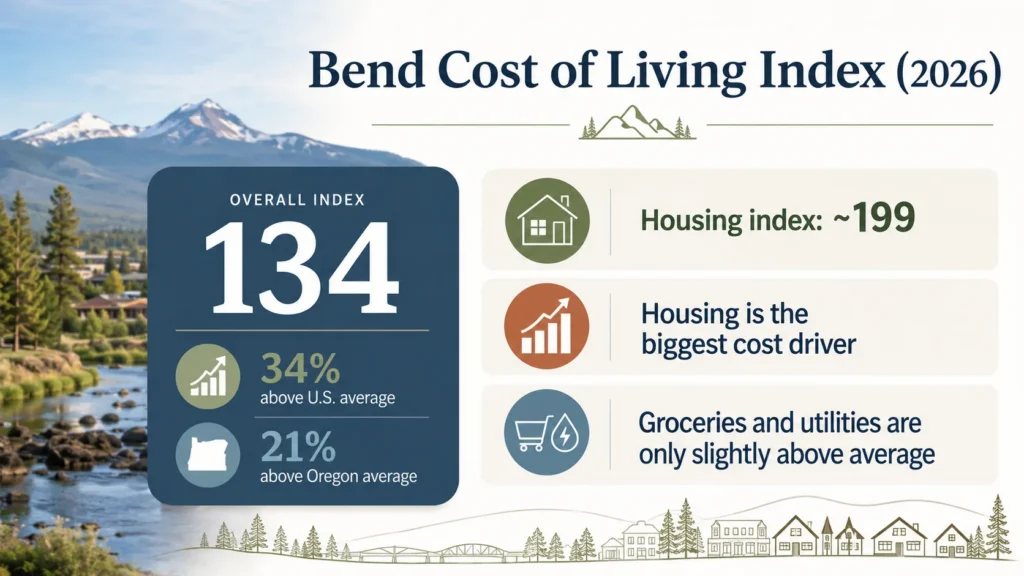
A useful starting point is Bend’s cost of living index. In 2026, Bend sits around 134, with the national average set at 100. That means Bend is roughly 34% more expensive than the national average.
Compared with Oregon overall, Bend also runs high, around 21% above the Oregon average depending on the cost-of-living model used. But the headline number does not tell the whole story.
The key nuance is that housing is the outlier. Bend’s housing index is around 199, which means housing costs are roughly double the national average. That one category pulls the entire cost-of-living number upward.
The other categories are much less extreme. Groceries are only slightly above average. Utilities are only slightly above average. Healthcare and transportation also tend to run above the national baseline, but not at the same level as housing.
So when people ask, “Is Bend expensive?” the honest answer is:
Yes, but mostly because of housing.
If you already own a home here, bought years ago, or are relocating with strong equity from another market, Bend may feel manageable. If you are moving here in 2026 and trying to buy your first Bend home, the numbers will feel much tighter.
Housing Costs: The Big One
Housing is the biggest cost in Bend, and it is the category that usually decides whether the move works.
As of early-to-mid 2026, Bend’s median single-family home price is generally in the $725,000 to $749,000 range, depending on the source and month. Zillow’s typical home value for Bend is also in the high $700,000 range, which matches what many buyers are seeing in the market.
That does not mean every home in Bend costs that much. You can still find smaller homes, townhomes, condos, older properties, and homes farther from the most popular areas at lower price points. But if you are picturing a move-in-ready single-family home in a desirable Bend neighborhood, especially on the Westside, this is the range you need to take seriously.
Renting is also expensive. In 2026, one-bedroom apartments in Bend are commonly around $1,700 to $1,900 per month, while two-bedroom apartments often land close to $2,000 or more. Three-bedroom apartments and single-family rentals can move well above that, especially in popular neighborhoods or newer communities.
The Bend rental market has cooled slightly in some places, but it is still competitive because many people rent before buying. Some are waiting for the right home. Some are testing the lifestyle before committing. Others want to move now but are not ready to buy at current rates and prices.
The biggest local pricing difference is the Westside Premium.
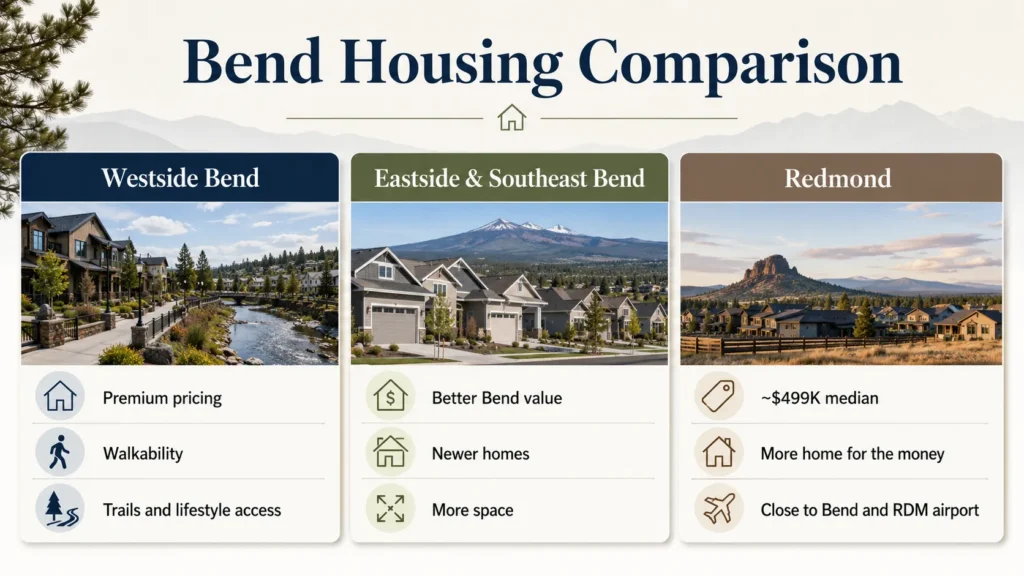
Homes west of Highway 97, especially near NorthWest Crossing, River West, Old Bend, the Galveston corridor, and the Old Mill area, usually cost more. Buyers pay for walkability, trail access, established streets, schools, restaurants, breweries, parks, and the Bend lifestyle they had in mind before they moved.
Eastside and Southeast Bend usually offer better value. These areas tend to be more car-dependent, but buyers may get newer homes, more square footage, larger garages, and a lower price than comparable homes on the Westside.
Redmond is the major value play. About 20 minutes north of Bend, Redmond often gives buyers more home for the money, with a median price around the high $400,000s to low $500,000s depending on timing and data source. For buyers who want the Central Oregon lifestyle but do not need a Bend address, Redmond can make the numbers work much better.
| Area | 2026 Price Position | What Your Dollar Buys |
|---|---|---|
| Westside Bend | Highest premium | Walkability, trails, established neighborhoods, lifestyle access |
| Eastside / Southeast Bend | Better Bend value | Newer homes, more space, stronger price flexibility |
| Redmond | Lower than Bend | More home for the money, airport access, Central Oregon lifestyle |
Read the full guide: Relocating to Bend, Oregon
Utilities, Groceries and Everyday Costs
Once you get past housing, Bend’s everyday costs are easier to understand.
For a mid-sized home, combined utilities often fall around $180 to $250 per month, depending on the home size, insulation, heating system, internet plan, season, and personal usage. Smaller homes and newer efficient builds may be lower. Larger homes, older homes, and heavy heating or cooling use can push that number higher.
The bill that surprises many newcomers is water.
Bend is high desert. If you are moving from Portland, Seattle, or another wetter climate, the summer watering reality can feel different. Lawns, landscaping, and irrigation can create a noticeable seasonal spike. In some cases, water alone can move over $100 per month during the summer if a property has a larger lawn or inefficient irrigation.
Groceries are not the main affordability problem, but they are not bargain-level either. Bend grocery costs are usually slightly above the national average, often around a few percentage points higher. This is where the local “mountain tax” shows up.
Bend is geographically isolated compared with larger metro areas. Goods travel farther to get here, labor is expensive, and tourism demand adds pressure to restaurants, coffee shops, and everyday services. You may not notice it on every grocery run, but over a month, small differences add up.
Transportation is another cost to plan for honestly. Bend is car-dependent. There is local transit, but most residents still need a vehicle for work, errands, school, groceries, trailheads, skiing, and weekend trips. If you are used to a more walkable or transit-heavy city, Bend will probably increase your car-related expenses.
Gas prices can also feel high because Oregon has higher fuel costs than many states, and Central Oregon sometimes carries a resort-market premium. Add snow tires, winter driving, outdoor gear, maintenance, and regular trips across town, and transportation becomes a real line item in the budget.
The Oregon Tax Picture: A Real Advantage
Oregon’s biggest tax advantage is simple:
No sales tax.
That is a real benefit, especially for people relocating from California, Washington, Arizona, or other states where sales tax adds up quickly. In Oregon, the price tag is usually the price you pay.
This matters most during a move. Relocation often comes with big purchases: furniture, appliances, tools, outdoor gear, winter gear, bikes, home office equipment, and sometimes a vehicle. Not paying sales tax on many everyday purchases can create meaningful savings.
Callout: What no sales tax can save a typical family
If a family spends $30,000 in a year on purchases that would normally be subject to an 8% sales tax in another state, Oregon’s no-sales-tax structure could save about $2,400.
That could cover several months of utilities, part of a moving bill, new home basics, or a strong start on a relocation emergency fund.
But there is a trade-off.
Oregon has a state income tax, with rates that can reach up to 9.9% for higher earners. That matters a lot if you are a remote worker bringing a strong salary into Oregon, especially if you are moving from a no-income-tax state like Washington.
The net effect depends on your income and spending. A household that spends heavily on goods may love the no-sales-tax benefit. A high-income household may feel the income tax more. For California movers, Oregon may feel familiar on the income tax side but better at the checkout counter. For Washington movers, the sales tax savings are nice, but the income tax can be a major adjustment.
So the Oregon tax picture is not automatically cheaper. It is different. You need to run the numbers based on your actual income, spending, and lifestyle.
How Much Do You Need to Earn to Live in Bend?
This is the real question behind the cost-of-living search. The answer depends on whether you rent or buy, whether you have kids, how much debt you carry, how much you put down on a home, and what kind of lifestyle you expect.
For a single person renting in Bend, a realistic income target is around $75,000 to $85,000 per year. Could someone live here on less? Yes. Many people do. But they may need roommates, an older rental, fewer restaurant meals, less travel, and a tighter lifestyle.
If you want your own place, a reliable car, some savings, occasional restaurants, and room to enjoy Bend instead of just survive it, that $75K to $85K range is a more honest target.
For a household looking for a comfortable lifestyle, $90,000 to $130,000+ is a better planning range. This is where housing, utilities, groceries, transportation, insurance, recreation, and normal life expenses become more manageable.
For a family trying to buy a median-priced home in Bend, the number usually moves higher. A combined household income of around $150,000+ is often needed to buy a median-priced Bend home without becoming house-poor, especially if the down payment is limited.
Even then, the details matter. Interest rate, down payment, property taxes, insurance, HOA dues, car payments, childcare, student loans, and credit profile can all change what is realistic.
This is why many relocating buyers adjust the plan. They may choose Southeast Bend instead of the Westside. They may buy smaller. That is not settling. That is making the move in a way that still leaves room to enjoy the life you came here for.
FAQ
Yes. Bend is expensive compared with the national average, mainly because of housing. The overall cost of living is around 34% higher than the national average, and housing is the biggest reason. Groceries, utilities, and healthcare are only slightly above average in comparison.
A single renter should generally aim for around $75,000 to $85,000 per year. A household may need around $90,000 to $130,000+ for a comfortable lifestyle. To buy a median-priced Bend home without becoming house-poor, many households need roughly $150,000+ in combined income, depending on debt, down payment, and interest rate.
No. Bend is in Oregon, and Oregon does not have a general state sales tax. This can save money on everyday purchases, furniture, appliances, outdoor gear, and many relocation-related expenses.
Groceries in Bend are usually slightly above the national average, but they are not the main reason Bend feels expensive. Housing is the real driver. Still, Bend’s Central Oregon location creates a small “mountain tax” effect because goods travel farther and local demand is strong.