


Retiring in Bend, Oregon appeals to active adults who want mountain scenery, outdoor recreation, golf, community programs, restaurants, and access to year-round activities. Bend offers a lifestyle built around trails, parks, the Deschutes River, Mt. Bachelor, golf communities, cultural events, and nearby high-desert recreation.
The city can work well for retirees who want an active routine without living in a major metropolitan area. However, Bend is not a low-cost retirement destination. Housing prices, insurance, healthcare access, winter driving, wildfire smoke, and Oregon income taxes should all be evaluated before moving.
The strongest retirement decision begins with everyday needs rather than vacation impressions. A neighborhood that feels ideal during a summer visit may be less convenient during winter, smoke season, medical appointments, or periods when family members need additional support.
Quick Answer
Bend can be a strong retirement destination for active adults who value outdoor access, golf, recreation, community programs, restaurants, and a smaller-city atmosphere. It is especially appealing to retirees who want to remain physically active through walking, cycling, skiing, swimming, pickleball, hiking, fishing, or golf.
The main concerns are cost and convenience. Bend’s housing market remains expensive, with a median sale price of approximately $704,000 over the three months ending May 2026. Homes sold in about 21 days, although conditions varied by neighborhood and property type.
Oregon does not tax Social Security or Railroad Retirement Board benefits. However, Oregon residents generally pay state income tax on pensions and other retirement income, subject to limited credits or exclusions in certain situations.
Is Bend a Good Place to Retire?
Bend may be a good fit for retirees who:
- Prefer an active outdoor lifestyle
- Want access to golf and recreation
- Can afford a higher-cost housing market
- Are comfortable with four seasons
- Want community programs and social activities
- Do not require major-city transportation
- Can reach healthcare and daily services from their chosen neighborhood
It may be less suitable for retirees seeking very low housing costs, extensive public transportation, mild winters, or immediate access to highly specialized medical care.
What Should Retirees Research First?
Before relocating, compare:
- Housing budget
- Healthcare providers
- Oregon tax treatment
- Neighborhood accessibility
- Winter driving
- Insurance costs
- Proximity to family
- Home-maintenance needs
- Social and recreational opportunities
- Long-term mobility needs

Why Retirees Choose Bend
Bend attracts retirees because it combines natural surroundings with many of the services expected from a regional city. Residents can spend the morning walking along the river, attend a fitness class, play golf, visit a restaurant, or drive to nearby mountain and high-desert recreation.
The city also supports an active community of older adults through recreation, fitness, education, volunteering, and social programs. The Bend Senior Center at Larkspur Community Center offers fitness classes, therapeutic programs, an indoor track, social activities, health clinics, educational classes, events, and volunteer opportunities.
Outdoor Lifestyle
Retirees can access:
- Deschutes River trails
- Neighborhood parks
- Golf courses
- Cascade lakes
- Mt. Bachelor
- Hiking trails
- Cycling routes
- Fishing
- Nordic skiing
- Snowshoeing
The outdoor lifestyle can support physical health and social connection, but residents should remain realistic about snow, ice, wildfire smoke, elevation, and changing mobility.
Smaller-City Environment
Bend is smaller than Portland, Seattle, or many California metros. That can mean:
- Less urban congestion
- Easier access to outdoor recreation
- Strong neighborhood identity
- A more relaxed daily pace
- Shorter trips across much of the city
The tradeoff is fewer specialized services and less public transportation than a large metro area.
Recreation and Social Programs
Bend Park and Recreation District provides more than 1,000 annual programs for participants ranging from young children to older adults. Offerings include fitness, arts, games, swimming, sports, skating, and community activities.
The Senior Center also provides social activities such as games, movies, brunches, classes, billiards, and community events.
Access to Nature
Bend residents do not need to plan a long vacation to enjoy outdoor scenery. Trails, rivers, parks, forests, mountains, golf courses, and lakes are part of everyday life.
For many retirees, this proximity is one of Bend’s strongest advantages over larger cities.
Best Neighborhoods
The best Bend neighborhood for retirement depends on mobility, housing budget, healthcare needs, desired home type, and access to activities.
A hillside home with mountain views may feel impressive but become less practical if it has multiple staircases, a steep driveway, or a long winter commute. Retirees should compare beauty with long-term usability.
Larkspur
Larkspur may appeal to retirees who want access to the Bend Senior Center, Larkspur Park, walking trails, established homes, and eastside services.
The Larkspur Community Center includes an indoor track, fitness areas, social spaces, and programs for older adults. It also connects to soft-surface walking paths and the regional Larkspur Trail.
Recent neighborhood-level data placed Larkspur’s median sale price near $592,000 in May 2026, although individual homes vary considerably by size and condition.
Old Bend
Old Bend offers access to downtown, the Deschutes River, restaurants, parks, and cultural activities.
It may work well for retirees who value walkability and central living. However, older homes may require renovation, have smaller garages, include stairs, or lack modern accessibility features.
River West
River West provides proximity to downtown, parks, river trails, restaurants, and westside amenities.
The area may suit active retirees who want an established neighborhood and a more walkable lifestyle. Buyers should evaluate traffic, lot size, home age, storage, and renovation needs.
NorthWest Crossing
NorthWest Crossing offers planned streets, parks, trails, restaurants, shops, and newer housing than many central Bend neighborhoods.
It may appeal to retirees who want a neighborhood center and the ability to reach some daily needs without driving. Home prices and HOA obligations should be reviewed carefully.
Southeast Bend
Southeast Bend offers newer subdivisions, single-level homes, quieter residential streets, and access to shopping and healthcare.
Some areas may provide better value than the west side, although access to downtown and certain recreation areas may take longer.
Awbrey Butte
Awbrey Butte is known for elevated homes, views, larger properties, and proximity to central Bend.
The area may appeal to luxury retirees, but buyers should evaluate steep driveways, stairs, snow exposure, landscaping, and long-term mobility.
Tetherow
Tetherow offers modern homes, golf, trails, resort amenities, and access toward Mt. Bachelor.
It may suit active luxury buyers, although HOA costs, club arrangements, and premium prices should be included in the ownership budget.
Healthcare
Healthcare access should be one of the first retirement-planning considerations. Bend functions as Central Oregon’s main medical center, but retirees should verify that local providers meet their specific needs.
A hospital or medical office being nearby does not guarantee that a specialist accepts new patients, participates in a particular insurance network, or offers the required level of care.
Primary and Emergency Care
Retirees should identify:
- Primary-care physician
- Nearest urgent care
- Emergency department
- Preferred pharmacy
- Dentist
- Vision provider
- Physical therapy
- Hearing services
Medical records and prescriptions should be transferred before the move.
Specialists
People managing heart conditions, cancer, neurological disorders, kidney disease, complex orthopedic needs, or other chronic conditions should contact specialists before purchasing a home.
Questions to ask include:
- Is the provider accepting new patients?
- Is Medicare accepted?
- Is a referral required?
- What are typical wait times?
- Are procedures available locally?
- Would regular travel to Portland be necessary?
Medicare and Insurance Networks
Retirees should confirm that their Medicare supplement, Medicare Advantage, or other plan operates effectively in Central Oregon.
Provider networks can vary by county, and changing residence may affect enrollment options. Insurance guidance should come from a qualified Medicare or benefits professional.
Long-Term Planning
A healthy retiree may not need regular support today, but the home and neighborhood should remain practical if circumstances change.
Consider proximity to:
- Medical care
- Grocery stores
- Pharmacies
- Family
- Home-care providers
- Rehabilitation
- Assisted living
- Transportation services
Emergency Access
Buyers considering rural, resort, or acreage properties should review emergency response time, winter road access, wildfire evacuation routes, and distance from medical services.
Taxes
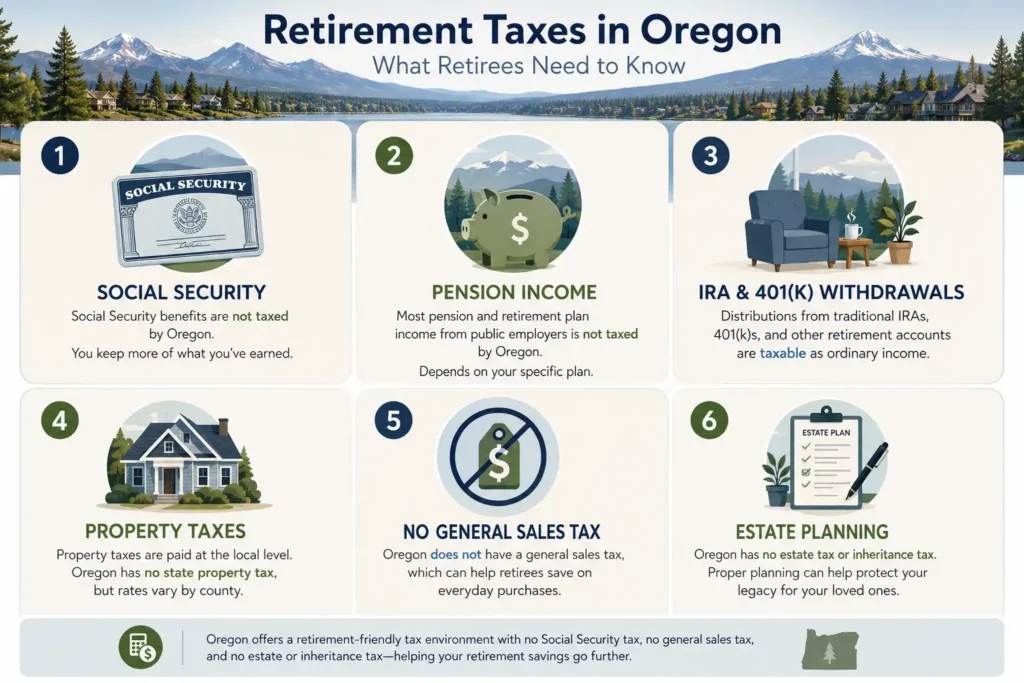
Oregon’s tax structure can be favorable in some ways and expensive in others.
The state has no general sales tax. Social Security and Railroad Retirement Board benefits are not taxed by Oregon. However, pension income and most other retirement income are generally taxable for Oregon residents.
Social Security
Oregon does not tax Social Security benefits. This can help retirees who depend heavily on Social Security for income.
Federal taxation may still apply depending on total income.
Pension Income
Pension income is generally taxable in Oregon after a person establishes residency. Certain federal pensions connected to service before October 1991 may qualify for a full or partial subtraction.
Retirees with significant pension income should calculate the effect before moving.
IRA and Retirement-Account Withdrawals
Traditional IRA, 401(k), and similar taxable withdrawals are generally included in Oregon taxable income.
Roth withdrawals may be treated differently when federal qualification requirements are met. Tax planning should be completed with a qualified professional.
Sales Tax
Oregon has no general statewide sales tax, which can reduce the cost of many purchases.
This may be helpful when buying furniture, appliances, outdoor equipment, or vehicles, although other fees and taxes may still apply.
Property Taxes
Property taxes depend on assessed value and the districts serving the property. Purchase price and taxable assessed value are not necessarily the same.
Before buying, retirees should review:
- Current tax statement
- Assessed value
- Local taxing districts
- Exemptions
- Special assessments
- Recent improvements
- HOA obligations
Estate Planning
Retirees should review Oregon estate-tax rules, residency, trusts, beneficiary designations, and property ownership with a qualified attorney and tax professional.
A relocation can affect more than annual income taxes. It may influence estate planning, healthcare directives, vehicle registration, and legal residency.
Tax note: This section is general information, not tax or legal advice.
Housing Options
Bend provides several housing types for retirees, including single-family homes, townhomes, condominiums, golf-community properties, luxury homes, and age-focused communities.
The best choice should balance present lifestyle with future maintenance and accessibility.
Single-Level Homes
Single-level homes can reduce stair use and may support aging in place.
Important features include:
- Step-free entry
- Wide hallways
- Main-floor laundry
- Walk-in shower
- Low-maintenance yard
- Attached garage
- Accessible kitchen
- Guest space
Single-level homes can be competitive because they appeal to retirees, families, and buyers with mobility needs.
Condominiums
Condos may provide lower exterior-maintenance responsibility and access to central locations.
Buyers should review:
- HOA dues
- Reserve study
- Master insurance
- Elevators
- Stairs
- Parking
- Storage
- Noise
- Assessments
- Rental and pet rules
Townhomes
Townhomes can provide lock-and-leave convenience while offering more privacy than a traditional condo.
Some include multiple levels, so buyers should decide whether stairs will remain practical.
Golf-Community Homes
Golf communities may provide scenic surroundings, social activities, trails, fitness facilities, and club options.
Ownership may involve HOA dues, club memberships, resort charges, and design standards.
Luxury Homes
Luxury retirees may consider custom homes, mountain-view properties, acreage, golf frontage, and homes with extensive entertaining spaces.
Long-term maintenance should be evaluated carefully. Large homes, steep lots, complex landscaping, private roads, and specialized systems can become expensive or difficult to manage.
Renting Before Buying
Renting for six to twelve months may help retirees understand:
- Neighborhood traffic
- Winter conditions
- Smoke season
- Healthcare access
- Social opportunities
- Home-maintenance preferences
- Distance from family
- Daily service needs
The drawback is moving twice and dealing with limited rental availability.
Outdoor Lifestyle
Bend’s retirement appeal is closely connected to outdoor recreation. Activities are available at several intensity levels, from paved walks and gentle fitness classes to skiing, cycling, golf, and backcountry hiking.
Walking and Hiking
Retirees can choose from:
- Neighborhood paths
- Deschutes River Trail
- Larkspur Trail
- Park loops
- Forest trails
- High-desert hikes
- Cascade routes
Trail difficulty, elevation, heat, smoke, snow, and ice should be considered.
Cycling
Bend supports road cycling, mountain biking, gravel riding, and paved recreational cycling.
Retirees may value a home with garage storage, safe street connections, and access to lower-traffic routes.
Skiing and Snowshoeing
Mt. Bachelor and nearby snow parks provide winter recreation. Active retirees may also use Nordic skiing and snowshoeing as lower-impact alternatives.
Winter tires, equipment storage, and comfort driving on snow are important practical considerations.
Fishing and Water Recreation
The Deschutes River, Cascade lakes, and surrounding waterways support fishing, paddleboarding, kayaking, and boating.
Water temperatures can remain cold, and seasonal regulations should be reviewed.
Fitness and Indoor Alternatives
The Bend Senior Center and Bend Park and Recreation District provide indoor fitness, swimming, therapeutic classes, games, arts, and social activities.
Indoor options are important during smoke events, winter storms, or periods of reduced mobility.
Golf Communities
Central Oregon is known for golf communities that combine residential property, mountain scenery, resort amenities, trails, and social opportunities.
Retirees should separate HOA membership from golf-club membership. Buying a home in a golf community does not always include the right to play the course.
Broken Top
Broken Top is a gated West Bend golf community with established homes, mature landscaping, and proximity to city services.
Buyers should review HOA requirements, club arrangements, renovation rules, and home condition.
Tetherow
Tetherow offers modern architecture, golf, trails, resort amenities, and relatively direct access toward Mt. Bachelor.
It may appeal to active luxury retirees, but pricing and ownership fees can be substantial.
Pronghorn
Pronghorn, within Juniper Preserve, offers luxury homes, golf, resort amenities, and a more secluded high-desert setting.
It can provide privacy and recreation but is farther from central Bend’s everyday services.
Bend Golf Club Area
The area around Bend Golf Club provides access to an established private-club environment and nearby southeast Bend neighborhoods.
Membership terms and availability should be verified directly with the club.
Eagle Crest
Eagle Crest is outside Bend near Redmond. It may appeal to retirees seeking golf, resort facilities, townhomes, single-family homes, and airport access.
Buyers should compare the drive to Bend healthcare and services with the potential housing and lifestyle benefits.
Sunriver
Sunriver offers golf, paths, aquatic facilities, resort amenities, and vacation-oriented housing.
It can work for full-time retirees, but seasonal visitor activity, association costs, and distance from healthcare should be reviewed.
Cost of Living
Bend is not generally considered an inexpensive retirement city. Housing is usually the largest concern, but insurance, utilities, healthcare, transportation, and recreation also affect the budget.
Recent Redfin data placed Bend’s median home sale price at approximately $704,114 over the three months ending May 2026.
Housing
Housing costs vary by property type:
- Condominiums may have lower purchase prices but higher HOA dues.
- Single-level homes can command premiums.
- Golf properties may involve club and association costs.
- Rural homes may require wells, septic systems, private roads, and wildfire preparation.
- Luxury homes carry greater maintenance and insurance costs.
Insurance
Insurance pricing can be affected by:
- Wildfire exposure
- Roof age
- Home size
- Construction type
- Distance from fire services
- Claims history
- Secondary-home use
- Short-term rental activity
Retirees should obtain a quote before removing an insurance contingency.
Utilities
Utility costs may include:
- Electricity
- Natural gas or propane
- Water and sewer
- Garbage
- Internet
- Irrigation
- Well and septic maintenance
Winter heating and summer cooling can create seasonal variation.
Transportation
Bend is easier to navigate by car than many large cities, but most retirees still need regular vehicle access.
Budget for:
- Fuel
- Insurance
- Maintenance
- Winter tires
- Registration
- Airport travel
- Medical trips
- Snow and ice preparation
Recreation and Memberships
Costs may include:
- Golf
- Fitness facilities
- Ski passes
- Recreation classes
- Club membership
- Equipment
- Travel
- Event tickets
Many walking, hiking, park, and community activities are free or relatively inexpensive.
Sample Retirement Housing Budget
| Expense | Monthly planning category |
|---|---|
| Mortgage or rent | Property-specific |
| Property tax | Based on current tax bill |
| Insurance | Property-specific quote |
| HOA or club dues | Community-specific |
| Utilities | Seasonal |
| Maintenance reserve | Based on age and condition |
| Transportation | Lifestyle and neighborhood |
| Healthcare | Insurance and provider needs |
Pros & Cons
| Advantages of Retiring in Bend | Potential Drawbacks |
|---|---|
| Strong outdoor lifestyle | High housing prices |
| Golf and recreation options | Oregon taxes most pension and retirement income |
| No general sales tax | Winter driving |
| Social and fitness programs | Wildfire smoke |
| Regional healthcare hub | Limited highly specialized care |
| Restaurants and cultural events | Less public transportation than large cities |
| Mountain and river scenery | Insurance can be expensive |
| Active adult community | Tourism and seasonal traffic |
| Multiple neighborhood styles | Distance from some family networks |
Who Is Most Likely to Enjoy Bend?
Bend may fit retirees who:
- Want to stay active
- Enjoy seasonal weather
- Have a stable retirement budget
- Prefer a smaller city
- Value nature and recreation
- Are comfortable driving
- Have researched healthcare and taxes
Who May Prefer Another Community?
Another community may be more practical for retirees who:
- Need lower housing costs
- Want milder winters
- Depend heavily on public transit
- Need frequent specialized medical care
- Prefer a larger cultural scene
- Want to live close to a major international airport
Planning Your Retirement Move
A retirement move should be completed in stages rather than based on a single trip.
Six to Twelve Months Before Moving
- Review retirement income
- Calculate Oregon taxes
- Compare healthcare providers
- Research neighborhoods
- Obtain mortgage or cash-purchase guidance
- Evaluate insurance
- Visit during different seasons
- Discuss the move with family
Three to Six Months Before Moving
- Choose whether to rent or buy
- Tour homes and communities
- Transfer medical records
- Review Medicare networks
- Update estate documents
- Plan movers
- Compare property taxes and HOA costs
One Month Before Moving
- Confirm healthcare appointments
- Transfer prescriptions
- Arrange utilities
- Prepare winter or smoke-season supplies
- Update legal residency
- Create an emergency contact plan
After Moving
- Join community programs
- Establish medical care
- Test emergency routes
- Meet neighbors
- Review recreation options
- Reassess the home for accessibility
FAQ
Bend can be a good retirement destination for active adults who value recreation, scenery, community programs, and a smaller-city lifestyle. Housing cost and healthcare needs should be considered carefully.
Yes. Bend’s median sale price was approximately $704,000 over the three months ending May 2026, making housing a major retirement-budget concern.
No. Oregon does not tax Social Security or Railroad Retirement Board benefits.
Generally, yes. Oregon residents typically pay state income tax on pension income, although limited exclusions or credits may apply in certain situations.
Larkspur, Old Bend, River West, Northwest Crossing, Southeast Bend, Awbrey Butte, and Tetherow may all work depending on budget, mobility, and lifestyle.
Yes. The Bend Senior Center operates within Larkspur Community Center and offers fitness, social activities, classes, health programs, events, and volunteer opportunities.
Yes. Residents can access walking, hiking, biking, skiing, golf, swimming, fishing, fitness programs, and social activities.
Bend is Central Oregon’s main healthcare center, but retirees should confirm provider availability, Medicare participation, and access to specialists before moving.
Renting first can help retirees evaluate neighborhoods, winter conditions, healthcare access, traffic, smoke season, and home-maintenance preferences.
Bend offers senior-living communities, age-focused housing, condominiums, townhomes, and neighborhoods popular with retirees. Availability and care levels vary by provider.
Bend offers better access to healthcare, shopping, restaurants, and year-round services. Sunriver provides a quieter resort atmosphere, paths, golf, and recreation but requires more travel for some daily needs.
Bend provides broader services and recreation, while Redmond may offer lower housing costs and easier airport access. The right choice depends on budget and healthcare needs.
Final Thoughts
Retiring in Bend, Oregon can provide an active and engaging lifestyle built around recreation, nature, community programs, golf, and a strong regional city center.
The move works best for retirees who plan beyond the scenery. Housing, taxes, healthcare, insurance, winter access, smoke conditions, and long-term mobility should be evaluated before selecting a home.
A single-level property near healthcare and recreation may offer more lasting value than a larger home with difficult stairs or a remote location. Similarly, renting first may be worthwhile for retirees who have only experienced Bend during vacations.
The right retirement home should support not only the lifestyle you want today, but also the practical needs you may have ten or twenty years from now.

