


Moving from California to Oregon can change how and when a household pays state and local taxes. Oregon has no general sales tax, but it relies heavily on personal income taxes. California imposes sales tax and also has a progressive income-tax system, with local sales-tax additions in many cities and counties.
The difference is more complicated than saying one state is simply “lower tax.” A high-income professional, retiree, remote worker, business owner, and young family can each experience the move differently. The outcome depends on income type, home value, assessed property value, spending habits, retirement withdrawals, business structure, and the exact city or county where the household lives.
This guide explains the major differences that matter to homebuyers. It provides general planning information and should not replace advice from a CPA, attorney, financial planner, or other qualified tax professional.
Quick Answer
Oregon and California both have progressive state income taxes, but their tax structures differ in important ways. Oregon’s personal income-tax rates range from 4.75% to 9.9%, while California’s published personal income-tax schedule ranges from 1% to 12.3%, with an additional 1% tax on taxable income above $1 million. That produces a maximum California personal income-tax rate of 13.3%.
Oregon does not impose a general sales or use tax. California’s statewide base sales and use tax rate is 7.25%, and local district taxes can raise the rate depending on the address.
Property taxation also works differently. Oregon generally taxes the lower of a property’s real market value or taxable assessed value, and maximum assessed value usually cannot rise more than 3% annually unless certain property changes occur. California’s property-tax system also limits taxable value growth, but buyers need to research how a purchase may establish a new base-year value and how local assessments affect the final bill.
At-a-Glance Comparison
| Tax Category | Oregon | California |
| Personal income tax | 4.75% to 9.9% | 1% to 12.3%, plus 1% above $1 million |
| General sales tax | None | 7.25% statewide base, plus possible district taxes |
| Social Security | Not taxed by the state | Not taxed by the state |
| Pension income | Generally taxable | Generally taxable for residents |
| Capital gains | Taxed through ordinary state income-tax system | Taxed as ordinary income |
| Property-tax system | Taxable assessed value and local district rates | Base-year value system and local assessments |
| State estate tax | Applies to qualifying estates above $1 million | No separate current state estate tax in most ordinary cases |
| Vehicle registration | Based partly on vehicle efficiency and county | Depends on vehicle value, location, fees, and assessments |
Which State Is Usually Lower Tax?
There is no universal winner.
Oregon may be more favorable for households that spend heavily on taxable goods because there is no general sales tax. California may be more favorable than expected for some lower-income households because its income-tax schedule begins at lower rates.
At higher income levels, California’s top rate exceeds Oregon’s. However, a household’s actual effective rate will be lower than its top marginal rate because income is taxed through brackets.

Income Tax Comparison
Income tax is one of the most important differences for someone moving between California and Oregon. Both states use progressive tax systems, which means higher portions of taxable income are taxed at higher rates.
A household should compare effective tax, not only the top published rate. Deductions, credits, filing status, dependents, business income, capital gains, retirement distributions, and residency dates all affect the final result.
Oregon Income Tax
Oregon’s published personal income-tax rates range from 4.75% to 9.9%. Personal income tax is a major source of state revenue because Oregon does not have a general sales tax.
Income that may be taxable in Oregon includes:
- Wages
- Self-employment earnings
- Pension income
- Traditional IRA withdrawals
- Taxable investment income
- Rental income
- Capital gains
- Business income
Oregon does not tax Social Security or Railroad Retirement Board benefits. Pension and other retirement income are generally taxable once a person becomes an Oregon resident, although limited credits or federal-pension subtractions may apply.
California Income Tax
California’s personal income-tax schedule ranges from 1% to 12.3%. An additional 1% applies to the portion of taxable income above $1 million, creating a maximum personal income-tax rate of 13.3%.
California residents are generally taxed on income from all sources. This can include wages, investments, rental income, business income, taxable retirement distributions, and capital gains.
California does not provide a special lower state rate for long-term capital gains. Capital gains are generally taxed as ordinary income for California purposes.
Marginal Rate vs Effective Rate
A household in a 9.9% Oregon bracket or 9.3% California bracket does not necessarily pay that percentage on every dollar of income.
The marginal rate applies to the highest portion of taxable income. The effective rate is total state income tax divided by total taxable income.
For relocation planning, the effective tax estimate is more useful.
Part-Year Residency
Someone moving during the year may need to file part-year resident returns in both states. Income earned before and after the move may be allocated based on residency and where the work or business activity occurred.
Moving on paper does not automatically end California residency. California considers factors such as domicile, purpose of absence, where a person maintains a home, family connections, business activity, and whether time outside the state is temporary or permanent.
Income Tax Questions to Review
Before relocating, ask:
- What date will Oregon residency begin?
- When will California residency end?
- Where will work physically be performed?
- Is income connected to a California business?
- Will stock compensation vest after the move?
- Will a California property remain rented?
- Are pension or IRA distributions expected?
- Will a business continue operating in both states?
Sales Tax
Sales tax is the clearest everyday difference between the two states.
Oregon does not impose a general sales or use tax and does not issue traditional sales-tax exemption certificates.
California applies a statewide base sales and use tax rate of 7.25%. Local voter-approved district taxes can increase the rate, and some locations have more than one district tax.
How Oregon’s No-Sales-Tax System Affects Households
In Oregon, consumers generally do not pay a general sales tax on items such as:
- Furniture
- Electronics
- Clothing
- Appliances
- Sporting equipment
- Household supplies
- Many retail purchases
That can produce noticeable savings for households furnishing a home or buying expensive equipment after a move.
However, no general sales tax does not mean every transaction is tax-free. Oregon still imposes specific taxes and fees on selected products, services, vehicles, lodging, fuel, telecommunications, and regulated goods.
How California Sales Tax Works
California’s total rate depends on the location where the taxable sale is sourced. The statewide base is 7.25%, and applicable city, county, or district taxes are added.
A household may therefore pay different rates in two nearby California cities.
Example Purchase Comparison
Suppose a relocating household buys $20,000 of taxable furniture, appliances, and electronics.
At a hypothetical California combined rate of 8.75%, the sales tax would be approximately:
$20,000 × 8.75% = $1,750
In Oregon, those purchases would generally not carry a broad state or local sales tax.
This simplified example does not account for product-specific taxes, delivery sourcing, exemptions, or purchases made before residency changes.
Does Oregon Tax Online Purchases?
Oregon generally does not impose a broad use tax simply because an item was purchased online for delivery to an Oregon address. However, specialized taxes and fees may still apply to specific goods or transactions.
Property Tax
Property-tax comparisons are more complex than income or sales taxes because taxes are calculated at the property level.
Two similarly priced homes can have very different tax bills based on assessed value, base-year treatment, local districts, voter-approved bonds, exemptions, and previous improvements.
Oregon Property Taxes
Oregon properties have a real market value, maximum assessed value, and taxable assessed value. The property is generally taxed on the lower of its real market value or maximum assessed value.
Maximum assessed value generally cannot increase by more than 3% per year unless certain events occur, such as new construction, major improvements, subdivision, or partition. The final bill is based on taxable assessed value, local district rates, and applicable assessments.
This means a home’s purchase price may be significantly different from its taxable assessed value.
Why Oregon Purchase Price Does Not Tell the Full Story
A buyer should review the actual property-tax statement rather than multiplying the purchase price by a general percentage.
The tax bill can be influenced by:
- Assessed value
- School district
- City
- County
- Fire district
- Library district
- Bond measures
- Local-option levies
- New construction
- Exemptions
- Special assessments
Oregon tax limits separate school and general-government categories, while voter-approved bond charges may be treated differently.
California Property Taxes
California’s property-tax system is strongly influenced by Proposition 13. In general, property is assigned a taxable base value when it changes ownership or when new construction occurs, subject to limited annual growth thereafter.
Local bonds, assessments, parcel taxes, and special charges can raise the total bill above the basic statewide framework.
A California homeowner who has owned a property for many years may have a taxable value far below current market value. After buying another property, the buyer may face a substantially higher tax bill based on the new purchase and reassessment rules.
Comparing a Bend Home With a California Home
A $750,000 Bend home and a $750,000 California home may not have comparable property taxes.
The Bend property may have an assessed value below its market value because of Oregon’s assessment system. The California home may establish a new taxable base near its purchase price, plus local charges.
The only reliable comparison uses:
- The current property-tax statement
- Expected post-sale assessment treatment
- Local district charges
- Applicable exemptions or transfer rules
- Planned improvements
Questions Homebuyers Should Ask
- What was last year’s tax bill?
- What is the taxable assessed value?
- Will the sale trigger reassessment?
- Are recent improvements already included?
- Are there local bonds or assessments?
- Is the property in a special district?
- Does an exemption currently apply?
- Could an accessory dwelling unit change taxes?
Vehicle Registration
Vehicle costs can change after a move because Oregon and California calculate registration fees differently.
A household should include title fees, registration, emissions testing where required, license plates, county charges, insurance, and any value-based fees.
Oregon Vehicle Registration
Oregon passenger-vehicle registration is generally valid for two years. The fee depends partly on fuel efficiency.
Current two-year registration fees include:
- $126 for vehicles rated 0–19 MPG
- $136 for vehicles rated 20–39 MPG
- $216 for vehicles rated 40 MPG or higher when not enrolled in OReGO
- $376 for fully electric vehicles when not enrolled in OReGO
Additional plate, county, title, or transfer fees may apply.
Oregon title fees for ordinary passenger vehicles also vary by fuel efficiency, with higher fees for electric vehicles.
Oregon County Charges
Some Oregon counties impose additional registration charges. The state currently lists added charges for Multnomah, Washington, and Clackamas counties. Central Oregon buyers should verify the current fee schedule for the county where the vehicle will primarily be housed.
California Vehicle Registration
California vehicle registration commonly includes several components rather than one flat amount.
Costs can depend on:
- Vehicle value
- Vehicle age
- City or county
- Weight
- License fee
- Transportation fees
- Special district charges
- Plate type
- Late penalties
Because the total is vehicle-specific, households should use the California DMV fee calculator or current registration notice rather than relying on a general estimate.
Moving a Vehicle to Oregon
A new Oregon resident may need to:
- Transfer title
- Register the vehicle
- Provide proof of ownership
- Complete a VIN inspection when required
- Provide insurance
- Pay title and registration fees
- Obtain Oregon plates
Oregon requires that a vehicle be connected to Oregon residency, domicile, or primary use and storage in the state for registration eligibility.
Electric and High-Efficiency Vehicles
Oregon charges higher standard registration fees for high-efficiency and electric vehicles because those vehicles contribute less through fuel taxes. OReGO provides an optional pay-per-mile system for qualifying vehicles.
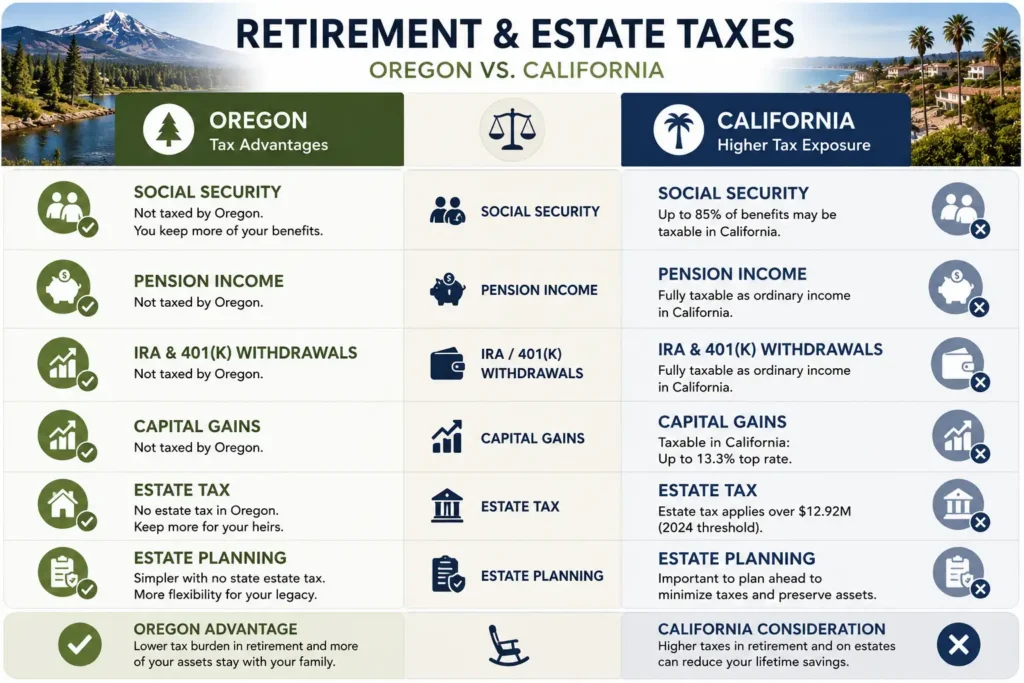
Estate & Retirement Taxes
Retirees and high-net-worth homeowners should review estate and retirement-income taxation before changing residency.
A state that appears attractive based on sales tax may be less favorable for pension income or estate planning.
Oregon Retirement Taxes
Oregon does not tax Social Security or Railroad Retirement Board benefits.
However, pension income and other income received after becoming an Oregon resident are generally taxable. Limited retirement-income credits and federal-pension subtractions may apply depending on age, income, and service history.
Taxable retirement income may include:
- Traditional pension payments
- Traditional IRA withdrawals
- 401(k) withdrawals
- Taxable annuity income
- Investment income
- Capital gains
- Rental income
California Retirement Taxes
California also excludes Social Security benefits from state taxable income.
Pension, IRA, annuity, and other taxable retirement distributions are generally taxable for California residents.
Therefore, moving from California to Oregon does not automatically make pension or IRA income tax-free.
Oregon Estate Tax
Oregon imposes an estate transfer tax when a decedent’s gross estate exceeds $1 million. Published rates range from 10% to 16%, depending on the taxable estate.
A proposal to increase Oregon’s estate-tax filing threshold did not pass in 2026, so the existing $1 million threshold remained relevant.
The calculation is more complicated than applying the rate to the estate’s entire gross value. Deductions, marital planning, trusts, property location, business interests, and federal rules may affect the result.
California Estate Tax
California does not currently impose a separate broad state estate tax comparable to Oregon’s estate transfer tax.
Federal estate-tax rules may still apply, and California residents still need estate plans covering property ownership, trusts, beneficiaries, healthcare directives, and probate.
Why Homeowners Should Care
A retiree moving to Bend with:
- A valuable California home
- Retirement accounts
- Investment property
- Business interests
- Life insurance
- Brokerage accounts
could cross Oregon’s $1 million gross-estate threshold more easily than expected.
Estate planning should be reviewed before establishing Oregon residency rather than after a health emergency.
Tax Examples
These examples are conceptual. They do not calculate exact tax liability because deductions, credits, filing status, property assessments, residency dates, and local rates vary.
Family
Consider a married couple with two children, employment income, a mortgage, and regular household spending.
Possible Oregon Advantages
- No general sales tax on most household purchases
- Potential savings when furnishing a home
- No general sales tax on clothing and many everyday goods
- Property taxes may be based on assessed value below market value
Possible Oregon Costs
- Income begins entering Oregon’s higher marginal brackets relatively quickly
- Childcare, housing, and insurance may remain expensive
- Paid Leave Oregon payroll contributions may affect wages, depending on employment arrangements
Possible California Considerations
- Sales tax increases the cost of taxable purchases
- Income-tax brackets begin at lower rates
- Tax credits and deductions may differ
- Property-tax reassessment may affect a new purchase
A middle-income family should compare complete annual tax, not top rates.
Retiree
Consider a retired couple receiving Social Security, pension income, and traditional IRA withdrawals.
Both states exclude Social Security from state taxable income. Pension and traditional retirement-account distributions are generally taxable for residents in both states.
The Oregon decision may therefore depend on:
- Amount of pension income
- IRA withdrawals
- Home purchase
- Estate size
- Spending subject to California sales tax
- Healthcare and insurance costs
A retiree with a large estate should give particular attention to Oregon’s $1 million estate-tax threshold.
Remote Worker
Consider a California employee who moves to Bend and continues working remotely.
The key issues are not only where the employer is located, but:
- Where services are physically performed
- Whether California-source income continues
- Whether the move is permanent
- Where the worker is domiciled
- How stock compensation is sourced
- Whether business travel occurs in California
California residency does not necessarily end simply because someone rents or buys an Oregon home. Residency must be supported by the overall facts and circumstances.
Remote workers should document:
- Move date
- Oregon home
- Driver’s license
- Voter registration
- Vehicle registration
- Mailing address
- Work location
- Travel days
- California ties
Business Owner
Business owners face the most complicated comparison.
Potential issues include:
- Entity structure
- Oregon Corporate Activity Tax
- California franchise or minimum taxes
- Payroll withholding
- Employees in both states
- Sales-tax obligations
- Business-property taxes
- Pass-through income
- Professional licensing
- Nexus
- Apportionment
California and Oregon may both claim the right to tax portions of business income when activity continues in both states.
A business owner should not move the household without reviewing the company’s state registrations, payroll, contracts, customers, property, and employees.
Overall Tax Burden
Overall tax burden combines more than income-tax brackets.
A complete comparison should include:
- State income tax
- Local income or payroll taxes
- Sales tax
- Property tax
- Vehicle fees
- Fuel taxes
- Business taxes
- Estate taxes
- Lodging and utility taxes
- Insurance
- Housing cost
- Available credits
Oregon’s Tax Structure
Oregon relies heavily on personal income tax and property tax. It does not impose a general sales tax.
This tends to favor households that:
- Spend heavily on taxable goods
- Have lower taxable income
- Are furnishing a new home
- Make large retail purchases
It may be less favorable for households with:
- High wages
- Large pension distributions
- Significant capital gains
- Large taxable estates
California’s Tax Structure
California combines progressive income tax with sales tax and local district additions.
The state’s top personal income-tax rate is higher than Oregon’s, but lower- and moderate-income households may fall into lower marginal brackets. California also taxes capital gains as ordinary income.
Housing Can Outweigh Tax Differences
A household that saves several thousand dollars in annual taxes but pays $150,000 more for a comparable home may not come out ahead financially.
The comparison should therefore include:
Annual tax difference + housing difference + insurance difference + transportation difference + utility difference
Taxes are only one part of relocation affordability.
City-Level Taxes Matter
The comparison is not only Oregon vs California.
A move from San Francisco or Los Angeles to Bend may produce a very different result than a move from a lower-cost inland California community.
Local district taxes, property values, utility fees, transportation expenses, and housing costs can be more important than statewide averages.
Should Taxes Influence Your Move?
Taxes should influence a relocation decision, but they should not control it by themselves.
A household should first determine whether the move improves:
- Housing fit
- Employment
- Healthcare
- Family support
- Schools
- Commute
- Lifestyle
- Long-term financial security
Then taxes should be added to the financial model.
When Taxes Deserve Extra Attention
Tax planning is especially important for:
- High-income earners
- Business owners
- Remote employees
- People receiving stock compensation
- Retirees with large IRA withdrawals
- Property investors
- Owners keeping California real estate
- Households with estates above $1 million
- People moving in the middle of a tax year
Questions to Ask a Tax Professional
- When does California residency end?
- When does Oregon residency begin?
- How will part-year income be allocated?
- Is remote work still California-source income?
- How will stock compensation be taxed?
- Should retirement withdrawals be timed differently?
- Will a California rental create filing obligations?
- Does Oregon estate tax affect the estate plan?
- Which business registrations remain necessary?
- Are estimated payments required in both states?
Practical Moving Checklist
Before changing residency:
- Estimate both states’ income taxes.
- Review the new property’s actual tax bill.
- Obtain insurance estimates.
- Calculate vehicle-registration costs.
- Review pension and IRA taxation.
- Assess Oregon estate-tax exposure.
- Document the permanent move.
- Update payroll and business records.
- Keep records of work and travel days.
- Meet with a qualified tax professional.
FAQ
Not in every situation. Oregon has no general sales tax and a lower top personal income-tax rate, but it relies heavily on income tax and has a state estate tax.
Oregon’s published personal income-tax rates range from 4.75% to 9.9%.
California’s regular personal income-tax schedule reaches 12.3%, plus an additional 1% on taxable income above $1 million, producing a maximum rate of 13.3%.
Oregon does not impose a general sales or use tax.
California’s statewide base sales and use tax rate is 7.25%. Local district taxes can raise the total rate.
No. Oregon does not tax Social Security or Railroad Retirement Board benefits.
No. California excludes Social Security benefits from state taxable income.
Generally, yes. Pension income received after establishing Oregon residency is usually taxable, although limited credits or exclusions may apply.
Generally, yes. Taxable pension and annuity income received while a California resident is normally included in California taxable income.
Yes. Oregon’s estate transfer tax applies when a decedent’s gross estate exceeds $1 million, with published rates from 10% to 16%.
No. Buying a home is only one factor. California looks at domicile, purpose, time in each state, family, work, property, and other connections.
Not necessarily. Oregon taxes the lower of real market value or maximum assessed value, subject to local rates and assessments.
It depends on the vehicle. Oregon uses fuel-efficiency-based registration fees, while California costs can include vehicle-value and location-based components.
Final Thoughts
The Oregon vs California tax comparison is not as simple as comparing top income-tax rates.
Oregon offers a clear sales-tax advantage and a lower maximum personal income-tax rate. California uses a wider progressive income-tax schedule but adds sales and district taxes to many purchases. Property taxes are calculated differently, and Oregon’s estate tax can become an important concern for homeowners with substantial real estate, investments, and retirement accounts.
For most homebuyers, the best decision comes from calculating the complete financial effect:
- Income tax
- Property tax
- Sales tax
- Housing cost
- Insurance
- Vehicle fees
- Retirement income
- Estate exposure
- Business obligations
A move to Bend or another Central Oregon community should make sense for the household’s lifestyle, housing needs, work, healthcare, and long-term plans—not only because Oregon has no general sales tax.

