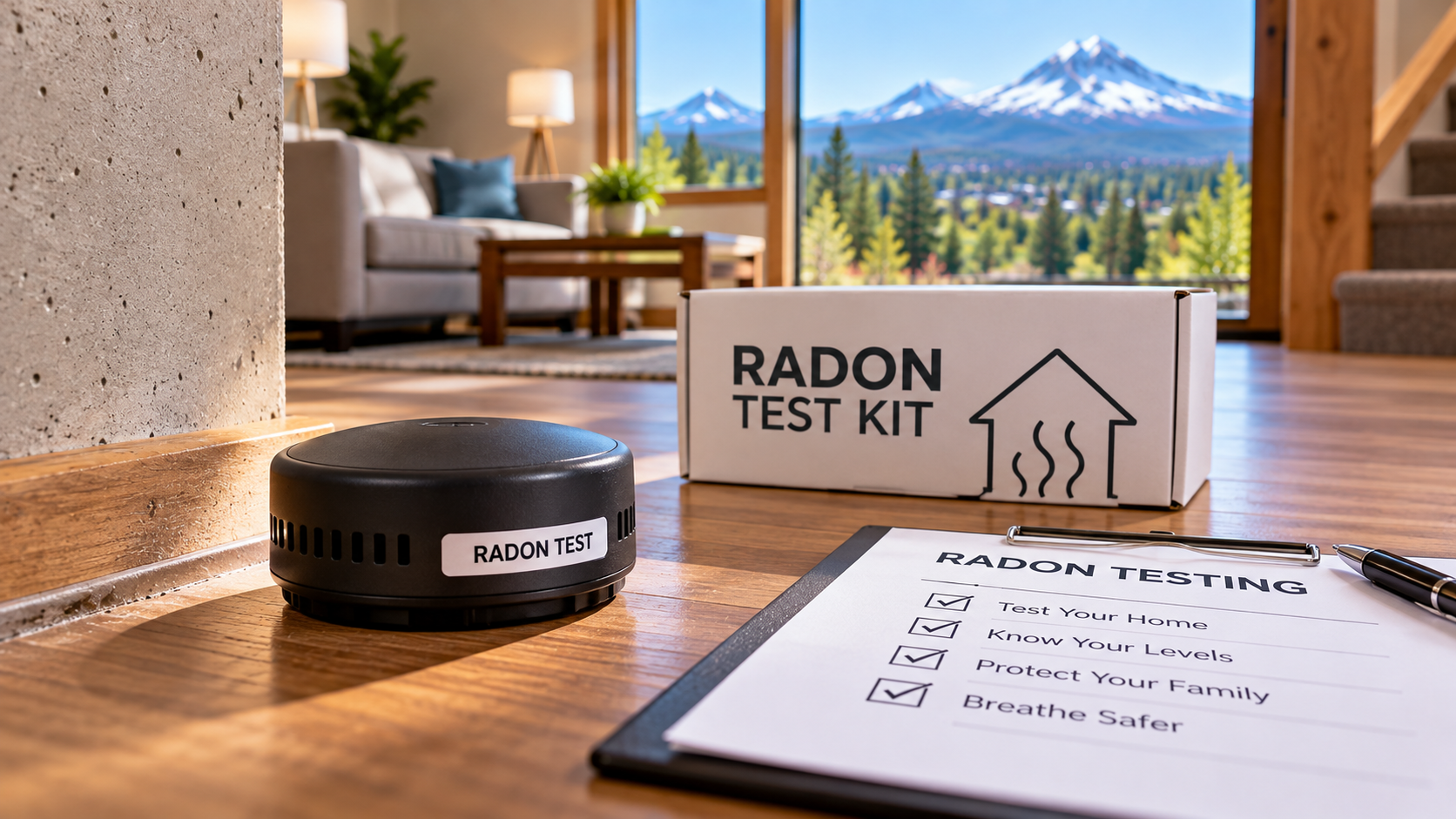


Most people looking at a house in Bend check the roof, the furnace, and the view. Very few ask about the air coming up from the ground. Radon is invisible, has no smell, and can’t be spotted during a showing, which is exactly why it gets overlooked until a buyer’s inspector brings it up.
This guide covers radon testing Bend Oregon buyers and homeowners should know about, including how to test, what the numbers mean, and what to do if your results come back high. It’s written for people buying a home, people who already own one, and people who haven’t thought about radon at all.
Radon levels Bend Oregon homes see are not the same as what you’d find in Portland or La Grande, and that’s part of the confusion. A lower regional risk doesn’t mean your particular house is safe, and the only way to know is to test. We’ll walk through what’s known, what isn’t, and how to make a calm, practical decision.
What Radon Is and Why It Matters
Radon is a naturally occurring radioactive gas that comes from the breakdown of uranium in soil and rock. It’s found outdoors in tiny amounts and isn’t a problem there. The concern starts when it collects inside a home, where it can build up over time.
How Radon Gets Into a House
Radon rises through the ground and enters through foundation cracks, gaps around pipes, sumps, and crawl spaces. Because it moves with air pressure, a home can pull it in more than you’d expect, especially when the house is closed up tight.
The Health Risk
Radon is the second leading cause of lung cancer after smoking, according to the Oregon Health Authority. The EPA says there’s no truly safe level, and long-term exposure is what matters most. If you smoke and your home has high radon, the risk is higher still. The good news is that radon is one of the easier home hazards to find and fix.

What We Know About Radon Levels Bend Oregon Homeowners Face
Here’s the honest answer: the risk in Central Oregon appears lower than in some parts of the state, but it’s not zero, and it’s not the same for every house. Understanding the difference between regional risk and your own home is the most important point in this guide.
The Regional Picture
Many radon resources list Deschutes County in EPA Zone 3, the lowest-risk category on the national map. The Oregon Health Authority maintains its own radon risk map and ZIP code table based on test kit data. Those maps are useful for context, but the state is clear that they shouldn’t replace testing an individual home.
Why Maps Aren’t Enough
Radon levels can differ a lot from house to house, even next door. Geology, foundation type, construction, and heating and ventilation systems all play a part. Oregon officials have pointed out that very high results have been found in areas labeled low potential, and low results in areas labeled high.
Limited Data in Some Areas
In ZIP codes where few tests have been done, the picture is simply less certain. That’s another reason a test on your own home is worth more than any map.
Radon Levels Change With the Seasons
Radon levels in Oregon homes can rise in winter, when doors and windows stay shut and heating systems change how air moves through the house. That’s why the state recommends testing during the heating season. If you’re curious how Central Oregon winters affect your home, our guide to Bend, Oregon climate and weather covers what to expect month by month.
Radon Testing Bend Oregon Homeowners Can Do Themselves
Testing is simple and inexpensive. You don’t need to be a handyman, and you don’t need to schedule a contractor to get started.
DIY Test Kits
Most hardware stores sell kits, and the American Lung Association sells them online. Kits generally cost $15 to $25 at local stores, and some mail-in kits include lab fees separately. If you follow the instructions carefully, results are close to what a professional test would show.
Short-Term Tests
Short-term kits measure radon over a few days. They give you a fast answer, but only for that window of time. They’re a good first step.
Long-Term Tests
Long-term kits run for months and give a better picture of your average exposure. If your short-term result is close to the action level, a long-term test can help you decide.
Professional Testing
A certified professional can test your home with continuous monitors and give results quickly, which is useful during a home sale. Local quotes have been reported in the range of $150 to $200, though prices vary. Oregon doesn’t certify radon professionals, so look for someone certified through a national program like NRPP or NRSB. The Oregon Health Authority keeps a list of contractors who meet that standard.
When and How to Test
Test during the winter if you can, and follow the closed-house conditions that come with your kit. Place the device in the lowest livable level of the home, away from drafts and exterior walls. Don’t move it, and send it to the lab promptly when the test period ends.
Radon in Real Estate: What Buyers and Sellers Should Know
If you’re buying or selling, radon testing Oregon law doesn’t require it, so it’s up to you and your agent to bring it up. That can work in your favor if you plan ahead.
For Buyers
Radon testing is often done during the inspection or due diligence period, and many buyers add it to their list alongside a general inspection. Results come back quickly with a professional test, which fits into a short timeline. If you’re buying from out of state, our article on buying a home in Bend Oregon without seeing it first explains why a local inspector matters. With Bend Oregon homes staying on the market longer, buyers also have more room to ask for inspections and negotiate.
For Sellers
If you’re selling, testing before you list lets you handle a high result on your own schedule, not in the middle of a negotiation. It also shows buyers you’ve done your homework. Talk to your agent about how to document test results and any mitigation work.
New Construction Isn’t Automatic
Seven Oregon counties require radon-resistant new construction, and Deschutes County isn’t one of them. Even if a new home has a radon system, the state’s own advice is to have it tested by someone certified. For radon testing Oregon buyers do on new builds, the same rule applies: don’t assume, test.
Radon Mitigation Bend Oregon: What to Expect If Levels Are High
A high test result isn’t a reason to panic. Radon problems are fixable, and the fix is usually straightforward.
When to Mitigate
The EPA recommends fixing a home when the level reaches 4 picocuries per liter. Because there’s no known safe level, the EPA also suggests considering mitigation for results between 2 and 4. If your first result is high, retest to confirm before you spend money.
How Mitigation Works
Many systems in Oregon use a method called sub-slab depressurization, which draws radon from beneath the foundation and vents it outside. Homes with crawl spaces may use a different approach. A standard system is usually effective within 24 hours of being installed.
Cost and Hiring a Pro
The state hasn’t regulated how companies mitigate radon, so hiring a certified professional matters. Costs depend on the size and design of your home and the method used. Older local reports put average installation in the neighborhood of $1,700 to $2,000, but get several quotes. Oregon doesn’t offer financial assistance for mitigation, so plan it like any other home repair. If you’re building a budget for a purchase, our breakdown of the cost of living in Bend, Oregon can help you plan around unexpected expenses. Ask any radon mitigation Bend Oregon contractor how they’ll measure success.
Retest After the Work
After a system is installed, test again to confirm levels dropped. A fan can fail over time, so periodic retesting every couple of years is smart.
Resources and Next Steps
You don’t have to figure this out alone. The Oregon Radon Awareness Program can answer questions about radon testing Oregon homeowners ask most, and it can point you toward test kits and certified contractors. You can reach the program by phone at 971-673-0440.
If you have health questions, or you’re concerned about long-term exposure, talk to your doctor. Our Bend Oregon healthcare guide can help you find local providers.
Common Radon Mistakes to Avoid
Most radon mistakes come down to assumptions. A few come up again and again.
Assuming Your Area Is Safe
A low regional risk doesn’t guarantee a low result in your house. Test regardless of the map.
Testing Once and Forgetting
Levels change with seasons and with changes to the house. Test again after renovations, new HVAC work, or foundation repairs.
Ignoring Results Between 2 and 4
A result under the action level isn’t a green light for everyone. Consider your own comfort level, who lives in the home, and whether a long-term test makes sense.
Final Thoughts on Radon Testing in Bend
Radon testing Bend Oregon homeowners and buyers do is simple, cheap, and worth doing. The regional numbers are encouraging, but they can’t tell you anything about your own house. A test can.
If your results are fine, you have peace of mind. If they’re high, radon mitigation Bend Oregon contractors can fix it quickly. Either way, you’ll be making decisions based on facts, not guesses.
Frequently Asked Questions
There’s no single answer. Deschutes County is generally listed in a low-risk EPA zone, but levels can vary a lot from house to house, so test your own home.
No. Oregon law doesn’t require radon testing in real estate transactions, but buyers can add it to their inspection or due diligence period. Radon testing Oregon buyers order is usually quick with a professional test.
DIY kits typically run $15 to $25 at local stores. Professional tests have been quoted around $150 to $200, so confirm current pricing with a certified tester.
Retest to confirm, then talk to a certified professional about mitigation. Radon mitigation Bend Oregon homeowners use most often is a sub-slab system that vents radon outside.
No. The counties that require it are Baker, Clackamas, Hood River, Multnomah, Polk, Washington, and Yamhill. Newer Bend homes may not have a radon system, so test anyway.
Winter is best, when homes are closed up. Follow the instructions on your kit and keep windows and doors closed as directed.