


The Bend and Portland housing markets are moving in different directions in 2026. Bend remains the more expensive city based on median sale price, but its prices have softened year over year. Portland has a lower citywide median, yet desirable homes are still attracting faster sales and stronger offer activity.
That difference matters for buyers comparing the two Oregon markets. Portland provides a much larger inventory of neighborhoods, condos, starter homes, and employment options. Bend has a smaller supply, a stronger concentration of lifestyle and luxury buyers, and greater variation between ordinary residential properties and high-end homes near golf, trails, mountains, or resort communities.
This report compares prices, inventory, market time, luxury demand, buyer opportunities, and seller conditions using the latest available 2026 market data. Because different reports may cover a city, metro area, or rolling three-month period, each statistic should be read with its stated geography and methodology.
Quick Answer
Bend is currently more expensive than Portland based on city-level median sale prices. During the three months ending May 2026, Bend’s median sale price was approximately $704,114, compared with $534,680 in Portland. That placed Bend about $169,000 higher, or roughly 32% above Portland’s median.
The direction of prices was different. Bend’s median was down 6.4% from the comparable period a year earlier, while Portland’s was up 1.8%. Bend homes sold in a median of 21 days, compared with 14 days in Portland.
The latest June reports reinforce the distinction. A Bend market report placed the city’s June median sale price at $727,925, with 2.8 months of inventory and 57 days from listing to closing. A Portland metro report based on RMLS data showed a June median of $564,900, 3.1 months of inventory, and 55 days of total market time.
Bend vs Portland at a Glance
| Market indicator | Bend | Portland |
|---|---|---|
| City median sale price | $704,114 | $534,680 |
| Year-over-year price change | -6.4% | +1.8% |
| Median days on market | 21 days | 14 days |
| Homes sold | 525 | 2,160 |
| Sale-to-list ratio | 99.2% | 100.8% |
| Homes sold above list | 20.9% | 43.4% |
| Listings with price drops | 36.5% | 31.7% |
City-level figures cover the three months ending May 2026.
Which Market Is Better for Buyers?
Bend may offer more room to negotiate on homes that have been overpriced, need work, or appeal to a narrower buyer pool. More than one-third of Bend listings had recorded price drops, and the average home sold slightly below its asking price.
Portland buyers have a broader range of property types and price points, but well-priced homes can move quickly and receive multiple offers. Portland’s average sale-to-list ratio was above 100%, and more than 43% of homes sold above list price during the measured period.

Which Market Is Better for Sellers?
Portland currently provides stronger citywide indicators for sellers of well-positioned homes. Bend sellers can still succeed, but pricing accuracy is especially important because buyers are comparing more carefully and requesting concessions.
Market Snapshot
The headline comparison is simple: Bend is the higher-priced market, while Portland is currently the faster and more competitive one.
Bend’s market is influenced by limited land, lifestyle migration, second-home demand, resort and golf properties, remote workers, retirees, and buyers relocating from higher-priced Western cities. Portland operates as a much larger employment and housing market with urban neighborhoods, suburban districts, condominiums, historic homes, new construction, and a wider range of entry prices.
Bend Market Snapshot
During the three months ending May 2026:
- Median sale price: $704,114
- Annual price change: down 6.4%
- Homes sold: 525
- Sales change: up 11.6%
- Median days on market: 21
- Sale-to-list ratio: 99.2%
- Homes sold above list: 20.9%
- Listings with price reductions: 36.5%
The combination of lower prices and higher transaction volume suggests that buyers remained active when sellers adjusted to current affordability and demand.
June Bend data showed a median price of $727,925, 202 closed sales, 564 active listings, and 2.8 months of inventory. Active inventory was down 20.3% from the prior June, while closed sales were up 16.8%.
Portland Market Snapshot
During the three months ending May 2026:
- Median sale price: $534,680
- Annual price change: up 1.8%
- Homes sold: 2,160
- Sales change: up 6.8%
- Median days on market: 14
- Sale-to-list ratio: 100.8%
- Homes sold above list: 43.4%
- Listings with price reductions: 31.7%
Portland metro data for June showed a median sale price of $564,900, 3.1 months of inventory, and total market time of 55 days. The difference between Redfin’s 14-day city statistic and the 55-day metro statistic reflects different geographies and definitions: one measures city-level median days on market, while the other reports total market time for Portland metro listings.
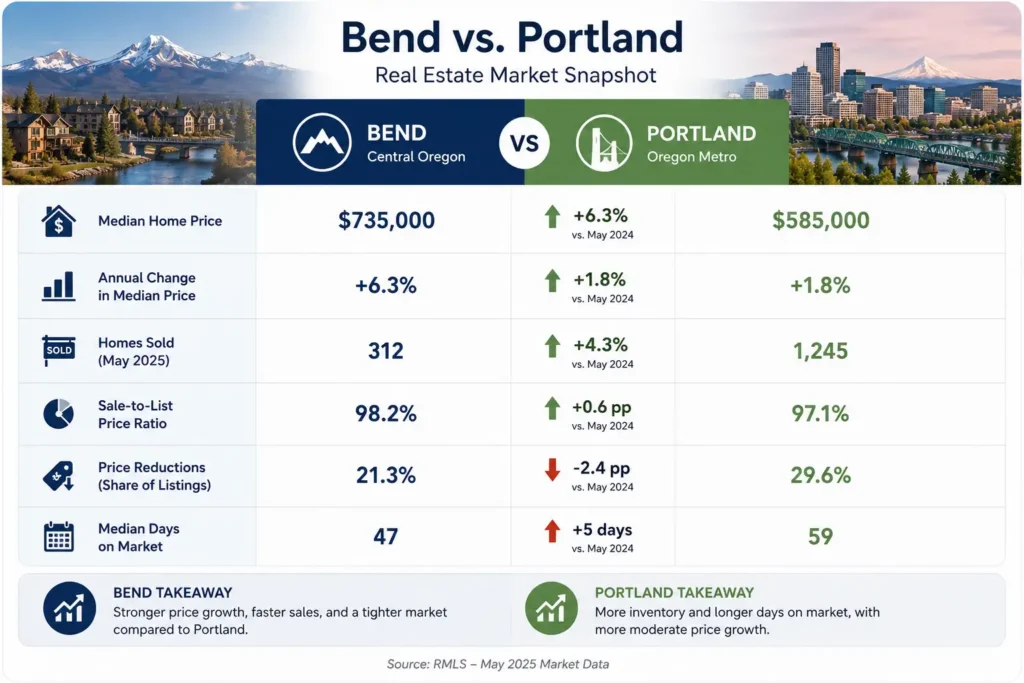
Median Prices
Bend’s citywide median sale price remains substantially higher than Portland’s. This can surprise buyers moving from Portland who expect a smaller city to be more affordable.
The price difference is partly explained by Bend’s housing composition and buyer demand. Bend has a meaningful share of newer detached homes, larger properties, luxury homes, golf-community residences, and homes priced for mountain access or outdoor lifestyle. Portland has expensive neighborhoods as well, but its much larger housing stock includes more condominiums, attached homes, smaller houses, and neighborhoods below the citywide median.
Bend Price Direction
Bend’s median sale price of $704,114 was down 6.4% year over year during the three-month period ending May 2026. Its median price per square foot was $387, which was up 1.7% from the previous year.
A falling median combined with a rising price per square foot can occur when the types and sizes of homes sold change. It does not mean every Bend home lost 6.4% of its value.
For example, a larger number of smaller or lower-priced homes closing in one period can reduce the median even when comparable homes remain stable.
Portland Price Direction
Portland’s median sale price was $534,680, up 1.8% year over year. Its median price per square foot was $321, up 0.6%.
Portland’s modest annual gain suggests relative price stability rather than rapid appreciation. The market remains expensive, but citywide pricing has been more resilient than Bend’s recent rolling median.
List Price vs Sale Price
Portland homes sold for an average of 100.8% of list price. Bend homes averaged 99.2%.
That difference may appear small, but it changes negotiation strategy:
- Portland buyers may need to compete quickly for strong listings.
- Bend buyers may have more leverage when a home has been available longer.
Sellers in either market should not assume that every property follows the citywide average.
Price Does Not Equal Affordability
A lower purchase price does not automatically make Portland more affordable for every household. Property taxes, commuting, insurance, HOA fees, income, employment location, and lifestyle expenses all affect affordability.
Similarly, a higher-priced Bend home may still fit a buyer selling a more expensive property elsewhere or working remotely with a high income.
Inventory
Inventory determines how many choices buyers have and how much competition sellers face. Neither Bend nor Portland is operating with unlimited supply, but current data shows somewhat healthier selection than during the most restrictive pandemic-era conditions.
Bend Inventory
Bend had 564 active homes in June 2026, representing a 20.3% decline from the previous June. New listings fell 18.4% to 204, while months of inventory declined to 2.8.
This created an unusual combination:
- Fewer homes were available.
- Closed sales increased.
- Buyer demand remained active.
- Price sensitivity still produced concessions and reductions.
Limited inventory does not guarantee stronger prices when monthly payments remain high. Buyers may have fewer choices but still refuse to overpay.
Portland Inventory
Portland metro inventory was reported at 3.1 months in June, down from 3.2 months in May.
A separate Realtor.com report counted 8,281 active Portland listings in June, down 0.4% year over year. New listings were also down 1.6%, indicating that the flow of fresh inventory remained limited even as buyers faced elevated borrowing costs.
The apparent differences between reports come from geography and methodology. Portland city, Portland metro, and listing-platform boundaries are not identical.
What Inventory Means for Buyers
In Bend, buyers may have limited options within a narrow combination of price, neighborhood, lot size, school area, and property condition.
In Portland, the total pool is much larger, but inventory is divided across many neighborhoods and housing types. A buyer seeking a specific school district, walkable neighborhood, or historic property may still face intense competition.
What Inventory Means for Sellers
Sellers benefit when their property is difficult to replace. Examples include:
- Updated homes in desirable locations
- Properties with mountain or city views
- Homes near parks and schools
- Single-level homes
- Quality acreage
- Well-maintained luxury homes
- Properties with functional layouts
Generic or overpriced homes face more competition, even when overall inventory is not high.
Days on Market
Market-time statistics require careful interpretation because platforms define them differently.
Redfin reported Bend homes selling after a median of 21 days during the period ending May 2026. Portland homes sold after 14 days.
June reports using broader measures showed 57 days from listing to closing in Bend and 55 days of total market time in Portland metro.
These figures are not contradictory. A home may accept an offer after two or three weeks but require several additional weeks for inspections, appraisal, financing, and closing.
Why Portland Homes Move Faster
Portland’s city market benefits from:
- A larger buyer base
- More local employment
- Broader neighborhood demand
- More price points
- Greater population
- More first-time and move-up buyers
Redfin reported that Portland homes received an average of three offers and that competitive homes could go pending in roughly five days.
Why Bend Market Time Varies
Bend’s market includes a wide range of properties:
- Entry-level homes
- New construction
- Downtown cottages
- Westside homes
- Acreage
- Luxury homes
- Golf properties
- Second homes
A correctly priced home in a popular neighborhood may sell quickly, while a luxury or unusual property may need considerably more time.
How Buyers Should Use Days on Market
A longer listing period may create an opportunity to ask about:
- Price reductions
- Seller concessions
- Repair credits
- Rate buydowns
- Closing-cost assistance
- Flexible possession
- Included furnishings
However, buyers should not assume a long-listed home is automatically overpriced. Condition, access, seasonality, financing eligibility, or a specialized design may explain the delay.
Luxury Market
The luxury segment behaves differently from the broader housing market in both cities.
Bend Luxury Market
Bend luxury properties may include:
- Tetherow homes
- Broken Top properties
- Pronghorn residences
- Awbrey Butte homes
- Northwest Crossing custom homes
- Acreage estates
- Golf-front residences
- Mountain-view properties
- Downtown luxury homes
Demand comes from local move-up buyers, retirees, executives, remote professionals, second-home owners, and people relocating from California, Seattle, Portland, and other higher-cost markets.
Bend’s luxury buyer pool is smaller than Portland’s, so condition and pricing matter greatly. A customized home may have cost the owner a substantial amount but still appeal to only a narrow group of buyers.
Portland Luxury Market
Portland offers luxury homes in established urban and suburban locations, including historic estates, hillside properties, contemporary homes, and large residences near employment and cultural amenities.
Portland’s larger population gives the luxury market a broader local buyer base. However, luxury demand can still vary by neighborhood, property tax burden, condition, architecture, and proximity to major employers.
Golf and Resort Properties
Bend has a stronger concentration of golf and resort-oriented real estate. These homes may carry:
- HOA dues
- Club memberships
- Resort fees
- Rental restrictions
- Design standards
- Higher landscaping costs
A luxury buyer moving from Portland should compare total ownership costs rather than purchase price alone.
Which Luxury Market Has Greater Liquidity?
Portland generally has more potential buyers because of its size. Bend may provide stronger lifestyle appeal for a buyer specifically seeking golf, skiing, trails, views, acreage, or a second home.
Buyer Opportunities
Both markets offer opportunities, but the strategy should be different.
Opportunities in Bend
Bend buyers may find leverage through:
- Listings with multiple price reductions
- Homes on the market longer than the local average
- Properties needing cosmetic updates
- New construction with builder incentives
- Sellers offering rate buydowns
- Homes outside the most competitive westside areas
- Luxury properties with a limited buyer pool
Bend’s June report showed that 46% of sales included seller concessions, with a median concession of $7,500.
That does not mean every seller will provide a credit, but it confirms that concessions are a meaningful part of current negotiations.
Opportunities in Portland
Portland buyers may benefit from:
- More neighborhoods and housing types
- Condos and attached homes below detached-home prices
- Listings that missed the initial pricing window
- Properties requiring renovation
- Higher-priced homes with a smaller buyer pool
- Sellers facing competition from nearby listings
Realtor.com reported that 27% of Portland listings had a price reduction in June.
Where Buyers Need to Act Quickly
Buyers should be ready to move faster when a property is:
- Correctly priced
- Recently updated
- In a highly desired neighborhood
- Near schools, parks, or employment
- On a usable lot
- Free of major repair issues
- Rare for its price range
Buyer Strategy Checklist
Before making an offer:
- Compare recent closed sales.
- Review the listing’s price history.
- Ask about competing offers.
- Estimate repairs.
- Obtain an insurance quote.
- Compare the full monthly payment.
- Review HOA documents.
- Protect essential inspection rights.
- Use concessions strategically.
- Avoid competing based on emotion alone.
Seller Trends
Sellers in both markets are dealing with informed buyers and higher monthly borrowing costs. A home may attract attention, but buyers are less willing to overlook poor condition, unrealistic pricing, or major ownership expenses.
Bend Seller Trends
Bend sellers are seeing:
- More price reductions
- Increased use of concessions
- Strong demand for well-priced homes
- Faster sales than a year earlier
- Lower active inventory
- Greater scrutiny of luxury and unusual homes
Although Bend’s rolling median price declined, homes sold faster and transaction volume increased. This suggests that the market is functioning when pricing aligns with buyer expectations.
Portland Seller Trends
Portland’s median price rose modestly, and homes sold more quickly than in Bend. More than 43% sold above list price, showing that competitive bidding remains common for attractive properties.
However, Portland sellers are not guaranteed an easy transaction. The June list-price report showed a 2.6% annual decline in median asking price and a median listing period of 51 days.
This indicates a split market:
- Strong homes can sell quickly.
- Overpriced listings can remain available and require reductions.
Pricing Matters More Than the Citywide Trend
A seller should focus on:
- Recent neighborhood sales
- Competing active listings
- Property condition
- Lot quality
- Renovation level
- Buyer price-search brackets
- Current financing costs
A home priced correctly at launch often performs better than one listed high and reduced repeatedly.
Preparation Priorities
Sellers should address:
- Deferred maintenance
- Roof and HVAC concerns
- Exterior appearance
- Interior cleanliness
- Lighting
- Landscaping
- Insurance-related issues
- Unpermitted work
- HOA documentation
Forecast
The near-term outlook for both markets depends heavily on mortgage rates, affordability, inventory, employment, and seller willingness to move away from older low-rate loans.
National pending home sales fell 5.4% in June 2026, and the West recorded a 4.7% monthly decline. Elevated mortgage rates and high prices remained major barriers for buyers.
Bend Forecast
Bend is likely to remain a high-cost but selective market.
The current combination of fewer active listings, increased closed sales, and frequent concessions suggests that neither buyers nor sellers have complete control. Properly priced homes can move, while aspirationally priced listings may sit or require reductions.
Likely near-term characteristics include:
- Stable to uneven prices
- Strong variation by neighborhood
- Continued concessions
- Limited entry-level inventory
- Selective luxury demand
- Faster activity for updated homes
Portland Forecast
Portland may continue to experience relatively stable prices with strong competition for desirable properties and softer conditions for ordinary or overpriced listings.
The metro’s 3.1 months of inventory remains below the four-to-six-month range commonly associated with a balanced market, but buyers have more time and information than they did during the pandemic-era peak.
What Could Strengthen Either Market?
- Lower mortgage rates
- Greater consumer confidence
- Strong regional employment
- More household formation
- Limited new supply
- Increased relocation demand
What Could Weaken Either Market?
- Higher mortgage rates
- Job losses
- Rising insurance costs
- Economic uncertainty
- Increased inventory without matching demand
- Sellers holding unrealistic price expectations
Forecast Summary
Bend is more likely to remain expensive but uneven. Portland is more likely to remain competitive at popular price points while offering broader housing choice.
Neither market should be treated as uniformly rising or falling. Property type, neighborhood, condition, and price positioning will matter more than broad headlines.
FAQ
Yes. Bend’s median sale price was approximately $704,114 during the three months ending May 2026, compared with $534,680 in Portland.
Bend’s rolling median was down 6.4% year over year during the period ending May 2026. That does not mean every property declined by the same amount.
Portland’s city median sale price was up 1.8% year over year during the three months ending May 2026.
Portland homes sold in a median of 14 days, compared with 21 days in Bend during the measured period.
Bend currently shows more frequent price reductions and slightly lower sale-to-list ratios. Portland buyers may still negotiate on stale or overpriced listings, but well-priced homes can receive multiple offers.
Neither city is automatically the better investment. Bend may offer lifestyle, luxury, golf, and second-home appeal. Portland offers a larger employment base, broader rental demand, and more property types. Returns depend on purchase price, expenses, location, and holding period.
Yes, in total number of homes because Portland is a much larger market. Months of inventory were relatively close in June, with approximately 3.1 months in Portland metro and 2.8 months in Bend.
Yes. A June Bend report found concessions in 46% of closed transactions, with a median seller concession of $7,500.
Some correctly priced homes still receive multiple offers. Portland homes received an average of three offers, and 43.4% sold above list price during the measured period.
The answer depends on payment affordability, expected ownership period, property availability, and personal timing. Waiting for lower rates could improve borrowing costs but may also bring more competition.
Final Thoughts
The 2026 Bend vs Portland housing market comparison shows two active but different markets.
Bend remains more expensive, with a smaller and more lifestyle-driven housing supply. Recent prices have softened, but homes are selling faster than last year, transaction volume has increased, and limited inventory continues to support desirable properties.
Portland has a lower citywide median, faster sales, and a larger share of homes selling above list price. Buyers have more neighborhoods and property types to consider, but competition remains strong for homes that are well located, updated, and correctly priced.
For buyers, Bend may provide better negotiation opportunities on overpriced or specialized properties. Portland may provide broader selection but requires faster decisions in competitive neighborhoods.
For sellers, success in either market depends less on citywide headlines and more on accurate pricing, condition, presentation, and neighborhood-level comparable sales.

