


Housing is usually the largest expense for anyone moving to Central Oregon. Buyers and renters must compare more than the advertised home price or monthly rent. Mortgage interest, property taxes, insurance, utilities, HOA dues, maintenance, rural systems, and commuting costs can materially change the amount a household spends each month.
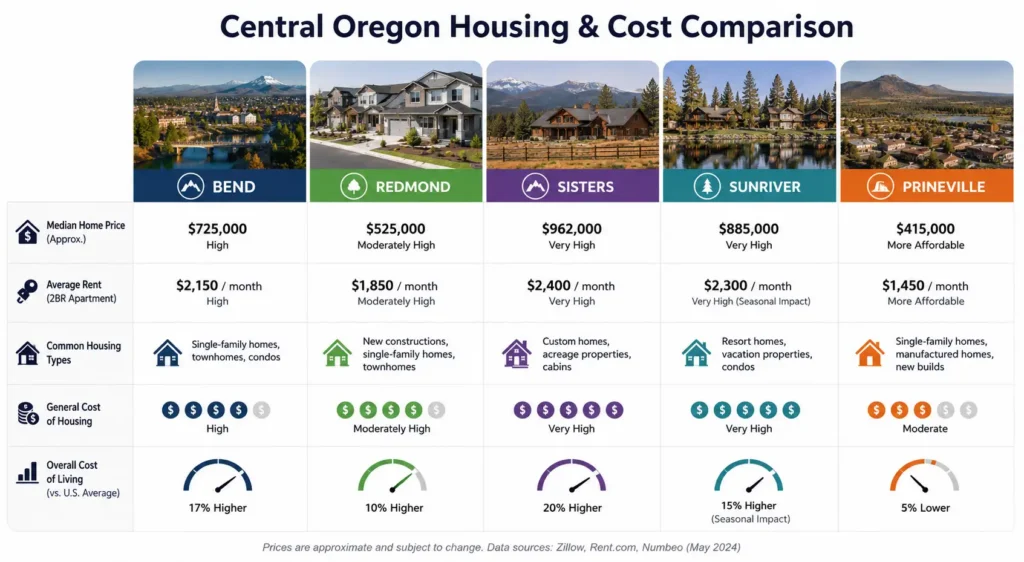
Housing costs also vary considerably across the region. Bend generally offers the largest selection of jobs, neighborhoods, apartments, restaurants, and services, but it remains one of the more expensive markets. Redmond can offer a lower purchase price and better airport access. Sisters combines limited inventory with demand for acreage, luxury homes, and small-town living. Sunriver operates as both a residential and vacation market, while Prineville is typically the most affordable of the five communities covered in this guide.
This article focuses specifically on housing costs in Central Oregon. It does not repeat the broader cost-of-living hub, which should also cover groceries, transportation, childcare, healthcare, taxes, and daily expenses.
Market note: Housing figures below are 2026 market snapshots. Prices and rents change by month, property type, neighborhood, condition, and data source.
Quick Answer
Central Oregon housing costs range from comparatively attainable homes in Prineville to luxury, resort, acreage, and westside properties priced well above regional medians.
Recent market data illustrates the difference. For the three months ending May 2026, Redfin reported median sale prices of approximately $704,000 in Bend, $825,000 in Sunriver, and $412,000 in Prineville. Zillow reported typical home values of roughly $737,000 in Bend, $519,000 in Redmond, and $793,000 in Sisters during June 2026. The figures are not directly interchangeable because the platforms use different calculations, but they show the broad price gap between communities.
Renters also face meaningful differences. Zillow’s June 2026 rental index placed typical rent around $2,300 in Bend, $2,055 in Redmond, $1,820 in Sisters, and $1,641 in Prineville. Sunriver is harder to summarize because much of its inventory serves vacation and seasonal demand rather than conventional year-long rentals.
Central Oregon Housing Snapshot
| Community | Approximate 2026 market indicator | General cost position |
|---|---|---|
| Bend | $704,000 median sale price | High |
| Redmond | $518,700 typical home value | Moderate to high |
| Sisters | $793,150 typical home value | High |
| Sunriver | $824,507 median sale price | High/resort market |
| Prineville | $412,253 median sale price | Most attainable of the five |
These are broad market indicators, not estimates for a particular property. A renovated West Bend home, a Sisters ranch, a Sunriver condo, and a new Prineville house should not be compared using citywide averages alone.

What Does Housing Really Include?
For renters, monthly housing costs may include:
- Base rent
- Security deposit
- Application fees
- Utilities
- Pet rent or deposits
- Parking
- Internet
- Renter’s insurance
- Moving expenses
For owners, the complete cost may include:
- Mortgage principal and interest
- Down payment
- Closing costs
- Property taxes
- Homeowners insurance
- HOA dues
- Utilities
- Repairs and maintenance
- Landscaping
- Snow removal
- Wildfire preparation
- Well and septic care
- Special assessments
Buying vs Renting
Buying and renting solve different problems. Renting provides flexibility and reduces responsibility for major structural repairs. Buying offers greater control over the property and the potential to build equity, but it usually requires more cash upfront and exposes the household to maintenance and market risk.
In higher-priced communities such as Bend, Sisters, and Sunriver, the monthly cost of buying can exceed the rent for a similar property, particularly when mortgage rates remain elevated. That does not automatically make renting better. The decision depends on how long the household expects to remain, available savings, monthly cash flow, and the type of property needed.
When Renting May Make More Sense
Renting can be useful when someone is:
- New to Central Oregon
- Unsure which community fits best
- Testing a work commute
- Comparing school boundaries
- Planning to stay fewer than three to five years
- Building a down payment
- Waiting for a particular home type
- Avoiding immediate maintenance responsibilities
A relocation household may benefit from renting through one winter and one summer. That period can reveal traffic, wildfire smoke, snow conditions, neighborhood activity, and the practical distance from work and services.
When Buying May Make More Sense
Buying may work better when the household:
- Plans to remain long term
- Has stable employment and savings
- Wants control over renovations or pets
- Needs a specialized property
- Wants acreage or equestrian facilities
- Can maintain an emergency repair reserve
- Has compared the full payment with rent
- Is comfortable with current market conditions
Upfront Costs of Buying
The down payment is only one part of the initial expense. Buyers may also need funds for:
- Loan origination
- Appraisal
- Inspection
- Title and escrow services
- Prepaid insurance
- Property-tax reserves
- Immediate repairs
- Moving
- Furniture and appliances
- HOA transfer or initiation fees
A buyer who uses nearly all available savings for closing may have difficulty handling the first roof, heating, plumbing, or appliance problem.
Rent Is Not Always the Advertised Number
A rental listed at $2,200 per month may cost more after utility charges, pet fees, parking, storage, and renter’s insurance. Some landlords include water, sewer, garbage, or landscaping; others pass those costs to tenants.
Renters should request a written breakdown before signing.
Housing Costs by City
Each Central Oregon community has a different mix of employment, services, housing inventory, land, recreation, and buyer demand. The least expensive listing is not necessarily the least expensive place to live once commuting, repairs, utilities, and property systems are included.
Bend
Bend has the region’s broadest housing selection, including apartments, townhomes, older cottages, planned subdivisions, luxury homes, golf communities, and rural-edge properties.
Redfin reported a median sale price of about $704,114 for the three months ending May 2026. Zillow’s June 2026 Home Value Index placed Bend’s typical home value near $737,350 and its typical rent around $2,300.
Pricing varies sharply by area. Westside neighborhoods, downtown-adjacent homes, golf communities, mountain-view properties, and larger lots may command substantial premiums. Northeast, southeast, and expanding edge communities may offer newer construction or more space, though commute patterns and construction activity must be considered.
Common Bend housing options:
- Apartments and multifamily rentals
- Older central Bend homes
- New subdivisions
- Townhomes
- Luxury westside homes
- Golf-community properties
- Acreage outside city limits
Bend cost considerations: buyers should budget for higher purchase prices, irrigation, landscaping, HOA dues in some developments, and potentially greater insurance costs near forested areas. City water, sewer, and stormwater charges also need to be included in the monthly budget.
The City of Bend’s rates effective July 2025 included a base water charge of $42.60 for a standard three-quarter-inch residential meter, plus usage. The single-family sewer base charge was $41.95, plus a volume charge based on winter water use.
Redmond
Redmond often attracts buyers who want lower purchase prices than Bend, newer subdivisions, larger lots, and convenient access to Redmond Municipal Airport.
Zillow reported a typical Redmond home value of about $518,700 in June 2026 and typical rent of approximately $2,055.
Redmond’s housing supply includes established neighborhoods, new construction, townhomes, rural-edge homes, and access to nearby resort communities such as Eagle Crest.
Redmond cost advantages potentially include:
- Lower entry prices than Bend
- More new-construction choices
- Airport proximity
- Access to regional retail
- Larger lots in some neighborhoods
- Shorter drives to some north Central Oregon employers
Redmond tradeoffs: a household working or attending school in Bend may spend more on fuel and vehicle maintenance. Commuting costs can reduce the apparent savings from a lower mortgage or rent.
New-construction buyers should compare the advertised base price with:
- Lot premiums
- Landscaping
- Fencing
- Window coverings
- Appliances
- HOA dues
- Upgrade packages
- Builder financing terms
Sisters
Sisters has a smaller housing supply and strong demand from retirees, remote workers, luxury buyers, second-home owners, and people seeking acreage.
Zillow reported a typical home value of approximately $793,150 in June 2026, with typical rent around $1,820. Rental figures should be treated cautiously because Sisters has a smaller rental inventory, and a limited number of available listings can change the reported average.
Housing types in Sisters:
- In-town older homes
- New construction
- Custom homes
- Luxury properties
- Acreage
- Ranch and equestrian properties
- Resort-area homes
- Condos and smaller attached units
A rural Sisters home may involve:
- Well inspection and maintenance
- Septic pumping and repairs
- Private-road agreements
- Propane
- Irrigation rights
- Fencing
- Outbuilding maintenance
- Snow removal
- Wildfire mitigation
- Longer service calls
A home outside town can provide privacy and land, but it is rarely maintenance-free.
Sunriver
Sunriver is both a residential community and a vacation destination. Its market includes full-time homes, vacation properties, luxury homes, condominiums, and townhomes.
Redfin reported a median sale price of approximately $824,507 for the three months ending May 2026. Homes took longer to sell than in Bend, reflecting the community’s smaller and more specialized buyer pool.
In addition to the mortgage, buyers may encounter:
- Sunriver Owners Association dues
- Sub-association dues
- Amenity-access programs
- Rental-management fees
- Furnishing replacement
- Cleaning
- Hot-tub maintenance
- Snow removal
- Higher utility usage
- Insurance for rental activity
- Special assessments
A vacation home with strong gross revenue can still produce limited net income after management, cleaning, maintenance, utilities, insurance, and owner use.
Traditional year-long rental data is less reliable because a meaningful share of the housing stock is used for seasonal or short-term stays. Renters seeking a permanent home should examine lease length, utility responsibility, seasonal owner use, and whether the property may return to the vacation market.
Prineville
Prineville generally provides the lowest entry price among the five communities in this guide.
Redfin reported a median sale price of approximately $412,253 for the three months ending May 2026. Zillow reported typical rent of roughly $1,641 in June 2026.
Housing includes established in-town homes, new construction, larger lots, rural acreage, manufactured homes, and properties near recreational or high-desert areas.
Prineville cost advantages:
- Lower median purchase price
- Lower typical rent than Bend and Redmond
- Acreage and rural options
- Smaller-community environment
- Access to Crook County recreation
Prineville tradeoffs — households should evaluate:
- Commutes to Bend or Redmond
- Fuel expenses
- Healthcare access
- Rural utilities
- Internet availability
- Well and septic systems
- Wildfire exposure
- Private roads
- Resale demand for specialized properties
A household commuting to Bend five days per week may spend enough on transportation to narrow the housing-cost advantage.
Property Taxes
Property taxes in Central Oregon vary by the property’s assessed value and the combination of city, county, school, fire, library, and special-district rates that apply to its location.
Buyers should not estimate taxes by multiplying the purchase price by a general county rate. Oregon’s taxable assessed value can differ substantially from current market value.
Market Value vs Assessed Value
A listing may show several numbers:
- Purchase price
- Real market value
- Assessed value
- Maximum assessed value
- Current annual tax bill
The existing tax bill is usually more useful for budgeting than a general percentage. However, buyers should still confirm whether a new improvement, exemption change, boundary change, or other event could affect future taxes.
Deschutes County
Bend, Redmond, Sisters, and Sunriver are in Deschutes County, but they do not all share the same total tax rate. The county provides a tax and millage lookup because rates depend on the property’s exact taxing districts.
Before making an offer, request:
- Current tax statement
- Assessed value
- Applicable districts
- Any exemptions
- Pending assessments
- Whether recent construction is fully reflected
Crook County
Prineville is in Crook County. Property owners can pay in thirds, or receive a 3% discount by paying the full amount by the November deadline. Crook County also allows a 2% discount when two-thirds is paid by that deadline.
Questions to Ask
- What was the most recent annual tax bill?
- Does the home have an exemption?
- Is new construction fully assessed?
- Are there local improvement charges?
- Are any tax deferrals attached?
- Does the property cross more than one tax district?
- Will an accessory dwelling unit affect assessment?
Insurance
Insurance has become a more important part of the Central Oregon housing budget because of wildfire exposure, forest proximity, replacement costs, rental use, and property-specific risk.
The least expensive policy is not always the most useful. Owners need enough coverage to rebuild under current labor and material costs, not merely to pay off the mortgage.
What Affects Insurance Cost?
Premiums may be influenced by:
- Location
- Wildfire risk
- Distance from fire services
- Roof age and material
- Siding
- Home size
- Replacement cost
- Claims history
- Wood-burning systems
- Short-term rental use
- Secondary-home status
- Deductible
- Well and septic systems
- Outbuildings
Wildfire Due Diligence
Before removing an insurance contingency, buyers should:
- Obtain a property-specific quote.
- Confirm that the insurer will issue the policy.
- Review wildfire deductibles and exclusions.
- Ask about defensible-space requirements.
- Confirm replacement-cost coverage.
- Disclose rental or second-home use.
- Review coverage for detached structures.
Condo and Townhome Insurance
Condo owners usually need an individual policy even when the association has a master policy. The buyer should understand where the master policy ends and the owner’s responsibility begins.
Review:
- Interior improvements
- Personal property
- Loss assessment
- Liability
- Water damage
- Temporary housing
- Deductible responsibility
Renter’s Insurance
Renter’s insurance may cover personal property and liability, but it does not cover the building itself. Landlords may require proof before move-in.
Utilities
Utility costs depend on the property’s size, age, heating system, insulation, occupancy, landscaping, and location.
Central Oregon’s climate creates seasonal changes. Winter heating, summer cooling, irrigation, hot tubs, and snow equipment may cause significant month-to-month variation.
Electricity
Electricity may power heating, cooling, water heaters, appliances, hot tubs, wells, and irrigation pumps.
Before buying, request 12 months of utility bills when possible. A large house with electric resistance heating may cost substantially more than a smaller, efficient home with a modern heat pump.
Natural Gas and Propane
Some properties use natural gas for heat, hot water, cooking, or fireplaces. Rural homes may use propane instead.
Propane owners should verify:
- Tank ownership
- Tank size
- Delivery access
- Current fuel level
- Rental charges
- Historic usage
- Supplier options
Water and Sewer
City properties usually pay municipal water and sewer charges. In Bend, current charges include separate base and usage components for water, sewer, and stormwater.
Rural properties may have a private well and septic system instead. This removes a monthly municipal bill but introduces inspection, pumping, electrical, repair, and replacement costs.
Garbage and Recycling
Garbage service may be billed separately or included in rent or HOA dues. Confirm container size, pickup frequency, recycling, yard debris, and seasonal schedules.
Internet
Internet availability can affect remote workers, students, and rural buyers. Never assume that a listing’s statement that internet is “available” means the service meets required speeds. Verify the exact address with the provider.
Example Monthly Utility Categories
| Utility | Cost drivers |
|---|---|
| Electricity | Heating type, cooling, home size, hot tub |
| Electricity | Winter temperature, insulation, fireplaces |
| Water | Household use, irrigation, landscaping |
| Sewer | Base charge and water-use calculation |
| Garbage | Container size and pickup frequency |
| Internet | Provider, speed and rural access |
| Well and septic | Pumping, testing, power and repairs |
HOA Costs
HOA dues are common in planned communities, condominiums, townhomes, golf developments, and resort properties.
The amount alone does not reveal whether an association is financially healthy. Buyers should examine what the fee covers and whether reserve funding is sufficient.
What HOA Dues May Cover
Depending on the community, dues may support:
- Common landscaping
- Private roads
- Snow removal
- Gates
- Parks
- Pools
- Clubhouses
- Exterior maintenance
- Roofs
- Insurance
- Pathways
- Management
- Reserve funding
Resort and Golf Communities
Properties in Sunriver, Eagle Crest, Tetherow, Broken Top, Pronghorn, and other resort or golf communities may have more than one cost layer.
Possible charges include:
- Master association dues
- Neighborhood association dues
- Condo dues
- Club membership
- Resort fees
- Amenity access
- Transfer fees
- Special assessments
Golf-club membership may be separate from HOA membership.
Review Before Buying
Request:
- Governing documents
- Current budget
- Reserve study
- Insurance certificate
- Meeting minutes
- Pending litigation
- Assessment history
- Delinquency information
- Fee schedule
- Rental restrictions
- Maintenance responsibilities
A low HOA fee can be a warning sign if the association is not saving enough for roofs, roads, pools, or other major projects.
Hidden Costs
The expenses that surprise buyers are often not included in a mortgage calculator.
Maintenance and Repairs
A common planning method is to maintain an annual reserve based on the home’s age, value, condition, and complexity. A newer townhome may need less immediate work than an older acreage home with a well, septic system, barn, fencing, and private road.
Potential expenses include:
- Roof repairs
- Heating systems
- Water heaters
- Appliances
- Plumbing
- Electrical work
- Decks
- Exterior painting
- Irrigation
- Tree removal
- Pest control
Landscaping and Irrigation
A large lawn, mature trees, or landscaped acreage can increase water, maintenance, and repair expenses.
Ask whether the home has:
- Automatic irrigation
- Irrigation rights
- Private landscaping
- HOA landscaping
- Seasonal blowout requirements
- Mature trees requiring professional care
Snow and Ice
Costs may include:
- Snowblower
- Shovels
- Ice melt
- Roof snow removal
- Driveway service
- Winter tires
- Heating
- Damage prevention
Wildfire Preparation
Defensible-space work can involve removing brush, limbing trees, managing firewood, replacing combustible materials, and maintaining access for emergency vehicles.
Rural Systems
Rural buyers may need reserves for:
- Well pump
- Pressure tank
- Water treatment
- Septic pumping
- Drain field
- Propane system
- Generator
- Private road
- Fencing
- Outbuildings
New Construction Extras
A newly built home may still need:
- Backyard landscaping
- Fencing
- Blinds
- Refrigerator
- Washer and dryer
- Air conditioning
- Garage storage
- Patio
- Irrigation
- Upgraded lighting
Commuting
A lower-priced home can create higher transportation costs. Calculate:
- Daily mileage
- Fuel
- Vehicle maintenance
- Winter tires
- Depreciation
- Time
- Airport or healthcare travel
Budget Examples
The following scenarios are planning examples, not lending estimates or quotes. Actual payments depend on purchase price, down payment, mortgage rate, taxes, insurance, utilities, HOA costs, and the property itself.
Example 1: Bend Renter
| Expense | Illustrative monthly amount |
|---|---|
| Rent | $2,300 |
| Electricity and gas | $180 |
| Water, sewer and garbage | $150 |
| Internet | $75 |
| Renter’s insurance | $20 |
| Estimated housing total | $2,725 |
A household with pets, paid parking, storage, or a larger detached rental may spend more.
Example 2: Redmond Homeowner
Assume a buyer purchases a home around $520,000 with a mortgage.
The monthly budget should include:
- Principal and interest
- Property taxes
- Insurance
- HOA dues, when applicable
- Utilities
- Maintenance reserve
- Commuting costs
Even when the mortgage is lower than a similar Bend home, regular driving to Bend can add a meaningful amount.
Example 3: Sisters Acreage Buyer
A Sisters-area acreage budget may include:
| Expense category | Why it matters |
|---|---|
| Mortgage | Higher land and property value |
| Property tax | Based on assessed value and district |
| Insurance | Wildfire, outbuildings and replacement costs |
| Well and septic | Inspection and future repairs |
| Propane or electricity | Heating and rural utility use |
| Road maintenance | Shared or private access |
| Land care | Trees, fencing, pasture and weeds |
Acreage ownership can be rewarding, but it requires a larger emergency reserve than many in-town properties.
Example 4: Sunriver Vacation Home
A vacation-home owner should model:
- Mortgage
- Taxes
- Insurance
- HOA and sub-association fees
- Utilities
- Furnishings
- Cleaning
- Management
- Repairs
- Hot-tub service
- Vacancy
- Owner stays
Rental income should be evaluated after all costs, not before them.
Example 5: Prineville Commuter
A buyer may save substantially on the purchase price but drive to Bend for work.
The full comparison should include:
- Mortgage savings
- Fuel
- Vehicle wear
- Winter travel
- Commute time
- Additional childcare scheduling
- Reduced flexibility for appointments
A Better Housing Formula
Use this calculation:
Complete Monthly Housing Cost = Mortgage or Rent + Taxes + Insurance + HOA + Utilities + Maintenance + Required Transportation
For buyers, also keep a separate emergency reserve for major repairs.
FAQ
Prineville generally has the lowest purchase prices and typical rents among Bend, Redmond, Sisters, Sunriver, and Prineville. The overall savings depend on commuting and property condition.
Housing in Bend is expensive relative to many Oregon communities. Redfin reported a median sale price of about $704,000 for the three months ending May 2026, while Zillow reported typical June rent around $2,300.
Redmond generally has lower home prices than Bend. It may also offer more new-construction choices, although buyers working in Bend should add commuting costs to the comparison.
Sisters has limited inventory and demand for small-town living, mountain access, acreage, luxury homes, and second properties. Zillow reported a typical home value of about $793,150 in June 2026.
Sunriver is a premium resort market. In addition to the purchase price, owners may pay association dues, amenity fees, rental-management costs, and higher maintenance expenses.
The appropriate amount depends on the home’s age, condition, systems, and land. Older homes, acreage properties, rental homes, and properties with wells or septic systems generally require larger reserves.
Not necessarily. Oregon property-tax calculations use taxable assessed values and local district rates, which may differ from the home’s current market or purchase price.
They are common in planned developments, condos, townhomes, golf communities, and resorts. Fees and included services vary considerably.
Renting first can help a relocating household understand neighborhoods, commutes, schools, winter weather, smoke season, and everyday services before making a long-term commitment.
Common rural expenses include well and septic maintenance, propane, private roads, snow removal, fencing, irrigation, internet limitations, wildfire preparation, and outbuilding repairs.
Final Thoughts
Housing costs in Central Oregon cannot be measured using home price or rent alone. The right comparison includes taxes, insurance, utilities, maintenance, HOA dues, commuting, and property-specific systems.
Bend offers the broadest range of services and neighborhoods but remains expensive. Redmond can provide a lower entry point and convenient airport access. Sisters combines limited inventory with lifestyle and acreage demand. Sunriver carries resort-related expenses, while Prineville may provide the lowest purchase cost but require longer regional travel.
Before choosing a community, buyers and renters should build a complete monthly budget and test how the location supports work, school, healthcare, recreation, and everyday errands. The most affordable home is the one that fits both the household’s finances and its actual daily life.

