


Property taxes are an important part of buying a home in Bend, but they are often misunderstood. A buyer may see a home’s purchase price, real market value, maximum assessed value, taxable assessed value, and annual tax bill—and assume those figures should be roughly the same. Under Oregon’s property-tax system, they can be substantially different.
There is also no single Bend property-tax percentage that accurately predicts the bill for every home. The final amount depends on the property’s taxable assessed value, the local government and service districts attached to its address, voter-approved bonds, special assessments, exemptions, and whether new construction or major improvements have been fully assessed.
This guide explains how Bend, Oregon property taxes work and what buyers should verify before making an offer. It is intended for general education and does not replace guidance from Deschutes County, the Oregon Department of Revenue, a tax professional, or a real estate attorney.
Quick Answer
Property taxes in Bend are calculated from a home’s taxable assessed value, not simply from its asking price or the amount a buyer pays. The taxable assessed value is generally the lower of the property’s real market value or maximum assessed value. That amount is multiplied by the combined rates of the taxing districts serving the property, with additional assessments added where applicable.
Because properties can have different assessment histories and district combinations, two similar Bend homes may have noticeably different annual tax bills. A buyer should review the exact property’s current tax statement rather than estimate taxes using a broad citywide percentage.
How Much Are Property Taxes in Bend?
There is no single annual tax rate that applies to every home in Bend.
The total tax bill can be affected by:
- Taxable assessed value
- Deschutes County charges
- City of Bend districts
- School districts
- Fire protection
- Library districts
- Parks or other special districts
- Voter-approved bonds
- Local-option levies
- Property-specific assessments
The most useful starting point is the current tax statement for the exact property. Deschutes County property records and statements can be accessed through the county’s online property-information system.

Are Oregon Property Taxes Based on Purchase Price?
Not directly.
The amount a buyer pays for a Bend home may influence market data, but Oregon property taxes are not automatically recalculated by applying a percentage to the purchase price.
Every property has:
- A real market value
- A maximum assessed value
- A taxable assessed value
The home is generally taxed on the lower of its real market value or maximum assessed value.
That is why a home purchased for $750,000 might have a taxable assessed value well below $750,000.
What Buyers Should Check Before Making an Offer
Before relying on the current annual tax bill, verify:
- The current property-tax statement
- Real market value
- Maximum assessed value
- Taxable assessed value
- All applicable taxing districts
- Existing exemptions or deferrals
- Whether recent improvements are included
- Whether new construction is fully assessed
- Pending special assessments
- Upcoming bond or levy changes
A low current bill can be misleading when the home is newly built, recently expanded, or benefiting from an exemption that may not continue after closing.
How Property Taxes Work in Oregon
Oregon property taxes are primarily administered at the county level. Counties assess property, issue tax statements, collect payments, and distribute revenue to the government and service districts attached to each property. The Oregon Department of Revenue supervises the statewide system and provides guidance, but buyers should contact the county assessor for records relating to a particular home.
The total property tax is generally calculated by multiplying the property’s taxable assessed value by the combined tax rates of all applicable districts and then adding any assessments.
Real Market Value
Real market value, often abbreviated as RMV, represents the county assessor’s estimate of what a property could reasonably sell for in the open market as of the assessment date.
It may reflect:
- Location
- Lot size
- Building size
- Age
- Condition
- Construction quality
- Recent comparable sales
- Improvements
- Outbuildings
- Land characteristics
Real market value is not necessarily the same as the listing price or final sale price. A seller may list above or below the assessor’s estimate, and market conditions can change after the annual valuation date.
Maximum Assessed Value
Maximum assessed value, often called MAV, limits how quickly taxable property value can grow.
Oregon generally limits annual growth in maximum assessed value to 3% unless certain changes occur. Exceptions can include adding a new structure, improving an existing structure, subdividing or partitioning land, and other qualifying property events.
This annual limitation is one reason longtime owners may have assessed values that are substantially lower than current market values.
Taxable Assessed Value
The taxable assessed value is generally the lower of:
- Real market value
- Maximum assessed value
This is the value used to calculate most property taxes.
For example, suppose a Bend property has:
- Real market value: $750,000
- Maximum assessed value: $410,000
The taxable assessed value would generally be $410,000, not $750,000.
Local Tax Rates
The combined rate depends on every district serving the property.
A Bend address may contribute to services such as:
- County government
- City government
- Schools
- Fire protection
- Libraries
- Parks and recreation
- Emergency services
- Special districts
- Voter-approved bonds
A property outside Bend city limits may be served by different fire, water, sewer, or special districts than a property inside the city. This is why a generalized Bend tax rate should never replace an address-specific statement.
Assessed Value vs Market Value
Homebuyers frequently confuse market value with assessed value. Both may appear in county records, but they serve different purposes.
Market value estimates what the property may be worth in the open market. Assessed value is used to determine taxation and may be limited by Oregon’s constitutional property-tax rules.
Why Assessed Value May Be Lower Than Sale Price
Oregon’s system generally limits growth in maximum assessed value to 3% per year unless a qualifying property change occurs.
During periods when home prices increase faster than 3% annually, the gap between market value and maximum assessed value may widen.
For example:
| Property figure | Illustrative value |
| Recent purchase price | $800,000 |
| Real market value | $775,000 |
| Maximum assessed value | $425,000 |
| Taxable assessed value | $425,000 |
This does not mean the assessor believes the home is worth only $425,000. It means the property is currently taxed using the lower taxable figure.
Why Two Similar Homes May Have Different Tax Bills
Two neighboring homes with similar market values may have different taxable assessed values because of:
- Different assessment histories
- Different construction dates
- Major additions
- Accessory structures
- Property divisions
- Exemptions
- Special assessments
- Different district boundaries
- Previously omitted improvements
A buyer should not use a neighbor’s annual bill as an exact estimate.
Does a Home Sale Reset the Assessed Value?
A normal ownership transfer does not automatically reset an Oregon property’s taxable assessed value to the sale price in the same way buyers may expect from California’s system.
However, the sale does not protect the buyer from changes caused by:
- Newly assessed construction
- Previously omitted property
- Major additions
- Subdivision or partition
- Expiring exemptions
- New local levies
- Special assessments
This distinction is especially important for California buyers moving to Bend. The Oregon system should be evaluated using the property’s current county record, not assumptions based on California reassessment rules.
What Makes Up a Bend Property Tax Bill?
A Bend tax bill may contain charges from several separate entities. Deschutes County collects the taxes, but the funds may be distributed among multiple public bodies and districts.
The exact combination depends on the address.
Deschutes County
County-related property-tax revenue may support services such as:
- Public safety
- Elections
- Courts and justice services
- Public health
- Planning
- Assessment and taxation
- Roads and infrastructure
- Administrative functions
Not every service is funded exclusively through property tax, but county government typically appears as part of the overall district structure.
City of Bend
Homes within Bend city limits may be subject to city-related tax components that help support municipal services and voter-approved obligations.
Properties with a Bend mailing address are not always inside city limits. Buyers should verify the actual jurisdiction rather than rely on the postal city shown in the listing.
School Districts
School-related taxes may include permanent district rates and voter-approved bonds.
These charges can support:
- School operations
- Buildings
- Facility improvements
- Capital projects
- Technology
- Safety upgrades
School district boundaries can extend beyond city boundaries, and nearby homes may not always belong to the same district.
Fire, Library and Special Districts
Depending on the address, a property may be served by:
- City fire services
- Rural fire protection
- Library districts
- Parks and recreation
- Emergency medical services
- Water districts
- Road districts
- Other special-service districts
A rural Bend property can have a very different combination than an in-town home.
Bond Measures and Local Levies
Voter-approved bonds and local-option levies may increase the annual bill.
These charges can change as:
- New measures are approved
- Older obligations expire
- Rates change
- Property values shift
- District budgets change
A buyer should review the current statement and ask whether any newly approved measures are not yet reflected.
Property Taxes by Bend Location
The neighborhood name alone does not determine property tax. Two homes marketed as being in the same general Bend area may have different jurisdictions, districts, assessed values, and assessment histories.
Homes Inside Bend City Limits
In-city properties generally benefit from access to city services such as municipal water, sewer, roads, and other infrastructure, depending on the location.
Their tax statements may include a combination of:
- Deschutes County
- City of Bend
- School district
- Library district
- Parks and recreation
- Bond-related charges
Municipal utility bills are separate from property taxes.
Homes Outside City Limits
A home with a Bend mailing address may sit outside the incorporated city.
These properties may rely on:
- Rural fire protection
- Private well
- Septic system
- Private road
- Irrigation district
- County planning
- Separate water or service districts
The absence of one city-related tax component does not automatically mean the total cost will be lower. Rural ownership may involve additional maintenance and private-system expenses.
Golf and Resort Communities
Homes in communities such as Tetherow, Broken Top, Pronghorn, or other planned developments may have:
- Property taxes
- Master HOA dues
- Neighborhood HOA dues
- Club membership costs
- Resort fees
- Transfer fees
- Special assessments
These are separate obligations.
A buyer should not assume that golf membership, landscaping, road maintenance, or resort amenities are included in the property-tax bill.
Rural and Acreage Properties
Rural properties may include land, barns, shops, arenas, detached garages, guest homes, irrigation infrastructure, and other improvements.
Property-tax due diligence should consider:
- Land classification
- Farm or forest special assessment
- Outbuilding value
- Accessory dwelling units
- Irrigation rights
- Partition history
- Recently constructed structures
- Potential disqualification taxes
If land receives a special assessment based on qualifying use, changing that use can sometimes create additional tax consequences. Oregon identifies farmland, forestland, historic property, conservation easements, and other qualifying uses as possible special-assessment categories.
Property Taxes on New Construction
New construction requires extra caution because the visible annual tax bill may reflect only the lot, an unfinished home, or part of the completed improvement.
A newly built home may appear to have an unusually low tax bill during its first sale. That number should not be used as the long-term estimate without confirming whether the completed home is included in the assessment.
Partial-Year Assessments
Depending on the assessment date and construction timeline, county records may show:
- Vacant land only
- Land plus foundation
- An incomplete structure
- A partially finished home
- Completed construction not yet reflected in the annual statement
The next tax cycle may include more of the completed value.
Added Property Value
Oregon’s 3% maximum-assessed-value limitation has exceptions for property changes. New structures, improvements, subdivisions, and partitions can add value outside the ordinary annual limit.
This means a newly completed home can experience a meaningful increase in taxable assessed value once the improvement is added.
Builder Estimates vs Final Tax Bill
A builder or sales representative may offer an estimate, but that figure is not a guaranteed county calculation.
The final bill may be affected by:
- Completed improvement value
- Lot assessment
- Local districts
- Special assessments
- Bond measures
- Completion timing
- Community infrastructure
- Property classification
Buyers should ask the Deschutes County Assessor’s Office for guidance about the current assessment status.
Questions to Ask the Builder
Ask the builder or sales team:
- Does the current tax bill include the completed home?
- Is the statement based only on the lot?
- When was the certificate of occupancy issued?
- Have all improvements been reported?
- Are there local improvement charges?
- Are there HOA setup or transfer fees?
- Are new bond measures expected?
- What infrastructure phases are still planned?
- Is the property in a special tax or service district?
- Is the tax estimate documented or informal?
A mortgage lender’s initial escrow estimate may also change after the completed home is fully assessed.
Renovations and Property Tax Changes
Not every repair increases taxable assessed value. Oregon distinguishes routine maintenance and minor construction from qualifying additions or improvements that can create exception value.
The Oregon Department of Revenue notes that new additions and improvements may increase maximum assessed value, while minor construction below indexed thresholds may be excluded from this treatment.
Major Additions
Projects that may affect value include:
- New bedrooms
- Expanded living space
- Added garage
- Second-story addition
- Finished detached structure
- Large structural expansion
- Major conversion of unfinished space
The specific tax effect depends on the work and how the county classifies it.
Accessory Dwelling Units
An accessory dwelling unit can increase:
- Market value
- Improvement value
- Rental potential
- Insurance needs
- Utility use
It may also create additional taxable value.
Before buying a home with an ADU, verify:
- Permits
- Final inspections
- Legal use
- Assessment status
- Utility arrangements
- Rental restrictions
Remodels and Maintenance
Routine work such as repainting, replacing worn flooring, repairing a roof, or maintaining existing systems does not necessarily have the same tax effect as adding new square footage or substantially changing the property.
A major renovation, conversion, or structural improvement may be treated differently from ordinary maintenance.
Unpermitted Work
Unpermitted additions create concerns beyond property taxes.
They may affect:
- Appraisal
- Insurance
- Financing
- Safety
- Resale
- Rental legality
- County assessment
- Future permitting
A buyer should compare the county property record with the home’s actual size, bedroom count, outbuildings, and improvements.
Property Tax Exemptions and Deferrals
Oregon has more than 100 property-tax exemption programs, but it does not have a general statewide homestead exemption based only on age or income. Some owners may qualify for full or partial exemptions, special assessments, or tax deferral programs.
Eligibility should be confirmed directly with Deschutes County and the Oregon Department of Revenue.
Veteran and Disability Programs
Qualifying disabled veterans, surviving spouses, and certain active-duty service members may be eligible to exempt part of a home’s assessed value.
Oregon guidance states that a veteran may qualify when certified as having a qualifying disability level, and certain surviving spouses may also be eligible.
The benefit is not automatic and may require an application and supporting documentation.
Senior and Retiree Deferral Programs
Oregon’s senior and disabled homeowner program is a deferral, not a permanent exemption.
When approved, the state pays the property taxes and places a lien on the home. Deferred taxes, interest, and applicable fees must later be repaid.
For 2026, the state lists a household income limit of $70,000 and property-value eligibility rules. Other qualifications also apply.
A buyer should understand that:
- The taxes are postponed, not erased.
- Interest accrues.
- A lien is recorded.
- Repayment is eventually required.
- Eligibility depends on age or disability, income, ownership, occupancy, value, and other rules.
Farm and Forest Special Assessments
Qualifying farmland, forestland, conservation land, and other designated uses may be assessed under special programs rather than ordinary market-value treatment.
The benefit may depend on continuing the qualifying use.
Changing the use, subdividing the land, or removing it from the program may create additional taxes or repayment obligations. Rural buyers should investigate the current classification before closing.
Nonprofit and Other Exemptions
Qualified nonprofit, religious, charitable, educational, and other organizations may receive full or partial exemptions when the ownership and use satisfy program requirements.
These exemptions are not generally transferable to an ordinary residential buyer.
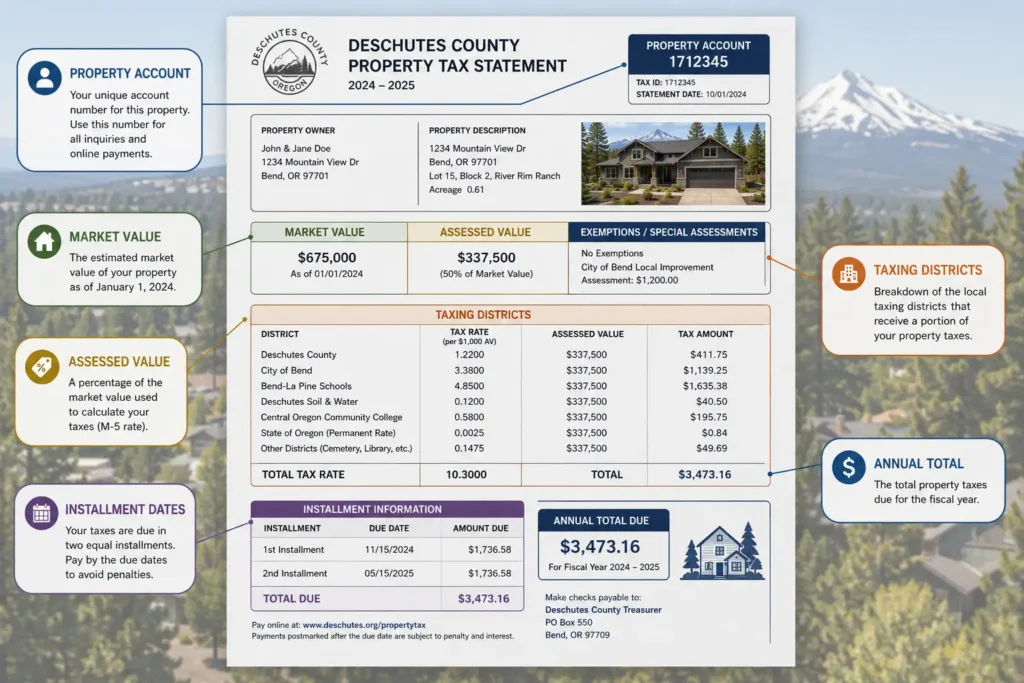
How to Read a Bend Property Tax Statement
A property-tax statement contains more information than the final amount due. Buyers should review the complete document rather than only the annual total.
Property Identification
Confirm:
- Owner name
- Situs address
- Mailing address
- Tax account number
- Map or parcel number
- Property description
The listed address and property description should match the home being purchased.
Real Market and Assessed Values
Locate:
- Land real market value
- Improvement real market value
- Total real market value
- Maximum assessed value
- Taxable assessed value
The taxable assessed value is generally the lower of real market value or maximum assessed value.
Taxing Districts
Review every entity listed on the statement.
A typical property may show multiple entries representing:
- County
- City
- School
- Library
- Fire
- Parks
- Bonds
- Special districts
Do not compare only the combined rate. Identify which districts are permanent and which charges relate to temporary bonds or local levies.
Annual Tax and Payment Schedule
Oregon property taxes can generally be paid in full or in installments.
Deschutes County’s published payment structure allows owners to:
- Pay in full by the November deadline and receive a 3% discount
- Pay two-thirds by the November deadline and receive a 2% discount on the amount paid
- Pay in three installments without a discount
The typical installment schedule is November, February, and May. Buyers should confirm current calendar-year deadlines directly with the county.
Estimating Property Taxes Before Buying
The most dependable estimate begins with the current tax record and then adjusts for property-specific changes.
A generic online calculator may not know whether the home has incomplete construction, an exemption, a special assessment, or a taxable assessed value far below market value.
Start With the Current Tax Bill
Obtain the latest statement through Deschutes County’s property-information system or from the seller.
Review:
- Annual tax
- Taxable assessed value
- Real market value
- Districts
- Exemptions
- Assessment history
Check for New Construction or Improvements
Compare the tax record with:
- Current square footage
- Number of buildings
- ADUs
- Garages
- Finished basements
- Shops
- Barns
- Additions
- Recent permits
A mismatch can indicate that the record is outdated or that improvements have not yet been fully assessed.
Review Exemptions
Ask whether the seller has:
- Veteran exemption
- Active-duty exemption
- Nonprofit exemption
- Special land assessment
- Senior or disabled deferral
- Other property-specific program
Do not assume it continues for the new owner.
Ask About Pending Bonds or Assessments
Check for:
- Local improvement districts
- Road projects
- Water or sewer projects
- Community infrastructure
- Approved bonds
- Special HOA assessments
Some of these costs may not appear as ordinary permanent tax rates.
Leave Room in the Budget
Even when maximum assessed value generally rises by no more than 3% annually, the final bill can change because of:
- New improvements
- District rate changes
- Bonds
- Assessments
- Expiring exemptions
- Added property value
A buyer should leave room in the monthly escrow and annual ownership budget.
Property Tax Examples
The following examples are illustrative only. They do not predict the actual tax bill for a Bend property.
Established Bend Home
Suppose an established home has:
| Property figure | Example |
| Purchase price | $725,000 |
| Real market value | $700,000 |
| Maximum assessed value | $390,000 |
| Taxable assessed value | $390,000 |
The buyer should not calculate taxes using $725,000. The current taxable assessment and applicable districts provide the better starting point.
New Construction Home
Suppose a newly completed home is listed for $650,000, but the current tax statement reflects only the lot and an unfinished structure.
The visible tax bill may be substantially lower than the next full-year bill after the completed improvement is assessed.
The buyer should ask:
- What construction value is currently included?
- When will the completed home appear?
- What estimate has the assessor provided?
- How will the lender adjust escrow?
Rural Acreage Property
A rural property may include:
- Residence
- Land
- Shop
- Barn
- Guest quarters
- Irrigation
- Farm or forest assessment
The current bill may be influenced by special land-use treatment. If the use changes after purchase, additional tax consequences may apply.
Condo or Townhome
A condo owner generally pays:
- Property tax on the individually owned unit
- HOA dues
- Insurance
- Possible special assessments
- Utility charges not covered by the association
HOA dues are not included in the county property-tax bill.
Common Buyer Mistakes
Property-tax errors can distort the affordability of a home. The following mistakes are especially common among buyers moving from another state.
Estimating Taxes From Purchase Price Alone
Applying a general percentage to the purchase price may produce an inaccurate result because Oregon taxes use taxable assessed value.
Using Another Home’s Tax Rate
A nearby home may have different districts, assessment history, improvements, or exemptions.
Ignoring Unassessed New Construction
A low first-year bill may reflect only vacant land or incomplete construction.
Assuming the Seller’s Exemption Transfers
Some benefits depend on the owner, occupancy, disability, veteran status, nonprofit use, or land use. Eligibility may end when ownership changes.
Forgetting HOA and Special-District Costs
Property taxes do not include every ownership obligation.
A home may also require:
- HOA dues
- Club dues
- Resort fees
- Irrigation charges
- Private-road contributions
- Sewer or water assessments
- Special HOA assessments
Buyer Property Tax Checklist
Use this checklist before removing your property-related contingencies.
Property Record
- Confirm the property address
- Verify the tax account number
- Review the legal description
- Compare county records with the actual home
Values
- Review real market value
- Review maximum assessed value
- Confirm taxable assessed value
- Compare land and improvement values
Taxing Districts
- Identify county charges
- Confirm city jurisdiction
- Review school district
- Check fire and library districts
- Identify bonds and local levies
Property Changes
- Check new construction
- Review additions and ADUs
- Confirm outbuildings
- Search recent permits
- Verify that improvements are assessed
Exemptions and Special Programs
- Identify current exemptions
- Confirm whether they transfer
- Review deferral liens
- Check farm or forest assessments
- Ask about potential disqualification taxes
Annual Payment
- Review the current annual bill
- Confirm the payment schedule
- Check for unpaid balances
- Ask about current-year prorations
- Budget for future changes
FAQ
There is no single rate for every Bend home. The total depends on taxable assessed value and the combined rates of the county, city, school, fire, library, bond, and other districts serving the exact property.
Not directly. Oregon generally taxes the lower of real market value or maximum assessed value, known as the taxable assessed value.
A normal sale does not automatically reset taxable assessed value to the purchase price. Taxes may still change because of new construction, improvements, district rates, bonds, assessments, or the loss of an exemption.
Your neighbor may have a different maximum assessed value, assessment history, exemption, improvement record, district combination, or land classification.
No. HOA dues, club fees, resort charges, and association assessments are separate from Deschutes County property taxes.
New construction can create added taxable value outside the standard 3% annual growth limit. A current statement may not reflect the completed home if construction was unfinished at the assessment date.
Qualifying senior or disabled homeowners may apply for Oregon’s deferral program. The state pays the tax and records a lien, and the deferred amount, interest, and fees must later be repaid.
Deschutes County provides property records and tax-statement copies through its online property-information system. Buyers can also request the statement from the seller, title company, or county tax office.
Final Thoughts
Understanding property taxes in Bend requires more than finding an average percentage.
The most important number is usually the property’s taxable assessed value, not its list price or recent sale price. Buyers must also review the exact taxing districts, current exemptions, recent improvements, new construction, bond charges, and special assessments.
An established Bend home may have a taxable value well below its market value. A new home may show an artificially low current bill because the finished structure has not yet been fully assessed. A rural property may benefit from a special land assessment that carries future use requirements. A condo or golf-community home may add HOA or club expenses that do not appear on the tax statement.
Before making an offer, obtain the current Deschutes County record, compare it with the property as it exists today, and build flexibility into the monthly ownership budget.

