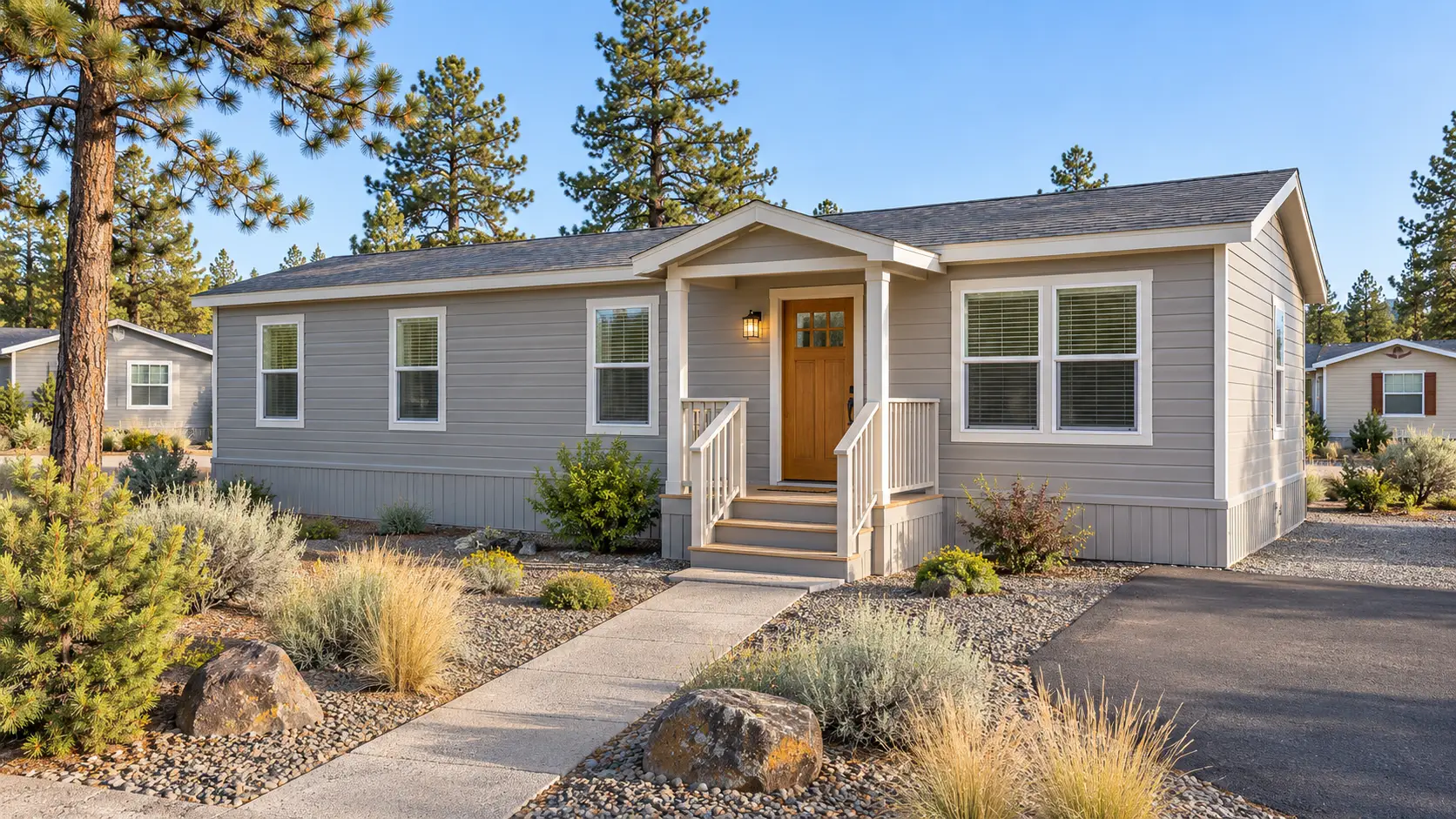


When comparing manufactured homes in Bend, Oregon, start with one question: does the sale include the land, or are you buying the home and renting its space? That distinction affects your monthly expenses, financing options, ownership responsibilities, and future sale.
A home in a park can have an attractive asking price while carrying ongoing space rent. A manufactured home sold with its own parcel may cost more upfront but include land ownership. Neither arrangement should be judged on the home’s advertised price alone.
This guide explains how to compare listings, research mobile home parks in Bend, Oregon, and evaluate a manufactured home on leased land before committing to a purchase.
Manufactured Homes in Bend: Your Main Options
| Purchase type | What you are buying | Costs to investigate | Main due-diligence question |
|---|---|---|---|
| Home on an owned parcel | The home and the land described in the sale | Financing, taxes, insurance, utilities, maintenance, and any association charges | Are both the home and parcel included, and how is ownership recorded? |
| Home in a leased-space park | The home, with occupancy of the site governed by a separate rental arrangement | Home financing, space rent, utilities, insurance, applicable taxes, and maintenance | Can you obtain tenancy approval on acceptable written terms? |
| Home in a resident-owned community | The home plus the rights provided by that community’s ownership structure | Financing, membership costs, community charges, and maintenance | What does membership provide, and who owns the underlying land? |
| New home placed on a separate site | The manufactured home plus separately arranged land and installation work | Home, land, permits, delivery, setup, utilities, and site preparation | Is the site approved and fully budgeted for the proposed home? |
For context on the wider housing decision, read our Bend housing affordability guide. Compare the full cost of each option against your household budget.

Manufactured Homes, Mobile Homes, and Modular Homes
Buyers often use “mobile home” and “manufactured home” interchangeably. For financing and documentation, however, the home’s construction date and classification matter.
HUD’s federal manufactured-home construction standards took effect in June 1976. A manufactured home built under those standards has identifying certification information. An older mobile home can raise different questions about condition, insurance, and loan eligibility.
Modular homes follow a different construction-code framework. Do not assume that a listing described as “factory-built” is a HUD-code manufactured home.
Ask for the construction year, manufacturer, model, serial information, and available HUD labels or data-plate documentation. Have the lender and the professional handling the transfer confirm what they need for that specific home.
How to Compare Manufactured Homes for Sale in Bend, Oregon
When searching for manufactured homes for sale in Bend, Oregon, separate home-only listings from properties that include land. Mixing the two groups can create a misleading picture of value.
Then compare homes within the same ownership category.
Check What the Asking Price Includes
Request written confirmation of:
- Whether the land is included.
- The exact home and parcel or space identification.
- Current charges and proposed terms for a new park resident.
- Included appliances, storage buildings, decks, and carports.
- Any work the seller has agreed to complete.
- Whether the home is being sold in place or must be moved.
A listing photograph cannot confirm land ownership, permitted additions, or tenancy eligibility.
Compare Condition and Financing Eligibility
Two homes of similar size may differ substantially in roof condition, subfloor repairs, insulation, heating equipment, installation history, and documentation.
Ask your lender to review the actual property early. A general preapproval does not mean every manufactured home qualifies for the same loan.
Confirm Location Beyond the Mailing Address
A Bend mailing address does not by itself establish that a property is within city limits. That can matter when researching permits, utilities, and site requirements.
Compare the exact address with your daily routes and preferred services. Our Bend Oregon neighborhoods guide helps place the location in a broader home-search context.
This article is a buying guide, not a live inventory feed. Confirm availability and asking prices directly when you begin viewing homes.
Owned Land vs Leased Land: What Changes?
The main difference is the right you acquire in the site beneath the home.
With an owned parcel, you acquire the land specified in the transaction, subject to its recorded restrictions and other obligations. With a leased site, you own the home while your use of the space depends on the rental arrangement and applicable law.
| Consideration | Home with owned land | Home on leased land |
|---|---|---|
| Land ownership | Included if expressly part of the sale | Generally remains with the landowner |
| Recurring site cost | Land-related taxes and maintenance; possible association charges | Space rent plus other applicable charges |
| Financing | May qualify for mortgage financing if property and borrower requirements are met | Often requires a home-only financing product |
| Changes to the property | Subject to permits, restrictions, and any association rules | May also require park approval under the rental agreement |
| Future sale | Buyer evaluates the home and parcel together | Buyer must consider both the home purchase and tenancy |
| Main documents | Deed, title information, home records, permits, and loan documents | Home ownership records, rental agreement, rules, and approval documents |
A resident-owned park is another arrangement worth understanding. Membership in a cooperative does not necessarily mean that you hold a separate deed to your individual lot. Review the community’s actual structure.
Researching Mobile Home Parks in Bend, Oregon
Park selection is part of the purchase decision, not an administrative task to leave until closing.
Examples listed in Oregon’s manufactured-home park directory include Cascade Village MHC, at 63700 Cascade Village Drive, and Deschutes Mobile Home Park, at 60311 Cheyenne Road. These are research starting points, not endorsements or claims that a suitable home is currently available.
The state directory identifies Cascade Village as a 55+ community and Deschutes Mobile Home Park as a family community. Confirm current occupancy requirements and application procedures directly with management. Directory entries do not replace current written terms.
Questions to Ask Park Management
Before committing to a home, request the proposed rental agreement, community rules, application criteria, and full schedule of charges.
Ask:
- What would the space rent be for me as the incoming buyer?
- Which utilities and services are included, and which are billed separately?
- What application and approval steps must be completed?
- What rules apply to pets, guests, parking, and additional occupants?
- Who maintains trees, landscaping, driveways, and utility connections?
- What approvals apply to decks, fences, sheds, or exterior changes?
- Are there outstanding notices or required work affecting this home?
- What restrictions and procedures would apply when I sell?
Do not rely only on what the current owner pays. Obtain terms applicable to your proposed tenancy and clarify how future rent changes are handled.
Oregon Housing and Community Services publishes a manufactured-home park directory and buyer information. You can use these resources to identify communities, then verify details directly with each park.
Financing a Manufactured Home
Financing depends on both the borrower and the property. Land ownership, the home’s age, its recorded status, installation, condition, and prior relocation can all be relevant to a lender’s review.
When the Home and Land Are Included
A manufactured home sold with land may be eligible for a mortgage if it meets the selected program’s requirements. Owning the land alone does not guarantee approval.
Ask the lender to review the ownership structure, foundation or installation documentation, and home identification before you spend heavily on the transaction.
When You Are Buying the Home Only
A loan secured by the manufactured home without the land is often called a home-only or chattel loan. Its rates, term, fees, and protections can differ from those of a mortgage secured by real estate.
Compare written offers using the annual percentage rate, loan term, monthly payment, total borrowing cost, and any early-payoff conditions. Avoid comparing monthly payments without checking how long each loan runs.
For either arrangement, confirm property eligibility before removing relevant financing protections in your purchase agreement.
Calculate the Total Monthly Cost
Space rent can materially change the affordability of a home-only purchase. Taxes, insurance, utilities, and maintenance also belong in the comparison.
Use a worksheet for each property:
| Monthly expense | Property A | Property B |
|---|---|---|
| Home or mortgage payment | $_____ | $_____ |
| Space rent, if applicable | $_____ | $_____ |
| Property taxes not already included in the payment | $_____ | $_____ |
| Insurance not already included in the payment | $_____ | $_____ |
| Association or community charges | $_____ | $_____ |
| Utilities and separately billed services | $_____ | $_____ |
| Maintenance reserve | $_____ | $_____ |
| Estimated monthly total | $_____ | $_____ |
Check whether taxes and insurance are already included in your quoted loan payment so you do not count them twice.
Also prepare a separate upfront budget for the down payment, inspections, transfer costs, lender charges, and immediate repairs. Our Bend closing costs guide for homebuyers provides a general starting point, but a home-only transaction needs its own written estimate.
Inspections: What Should You Check?
Use an inspector familiar with manufactured homes. A clean interior and fresh paint do not tell you enough about the structure or systems.
The inspection scope should address the accessible portions of:
- Roof, flashing, exterior siding, and signs of water entry.
- Floors and subfloors, especially around bathrooms and plumbing.
- Under-home moisture, insulation, plumbing, and pest evidence.
- Supports, anchoring, and visible installation concerns.
- Electrical, heating, cooling, and ventilation equipment.
- Connections between sections in a multi-section home.
- Decks, porches, carports, and other additions.
An inspection is not a substitute for an engineering certification or permit review when one is required. Ask which specialist evaluations are appropriate for the home and loan.
Our Bend home inspection guide explains how to turn findings into a clearer repair and negotiation plan.
Verify Ownership Records and Permits
Oregon’s Building Codes Division maintains manufactured-home ownership information through the Manufactured Home Ownership Document System, commonly called MHODS, for homes within its scope. Homes deeded as real property follow a different documentation path.
Deschutes County explains that manufactured-structure ownership transfers may be handled through the relevant county office acting for the state, a title company or dealer, or directly through the Building Codes Division. This is not an Oregon DMV vehicle-title transaction.
Have the professional handling the transfer establish:
- Who owns the home and, where applicable, the land.
- Whether security interests or unpaid obligations need resolution.
- Which ownership-transfer process applies.
- Whether identification records match the home.
- What permits and approvals exist for installation and additions.
A seller’s description of the property as “real estate” does not replace verification of its recorded status.
Buying a New Home to Place on Land
If you plan to purchase a manufactured home and place it on a separate site, budget the complete project before ordering.
A home’s advertised price may exclude delivery, site preparation, installation, permits, utility connections, steps, skirting, and other completion work.
Ask the local permitting authority whether the proposed home and use are allowed on the exact parcel. Then obtain written estimates for access, grading, foundation or support work, water, sewer or septic, and power.
A vacant parcel is not automatically ready for a manufactured home. Resolve site feasibility and major cost items before treating the home-and-land combination as affordable.
Resale and Long-Term Planning
Avoid blanket claims that every manufactured home loses value or that owning land guarantees appreciation. The eventual sale depends on condition, location, land rights, financing availability, buyer demand, and the terms attached to the property.
For a leased-space home, consider whether future buyers can obtain tenancy approval and acceptable financing. For an owned-land property, review comparable sales with similar homes and parcels.
Do not assume moving the home provides an easy alternative if circumstances change. Transportability, receiving-site approval, and the full cost of relocation need separate investigation.
Buyer Checklist Before Closing
Before proceeding, make sure you can answer these questions:
- Am I buying the land, leasing a space, or joining a resident-owned community?
- Has the lender approved this property and ownership arrangement?
- Have I reviewed the inspection and priced necessary repairs?
- Are the ownership records and required releases ready for transfer?
- Have I obtained written tenancy approval where applicable?
- Do I understand every recurring charge and maintenance obligation?
- Is suitable insurance available for this exact home?
- Does the final budget include upfront costs and realistic monthly expenses?
Frequently Asked Questions
Some have lower asking prices, particularly when land is excluded. Compare total monthly expenses and ownership rights before deciding whether a listing offers better value.
Yes, manufactured homes can be sold with owned parcels. Confirm that the land is explicitly included and verify the property’s documentation and financing eligibility.
Usually, a home-only park purchase does not include the land. The written transaction documents and community ownership structure determine what you acquire.
The available financing depends on the loan program and property arrangement. Home-only loans are common for leased-space purchases, while some specialized programs have other options. Have a lender assess the specific home and lease.
Paying cash for the home does not by itself establish your right to occupy a leased space. Complete the applicable tenancy process and review the written rental terms.
Start with land ownership, total cost, condition, financing eligibility, and documentation. A lower price is only useful when the full arrangement fits your budget and plans.