


Buying a home in Bend means evaluating more than price, neighborhood, schools, and mountain access. Central Oregon’s dry summers, forested land, grasslands, high-desert vegetation, wind, and expanding development near natural areas make wildfire preparation an important part of homebuyer due diligence.
That does not mean every property carries the same risk. A home’s exposure depends on its surrounding vegetation, roof and siding materials, nearby open land, road access, slope, maintenance, water availability, and distance from emergency services. An in-town home can still be exposed to wind-driven embers, while a rural property may face additional concerns related to long driveways, private roads, limited evacuation routes, and delayed emergency response.
Insurance also needs to be researched early. Oregon’s Division of Financial Regulation explains that insurers consider factors such as location, construction materials, replacement cost, fire-protection access, claims history, and surrounding vegetation when determining eligibility and premiums. Some insurers may write fewer policies in areas they consider more exposed to disasters or where maintenance problems remain unresolved.
This guide explains how buyers can evaluate Bend Oregon wildfire risk, obtain insurance, assess defensible space, inspect fire-resistant home features, and budget for long-term wildfire preparation.
Important: This article provides general real estate and risk-planning information. Insurance eligibility, building requirements, fire behavior, and property conditions are address-specific. Buyers should consult licensed insurance professionals, inspectors, fire officials, contractors, and legal advisers where appropriate.
Alt Text: Bend, Oregon home designed with defensible space and wildfire-resistant features.
Quick Answer
Bend and the surrounding Central Oregon region have wildfire exposure, but the level of risk varies substantially from one property to another. Buyers should avoid labeling an entire neighborhood as safe or unsafe. Instead, they should evaluate the exact parcel, home construction, neighboring vegetation, road access, slope, and insurance options.
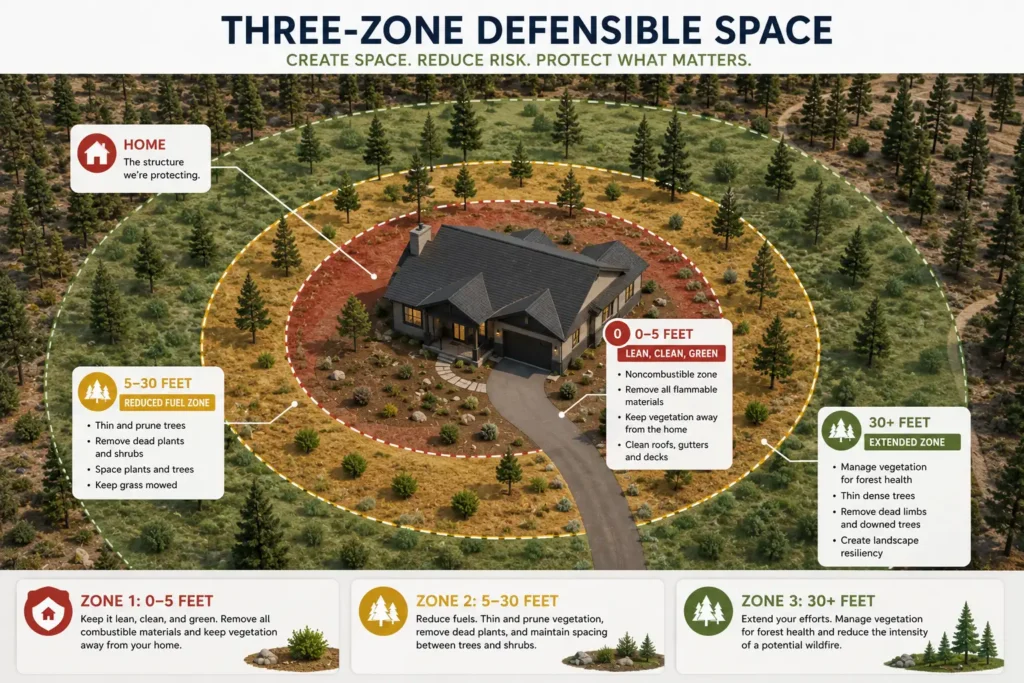
Oregon’s wildfire-preparation guidance emphasizes that the first five feet around a structure are especially important. Defensible space extends outward through additional zones where vegetation, dead material, tree branches, and other fuels should be managed.
Does Bend Have Wildfire Risk?
Yes. Wildfire is a natural part of Oregon’s forest environment, and the City of Bend states that wildfires have threatened the community before and will do so again. The risk is not limited to rural homes. Wind-driven embers can travel into developed neighborhoods and ignite roofs, vents, decks, fences, vegetation, or debris near a home.
Property-specific risk may be influenced by:
- Dense trees or brush
- Dry grass
- Forest or vacant land nearby
- Combustible roofing or siding
- Wood decks and fences
- Leaves in gutters
- Narrow or private roads
- Limited evacuation routes
- Hillside exposure
- Distance from fire services
- Poorly maintained neighboring land
Can Buyers Still Get Home Insurance?
Many Bend homes remain insurable, but buyers should not assume coverage will be available at a preferred price from every carrier.
The Oregon Division of Financial Regulation reports that insurers may consider:
- Home age
- Replacement cost
- Location
- Fire-protection availability
- Construction type
- Roof and exterior condition
- Claims history
- Surrounding vegetation
- Overall disaster exposure
Insurers may reduce how many policies they write in disaster-prone areas or decline homes with unresolved maintenance issues.
An insurance quote should be obtained during the offer or inspection period—not a few days before closing.
What Should Buyers Inspect First?
Begin with the areas most likely to allow embers or flames to reach the structure:
- Roof material and condition
- Gutters and roof valleys
- Exterior siding
- Attic and crawlspace vents
- Windows
- Decks and fences
- Vegetation within five feet
- Tree limbs above or near the roof
- Firewood and combustible storage
- Driveway and emergency access
- Available water systems
- Evacuation routes

Understanding Wildfire Risk in Bend
Regional wildfire exposure tells a buyer that preparation is important, but it does not determine the risk of a specific home.
Two homes in the same part of Bend may perform differently during a wildfire because one has a clean noncombustible perimeter, maintained roof, ember-resistant vents, and multiple exit routes, while the other has dry shrubs against wood siding, debris in gutters, and a narrow driveway surrounded by vegetation.
Wildland-Urban Interface
The wildland-urban interface is the area where homes and development meet or mix with forests, brush, grasslands, or other natural vegetation.
Properties in these areas may have:
- Forest directly behind the lot
- Brush or dry grass nearby
- Open public land
- Undeveloped parcels
- Natural slopes
- Continuous vegetation between properties
- Longer emergency-response routes
A home does not need to sit deep in the forest to be affected. Subdivisions near open land, ridgelines, grasslands, or forest edges may also experience wildfire exposure.
Embers vs Direct Flame
Many buyers picture wildfire risk only as a wall of flame reaching the home. Embers can be equally important.
The Oregon State Fire Marshal defines embers as small burning pieces that can travel through the air and start new fires. They may enter vents, collect on decks, ignite dry vegetation, or lodge in roof debris.
This means a home can be threatened even when the main fire is some distance away.
Common ember-entry or ignition points include:
- Attic vents
- Eaves
- Roof edges
- Gutters
- Deck boards
- Wood fences
- Dry mulch
- Patio furniture
- Leaf piles
- Firewood stacks
Smoke and Air Quality
Wildfire smoke can affect daily life even when a home is not directly threatened.
Buyers should consider:
- HVAC filtration
- Portable air cleaners
- Sealing around windows and doors
- Indoor recreation options
- Health needs
- Pet safety
- Backup plans for children or older adults
- Remote-work air quality
- Outdoor-event cancellations
A buyer with asthma, heart disease, respiratory sensitivity, or young children may need a stronger indoor-air plan.
Evacuation Risk
Property safety includes the ability to leave quickly.
The City of Bend recommends that residents know alternate routes out of their neighborhood, register for emergency notifications, prepare a 72-hour kit, maintain at least half a tank of fuel, and create plans for pets, medication, documents, and family members in schools or care facilities.
A beautiful property with one narrow exit road may carry a different practical risk than an ordinary home connected to several streets.
Which Bend Properties May Face Greater Risk?
Risk should be evaluated through physical property characteristics rather than general neighborhood labels.
The following property types may require additional review, but none should automatically be rejected without a closer inspection.
Forest-Edge Homes
Homes bordering forests or heavily treed open space may experience:
- Dense vegetation near the lot
- Falling needles and leaves
- Dead branches
- Ladder fuels
- Limited separation from wildland vegetation
- Trees overhanging roofs or decks
- Shared fuel conditions across boundaries
The appeal of privacy and forest views must be balanced with vegetation management and insurance requirements.
Rural and Acreage Properties
Rural properties may have more room for defensible space but greater responsibility.
Review:
- Driveway length
- Road width
- Turnaround space
- Bridge weight limits
- Well and pump reliability
- Water storage
- Generator capacity
- Gate access
- Fire-department access
- Private-road maintenance
- Brush and grass control
- Outbuildings
- Propane tanks
Acreage does not automatically reduce risk. Large unmanaged parcels may require extensive annual clearing.
Hillside Homes
Hillside properties may face additional concerns because fire can move quickly uphill and wind patterns can change across slopes.
Buyers should examine:
- Vegetation below the home
- Steep driveways
- Retaining walls
- Emergency-vehicle access
- Road grades
- Tree stability
- Multiple exit routes
- Deck exposure
Golf and Open-Space Properties
Golf frontage and open views can create the impression that wildfire risk is minimal.
However, grass, native vegetation, vacant land, landscaping, and nearby trees can still carry fire. Buyers should ask:
- Who maintains the open space?
- How frequently is vegetation cut?
- Is the land irrigated?
- Are native areas allowed to dry seasonally?
- Does the HOA have a mitigation plan?
- Are fences or decks connected to combustible landscaping?
Homes Near Vacant Land
A maintained lot can change when it borders unmanaged property.
Potential concerns include:
- Tall seasonal grass
- Brush accumulation
- Illegal dumping
- Uncertain ownership
- Future construction
- Limited access for vegetation maintenance
- Shared fencing
Buyers should inspect adjoining land and not focus only on the parcel boundary.
How Wildfire Risk Affects Home Insurance
Home insurance is both a financing requirement and a major ownership expense.
A lender usually requires coverage, but even cash buyers should protect the structure, personal property, liability exposure, and potential temporary-living costs.
Property Eligibility
An insurer may evaluate whether the property fits its underwriting standards.
Potential concerns include:
- Wood roofing
- Aging roof
- Heavy vegetation
- Poor exterior maintenance
- Remote fire response
- Long private roads
- Old electrical systems
- Wood stoves
- Outbuildings
- Short-term rental use
- Previous claims
One carrier declining the home does not prove the property is uninsurable, but it is a sign that buyers should investigate further.
Premiums and Deductibles
Insurance availability and affordability are separate questions.
A policy may be available but include:
- Higher annual premium
- Larger deductible
- Reduced coverage
- Inspection requirements
- Vegetation-removal conditions
- Roof replacement requirements
- Limited carrier choices
Oregon regulators note that increasing disaster losses, wildfire claims, labor costs, and material prices have contributed to higher premiums.
Replacement-Cost Coverage
Replacement cost is not the same as market value.
A home purchased for $900,000 may include land value, views, location, and scarcity. The amount required to rebuild the structure depends on:
- Square footage
- Architecture
- Materials
- Labor
- Debris removal
- Building-code upgrades
- Contractor availability
- Permit costs
- Temporary housing
- Outbuilding replacement
Luxury or custom homes may require more detailed coverage than a standard policy estimate.
Secondary Homes and Rentals
Second homes, vacation properties, and rentals may require specialized coverage.
Disclose:
- How often the home is occupied
- Whether it will be vacant for extended periods
- Short-term rental activity
- Long-term tenants
- Property-management arrangements
- Hot tubs
- Guest amenities
- Detached structures
Failing to disclose the intended use can create coverage problems.
Condo and HOA Master Policies
A condo association’s master policy does not eliminate the need for an individual owner policy.
Review:
- What the master policy covers
- Exterior vs interior responsibility
- Deductible allocation
- Loss-assessment coverage
- Common-area wildfire exposure
- Roof responsibility
- Siding responsibility
- Landscaping responsibility
- Reserve funding
Insurance Due Diligence Before Making an Offer
Insurance should be treated as an early contingency item.
Obtain an Address-Specific Quote
Do not rely on a general estimate for the neighborhood.
Provide the insurer with:
- Exact address
- Property type
- Square footage
- Roof age and material
- Construction type
- Planned occupancy
- Rental use
- Outbuildings
- Wood stove or fireplace
- Claims information
- Desired replacement coverage
Confirm the Policy Can Be Bound
A preliminary estimate is not always the same as a policy ready to take effect.
Ask:
- Has underwriting reviewed the address?
- Is an inspection required?
- Are there vegetation conditions?
- Must the roof be replaced?
- Can coverage begin on the closing date?
- Is the quote guaranteed for a stated period?
Review Wildfire Exclusions
Standard homeowners policies generally cover fire, but buyers should confirm:
- Structure coverage
- Smoke damage
- Personal property
- Additional living expenses
- Debris removal
- Landscaping limits
- Outbuilding coverage
- Code-upgrade coverage
Oregon’s insurance regulator notes that policies may provide additional living expenses when a covered event makes a home uninhabitable.
Check Roof and Construction Requirements
Some carriers may require repairs before issuing or renewing coverage.
Possible requirements include:
- Roof replacement
- Tree trimming
- Brush removal
- Updated electrical panel
- Chimney inspection
- Handrails
- Deck repairs
- Exterior paint or siding work
Disclose Rental or Vacancy Use
Tell the insurer how the property will actually be used.
A primary-residence policy may not adequately cover:
- Vacation rental guests
- Long vacant periods
- Business activity
- Frequent short-term occupancy
- Property-management operations
Compare More Than One Carrier
Quotes can vary significantly between insurers because underwriting models and risk tolerance differ.
Compare:
- Premium
- Deductible
- Replacement cost
- Exclusions
- Additional living expenses
- Personal-property limits
- Water backup
- Equipment breakdown
- Outbuildings
- Liability
- Rental coverage
Oregon provides consumer resources for comparing homeowners insurance and understanding underwriting factors.
Defensible Space Basics
Defensible space is the managed buffer between a structure and surrounding vegetation or combustible materials.
It does not mean removing every tree or turning the property into bare ground. The goal is to reduce fuel continuity, slow fire movement, limit ember ignition, and create safer conditions for emergency response.
Oregon’s current guidance divides defensible space into zones beginning with the structure itself and the first five feet around it.
Immediate Zone Around the Home
The first five feet are especially important.
Buyers should look for:
- Dead leaves against the foundation
- Bark mulch beside siding
- Firewood near the house
- Wood furniture under windows
- Dry shrubs touching walls
- Combustible doormats
- Debris below decks
- Branches over the roof
- Wooden fences attached to the structure
Oregon’s 2026 defensible-space model code includes maintaining a five-foot noncombustible zone next to structures as a key practice. The code is available for voluntary local adoption.
Intermediate Vegetation Zone
The next zone generally extends from approximately five to 30 feet.
Review:
- Tree spacing
- Low branches
- Dense shrubs
- Ladder fuels
- Dry grasses
- Dead vegetation
- Vegetation under decks
- Plants beneath windows
Ladder fuels are lower vegetation or branches that can carry fire from the ground into tree canopies.
Extended Property Zone
Beyond the immediate area, buyers should evaluate how vegetation could carry fire toward the home.
Potential work may include:
- Removing dead trees
- Mowing dry grass
- Thinning dense vegetation
- Clearing debris
- Maintaining driveways
- Separating combustible storage
- Managing slash piles
- Improving emergency access
Shared Boundaries
Wildfire preparation is more difficult when neighboring land is unmanaged.
Ask:
- Does the HOA maintain common land?
- Is public land adjacent?
- Can vegetation cross the property line?
- Are neighbors participating in mitigation?
- Who maintains roadside grass?
- Are there community fuel-break projects?
Defensible space works best when multiple properties participate.
Fire-Resistant Home Features
Home hardening refers to construction and renovation features that make a structure more resistant to wildfire ignition.
Oregon’s Building Codes Division identifies resistant roofing, siding, windows, and attic-ventilation measures as examples of home hardening.
Roofing
The roof is one of the most important areas to inspect.
Review:
- Material
- Age
- Missing shingles
- Gaps
- Flashing
- Debris
- Moss
- Leaves
- Overhanging branches
Noncombustible or fire-resistant roofing is generally preferable to untreated wood materials.
Siding
Exterior materials differ in ignition resistance.
Buyers should inspect:
- Gaps
- Cracks
- Rot
- Loose boards
- Ground contact
- Vegetation touching siding
- Combustible trim
More resistant materials can reduce ignition potential, but installation quality and maintenance also matter.
Vents
Attic and crawlspace vents can allow embers to enter hidden spaces.
Check for:
- Damaged screens
- Large openings
- Missing covers
- Debris accumulation
- Older vent designs
Ember-resistant venting can reduce intrusion.
Windows
Heat can damage windows before flames directly reach the structure.
Review:
- Single vs double panes
- Tempered glass
- Frame material
- Seal condition
- Nearby vegetation
- Combustible shutters
Decks and Fences
Decks and fences can connect surrounding vegetation to the home.
Inspect:
- Debris below decks
- Dry vegetation
- Stored fuel
- Rot
- Openings
- Attached wood fences
- Combustible furniture
- Gas cylinders
Gutters and Roof Valleys
Leaves, pine needles, and other debris can collect in gutters and roof valleys.
Regular cleaning is a relatively simple but important maintenance task.
Landscaping for Wildfire Resilience
A wildfire-resilient landscape is maintained, spaced, and designed to reduce continuous fuel.
Tree Placement
Trees should be evaluated based on:
- Distance from the home
- Branches over the roof
- Canopy spacing
- Dead limbs
- Lower branches
- Health
- Wind exposure
City guidance describes tree limbing as removing lower branches to reduce the chance that surface fire moves into the canopy.
Shrub Selection
Avoid dense shrubs directly beneath windows, vents, decks, or roof edges.
Choose plants based on:
- Mature size
- Maintenance needs
- Moisture retention
- Dead-material buildup
- Placement
No plant is completely fireproof.
Dry Grass and Weeds
Seasonal grasses can dry quickly and carry fire.
Buyers should ask who is responsible for:
- Mowing
- Weed control
- Vacant-lot maintenance
- Roadside clearing
- Common areas
Mulch Materials
Combustible mulch near a structure may collect embers.
Consider noncombustible options close to the home, such as:
- Gravel
- Stone
- Concrete
- Pavers
Firewood Storage
Firewood should not be stacked against siding, under a deck, or beside windows.
Review storage for:
- Separation from the house
- Covering
- Dry vegetation
- Access
- Nearby propane or fuel tanks
Irrigation and Water Access
Irrigation can support healthy landscaping, but it should not be treated as a substitute for vegetation management.
Rural buyers should also examine:
- Well production
- Pump power
- Backup generator
- Water storage
- Hose reach
- Hydrant locations
- Fire-department access
Evacuation and Emergency Access
A wildfire-ready property must support safe evacuation.
Number of Exit Routes
Drive every route out of the neighborhood.
Consider:
- Dead ends
- Bridges
- Railroad crossings
- Narrow roads
- Forest routes
- Seasonal closures
- Traffic bottlenecks
Road Width and Turnaround Space
Emergency vehicles need room to enter, turn, and leave.
Rural properties should be checked for:
- Narrow gates
- Sharp turns
- Low branches
- Weak bridges
- Soft shoulders
- Limited turnaround space
Address Visibility
The address should be visible from the road during:
- Darkness
- Smoke
- Snow
- Power outages
Reflective signs can improve identification.
Gates and Private Roads
Confirm:
- How gates open during power failure
- Whether responders have access
- Who maintains the road
- Snow and vegetation responsibilities
- Whether multiple owners share costs
Emergency Alerts
The City of Bend advises residents to register for emergency notifications and prepare before fire season.
Buyers should identify:
- County alert system
- Evacuation-zone information
- Local fire agency
- Neighborhood communication plan
- Radio or backup communication options
Household Evacuation Plan
A written plan should cover:
- People
- Pets
- Medication
- Important documents
- Photos
- Vehicles
- Meeting locations
- Out-of-area contact
- School or care-facility procedures
Wildfire Risk by Property Type
Different property types create different maintenance and insurance needs.
In-Town Home
An in-town home may have:
- Better road access
- Municipal water
- Closer fire services
- More neighboring structures
- Smaller defensible-space area
However, it can still be exposed to embers, dry landscaping, fences, vacant lots, and nearby open space.
New Construction
New homes may include updated materials and modern systems, but buyers should not assume they automatically meet every wildfire-hardening standard.
Oregon’s building guidance notes that wildfire-hazard construction requirements apply where adopted by the local building jurisdiction and within designated zones.
Ask the builder:
- Which wildfire standards apply?
- What roof rating is used?
- Are vents ember resistant?
- What siding is installed?
- Is landscaping included?
- Who maintains nearby open space?
Rural Acreage
Rural properties may require the largest annual maintenance budget.
Potential needs include:
- Tree thinning
- Brush clearing
- Road work
- Generator
- Water storage
- Outbuilding protection
- Fuel management
- Private fire services
Golf-Community Home
Golf communities may provide managed landscapes and HOA rules, but buyers should verify:
- Native-area maintenance
- Common-land responsibility
- Fire plans
- Roof and siding standards
- Tree-removal approvals
- Evacuation routes
- Insurance master policies
Vacation or Second Home
A property that sits vacant may not receive regular maintenance or early problem detection.
Consider:
- Local property manager
- Remote cameras
- Leak and smoke sensors
- Landscape service
- Emergency contact
- Insurance disclosure
- Evacuation access for guests
Luxury Estate
Large or custom homes may involve:
- Higher replacement cost
- Specialized materials
- Multiple structures
- Long driveways
- Extensive landscaping
- Private gates
- Guest houses
- Valuable contents
The insurance policy and mitigation plan should reflect the full property, not only the main residence.
Buyer Inspection Checklist
Exterior Materials
- Identify siding type
- Inspect gaps and damage
- Review eaves
- Check exterior trim
- Note combustible attachments
Roof Condition
- Confirm age
- Identify material
- Inspect debris
- Check roof valleys
- Review gutters
- Note overhanging limbs
Vegetation and Trees
- Measure vegetation near the home
- Identify dead branches
- Look for ladder fuels
- Check dry grass
- Inspect adjoining properties
- Review tree-removal restrictions
Driveway and Access
- Measure road width
- Inspect turning area
- Check gate operation
- Review bridge access
- Identify alternate exits
Water Systems
- Confirm municipal or well water
- Review pump and electrical backup
- Identify hydrants
- Check hose reach
- Inspect water storage
Outbuildings
- Review barns and shops
- Check fuel storage
- Inspect propane tanks
- Evaluate separation from the house
- Confirm insurance coverage
Insurance Documentation
- Obtain written quote
- Confirm binding
- Review exclusions
- Verify replacement cost
- Disclose property use
- Review deductible
HOA Fire-Mitigation Rules
- Request vegetation rules
- Review common-area plan
- Check tree-removal approval
- Read emergency policies
- Confirm responsibility for open space
Ownership Costs to Budget
Wildfire preparation creates recurring ownership costs.
| Cost category | Possible work |
| Tree management | Trimming, removal, arborist inspection |
| Brush clearing | Seasonal vegetation and debris removal |
| Roofing | Repair or replacement |
| Vent upgrades | Ember-resistant products and installation |
| Gutters | Cleaning and repairs |
| Insurance | Premiums, inspections and deductibles |
| Air quality | Filters and air-cleaning equipment |
| Backup power | Generator and fuel |
| Private roads | Clearing, grading and access maintenance |
| Landscaping | Irrigation, pruning and noncombustible materials |
Tree Removal
Large-tree removal can be expensive, particularly when access is difficult or structures are nearby.
Check whether the HOA or city requires approval.
Brush Clearing
Budget for annual work rather than a one-time cleanup.
Roof Replacement
An old or combustible roof can affect both risk and insurance eligibility.
Vent Upgrades
Ember-resistant vents may require specialized products and labor.
Gutter Maintenance
Homes near pine trees may need frequent cleaning.
Insurance Premium
Get a current quote and leave room for future increases.
Deductible Reserve
Keep enough accessible funds to cover the policy deductible.
Air Filtration
Budget for:
- HVAC filters
- Portable cleaners
- Replacement filters
- Room sealing
- Indoor cooling
Generator
Rural wells and gates may depend on electricity. Backup power can support essential systems, but installation, fuel, and maintenance add costs.
Private-Road Maintenance
Shared roads may require annual contributions for grading, clearing, vegetation control, and snow removal.
Common Buyer Mistakes
Waiting Until Closing to Request Insurance
A late insurance problem can delay financing or reveal that the home costs more to insure than expected.
Assuming a Cleared Lot Is Low Risk
Risk also depends on building materials, neighboring vegetation, road access, slope, embers, and maintenance.
Ignoring Neighboring Vegetation
Fire does not stop at property lines.
Underestimating Ongoing Maintenance
Defensible space requires recurring work as plants grow, branches fall, grass dries, and debris accumulates.
Buying a Remote Property Without an Evacuation Plan
Privacy is valuable, but a one-road property needs serious access and emergency planning.
FAQ
Bend and Central Oregon have wildfire exposure, but risk varies by property. Vegetation, surrounding land, construction, slope, road access, and maintenance all matter.
Many properties remain insurable, but coverage and pricing vary by insurer and address. Some homes may require repairs, vegetation work, or a different carrier.
Defensible space is the managed buffer between a home and surrounding combustible vegetation or materials. It is designed to slow wildfire spread and reduce the chance of ignition.
Helpful features may include fire-resistant roofing and siding, ember-resistant vents, maintained gutters, strong windows, noncombustible landscaping near the home, and well-managed vegetation.
Metal roofing is noncombustible and can be a strong wildfire-resistant option when installed and maintained correctly. Roof design, gaps, debris, flashing, and nearby vegetation still matter.
A buyer can seek preliminary insurance guidance before offering, but an address-specific written quote should be obtained during the contingency period before the buyer becomes fully committed.
Sometimes the HOA maintains common areas, but individual owners are usually responsible for their lot and structure. Buyers must review the governing documents.
Yes. Insurance cost, vegetation, roof condition, access, maintenance obligations, and buyer perception can influence marketability and resale value.
Final Thoughts
Wildfire risk should not automatically prevent someone from buying a home in Bend, but it should change the due-diligence process.
Buyers need to look beyond a beautiful forest setting or mountain view and evaluate the property as a complete system. Roof materials, vents, siding, landscaping, decks, road access, neighboring vegetation, emergency routes, insurance eligibility, and annual maintenance all affect long-term ownership.
The strongest process is straightforward:
- Inspect the structure and surrounding land.
- Obtain an address-specific insurance quote.
- Confirm the policy can be bound.
- Review evacuation routes and emergency access.
- Estimate mitigation and maintenance costs.
- Read HOA or community wildfire rules.
- Keep inspection and insurance contingencies until the major questions are resolved.
A home with manageable vegetation, good access, resilient construction, and an affordable insurance policy may be a much better purchase than one selected only for privacy or scenery.

