


For years, Portland was the obvious expensive housing market in Oregon.
Bend was the smaller Central Oregon lifestyle move. It had the sunshine, trails, skiing, river access, breweries, and slower pace, but many buyers still assumed it would cost less than Portland.
That assumption no longer works.
In 2026, Bend is often more expensive than Portland for buying a home, especially when you compare median sale prices. Portland still has expensive neighborhoods and a larger metro market, but Bend’s lifestyle demand, land constraints, remote-work migration, and limited supply have pushed prices high enough that the old price relationship has flipped.
The headline answer is simple:
Bend now costs more than Portland at the median price level.
But the full story is more useful. Portland has more housing variety, deeper job access, and more inventory across different property types. Bend has a smaller market, a stronger lifestyle premium, and a more predictable Westside-versus-Eastside pricing structure.
This guide compares the Bend vs Portland housing market in 2026, including home prices, days on market, list-to-sale ratios, inventory, buyer competition, and which market may fit your goals better.

Quick Answer: Which City Costs More?
Bend generally costs more than Portland for buying a home in 2026.
Direct Answer-First Statement of the Price Reversal
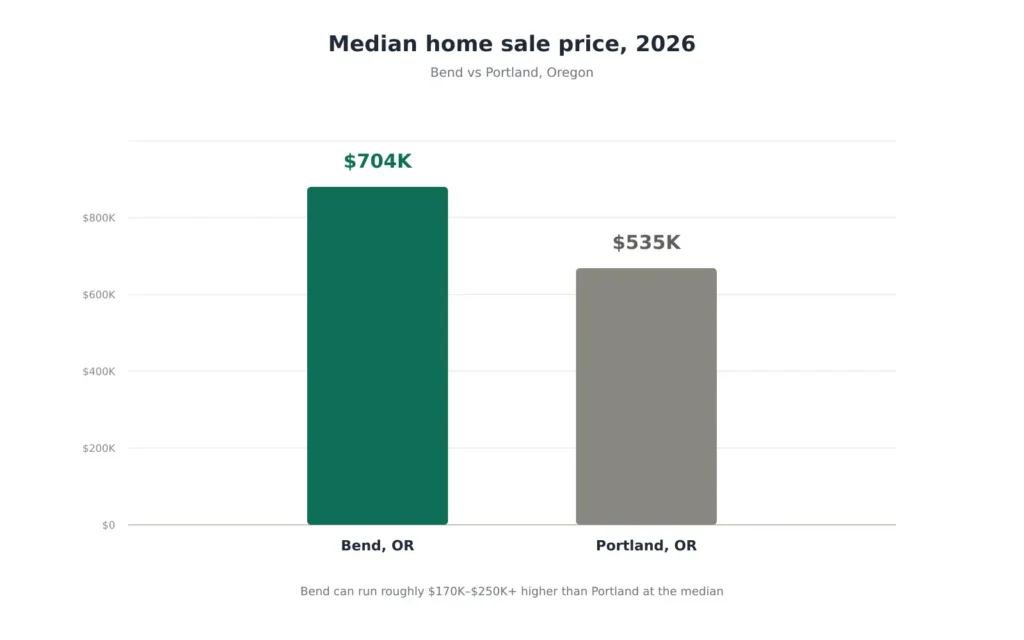
Using current 2026 market snapshots, Portland’s median sale price is commonly around the low-to-mid $500Ks, while Bend’s median sale price is commonly in the low-to-mid $700Ks depending on the data source and property type.
That means Bend can run roughly $170,000 to $250,000+ higher than Portland on a median-price basis.
That is the price reversal.
Portland is still a major metro with expensive close-in neighborhoods, but Bend’s smaller housing market has been pushed up by lifestyle demand, remote work, limited supply, and the premium people place on Central Oregon recreation.
So when buyers ask, “Is Bend more expensive than Portland?” the direct answer is:
Yes, for buying a home, Bend is often more expensive than Portland in 2026.
But that does not automatically mean Portland is the better buy. It depends on whether you are buying for lifestyle, career, affordability, resale strength, outdoor access, or long-term location fit.
Median Home Price Comparison
The Bend vs Portland housing market comparison starts with the median price, but buyers should understand how each market is built.
Bend is smaller, more lifestyle-driven, and more constrained. Portland is larger, more varied, and spread across many different neighborhoods and property types.
Bend Pricing Breakdown
Bend’s 2026 pricing depends heavily on which data set you use.
Broad all-home trackers place Bend around the low $700Ks, while local single-family home snapshots can run closer to the mid-to-high $700Ks. That spread is normal because condos, townhomes, single-family homes, acreage exclusions, and neighborhood mix all change the number.
The key point is that Bend is expensive across most buyer conversations.
Westside Bend usually carries the biggest premium. Neighborhoods like NorthWest Crossing, Old Bend, River West, Discovery West, Awbrey Butte, Broken Top, and Tetherow can sit well above the citywide median.
Eastside and Southeast Bend may offer better value, but they are still not “cheap” compared with Portland’s broader market.
Portland Pricing Breakdown
Portland’s median sale price is lower than Bend’s in 2026, but the city has much more range.
A close-in Portland neighborhood, an outer eastside home, a condo, a townhome, and a westside luxury property can all produce very different pricing. Portland has more older homes, more condos, more attached housing, more suburban options, and a much deeper inventory base across the metro.
That variety is one reason Portland’s median price can sit lower even though some Portland neighborhoods remain expensive.
For buyers who care mainly about price and housing options, Portland often gives more variety than Bend.
Bend vs. Seattle Housing Market Snapshot
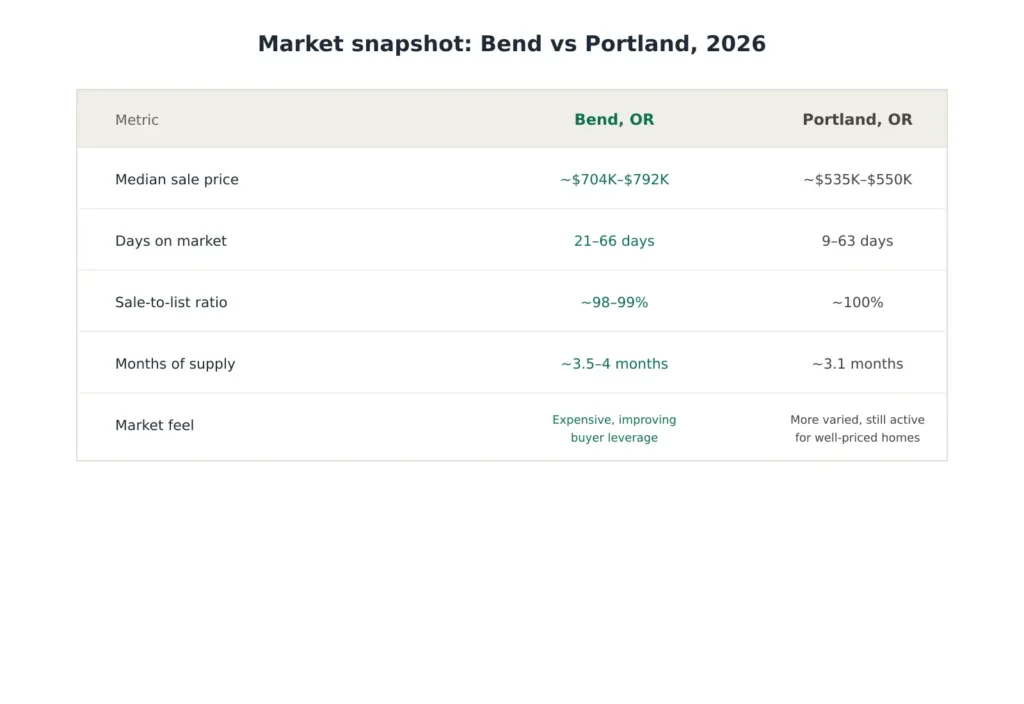
Market Snapshot: Bend vs Portland, 2026
| Metric | Bend, Oregon | Portland, Oregon |
| Median sale price | ~$704K Redfin / ~$725K+ local snapshot / ~$792K single-family snapshot | ~$535K Redfin / ~$535K Zillow / ~$550K local spring snapshot |
| Price position | Higher median than Portland | Lower median than Bend |
| Days on market | ~21 days Redfin / 64–66 days local Bend snapshot | ~14 days Redfin / 9 days to pending Zillow / ~63 days local market time |
| Sale-to-list ratio | ~98–99% in local Bend reporting | Around 100% in Zillow data |
| Months of supply | ~3.5–4 months in local Bend reporting | Around 3.1 months in local spring reporting |
| Market feel | Expensive, improving leverage for buyers | More varied, still active for well-priced homes |
The table shows the real difference.
Bend is higher priced, but some Bend data shows more buyer room than the peak frenzy years. Portland is lower at the median, but certain homes still move quickly when priced correctly.
Why the Gap Flipped
Bend did not become more expensive than Portland by accident.
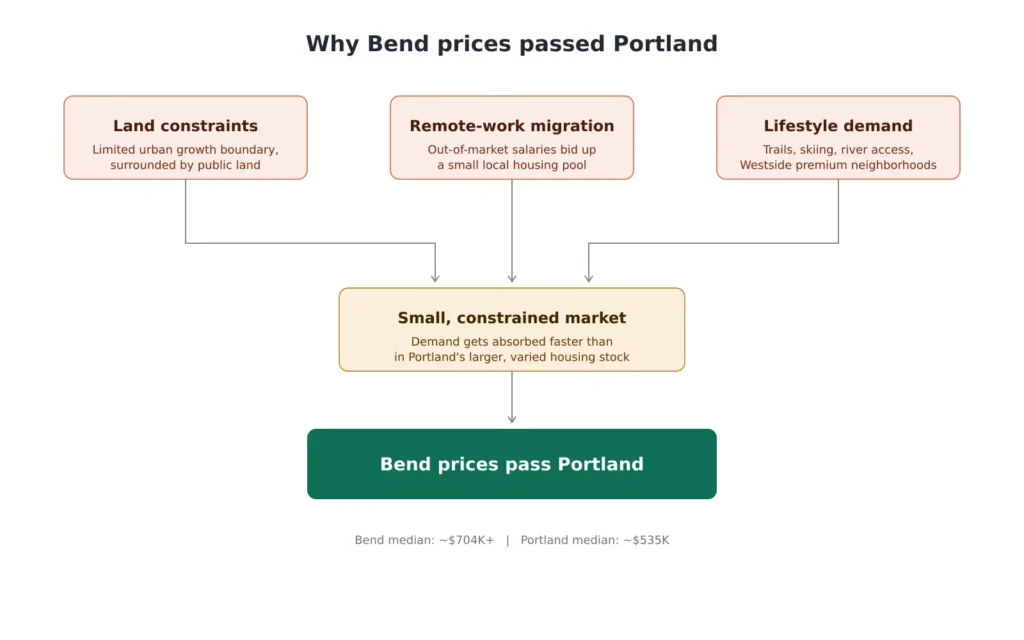
The price gap flipped because Bend is a smaller market with strong lifestyle demand and limited ability to expand quickly.
Bend’s Land Constraints
Bend is physically and policy-constrained in ways that affect housing supply.
The city is surrounded by public lands, natural features, forest access, and a defined urban growth boundary. Oregon’s land-use system controls how cities expand, and Bend has had to manage growth carefully through UGB planning and limited expansion opportunities.
That does not mean no new homes are being built. Bend continues to grow. But supply cannot simply expand at the speed demand arrives, especially in the most desirable areas.
When a small city with limited land becomes a national lifestyle destination, prices respond.
Portland’s Larger, More Varied Housing Stock
Portland has more housing variety.
It has condos, townhomes, older bungalows, mid-century homes, infill, apartments, duplexes, outer-neighborhood homes, close-in luxury areas, and a large metro supply across multiple suburbs.
That larger and more varied housing stock gives Portland more ways to absorb buyer demand.
Portland may have its own affordability challenges, but it is not as constrained by a small-city lifestyle market in the same way Bend is.
Remote-Work Migration’s Outsized Impact on a Small Market
Remote work changed Bend faster than it changed Portland.
Bend attracted buyers who could bring salaries from Portland, Seattle, California, the Bay Area, and other higher-income markets. Those buyers did not always depend on local Bend wages, which allowed them to compete more aggressively for homes.
In a large metro, remote-worker demand is diluted across a bigger housing stock. In Bend, the same demand can move prices quickly because the market is smaller.
That is why Bend’s price growth felt so intense in recent years.
Inventory & Competition
Price tells you what a home costs. Inventory tells you how hard the buying process may feel.
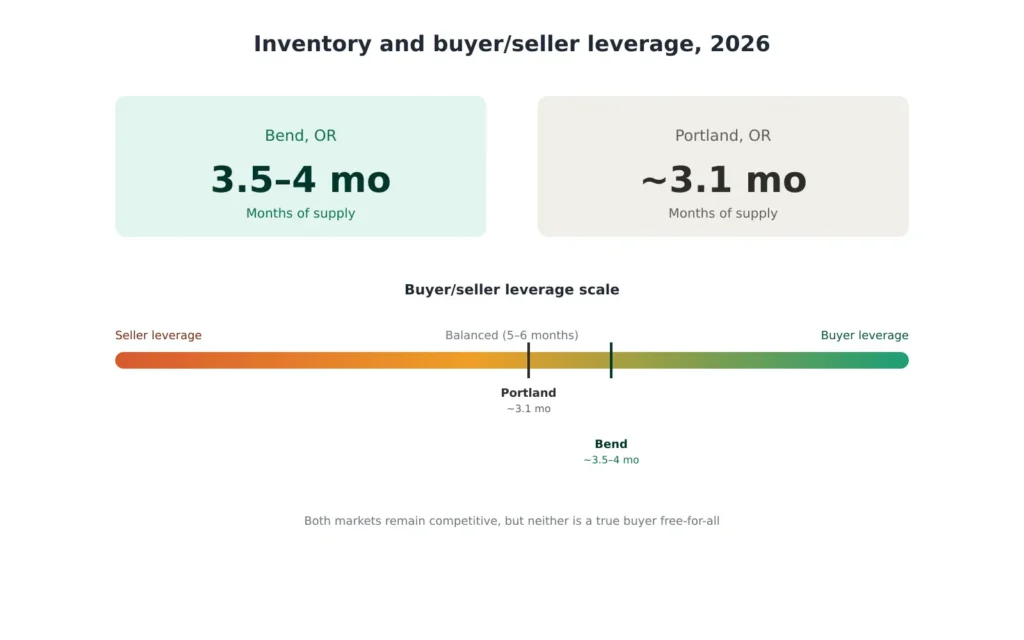
Both Bend and Portland are more balanced than the peak pandemic market, but neither is a true buyer free-for-all.
Months-of-Supply Comparison
Bend’s local 2026 reporting has shown roughly 3.5 to 4 months of supply, approaching a more balanced market but still not oversupplied.
Portland’s local spring reporting showed around 3.1 months of inventory, which is also relatively tight, though Portland’s larger market means buyers may find more practical options across different neighborhoods and property types.
A simple rule of thumb: under four months of supply usually still gives sellers some leverage, while five to six months is closer to balanced.
By that measure, both Bend and Portland remain competitive, but not frantic in the same way they were during the hottest years.
Which Market Currently Favors Buyers vs. Sellers
Bend is more negotiable than it was during the boom.
Buyers may have more time, more inspection leverage, more price-discussion room, and more opportunity to compare neighborhoods. But well-priced homes in desirable Bend locations still get attention.
Portland is also mixed.
The city has more inventory variety, but well-priced homes can still move quickly. Portland buyers may find more options under Bend’s median, but they may also face fast competition for updated homes in desirable neighborhoods.
The practical takeaway:
Bend favors prepared buyers who know their neighborhood priorities. Portland favors buyers who can move quickly when the right property appears but want more price variety.
Cost Beyond the Purchase Price
The purchase price matters most, but it is not the only cost.
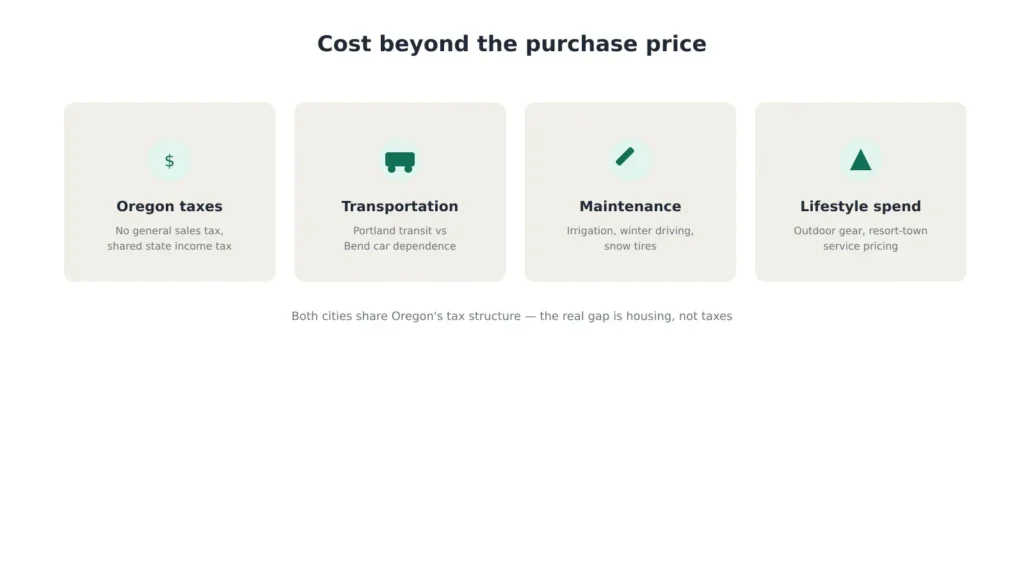
A buyer comparing Bend and Portland should also consider taxes, transportation, maintenance, lifestyle spending, and everyday services.
Shared Oregon Tax Structure
Taxes are not a major differentiator between Bend and Portland because both cities are in Oregon.
Both benefit from Oregon’s lack of a general sales tax. Both are subject to Oregon income tax. That means a Portland-to-Bend move does not create the same tax shift as a Seattle-to-Bend or California-to-Bend move.
For most Oregon-to-Oregon comparisons, the real financial difference is housing, not taxes.
Link to Full Cost of Living Comparison
Housing is only one part of the Bend vs Portland cost discussion.
Bend may cost more to buy, but Portland may come with different costs around commuting, parking, urban services, insurance, dining, and daily lifestyle. Bend may add costs around outdoor gear, snow tires, winter driving, irrigation, and resort-town service pricing.
For the full household-budget view, use the dedicated cost comparison:
Which Market Should You Buy In?
There is no single right answer.
Bend and Portland solve different problems for buyers.
Choose Bend If: Lifestyle-First Buyers
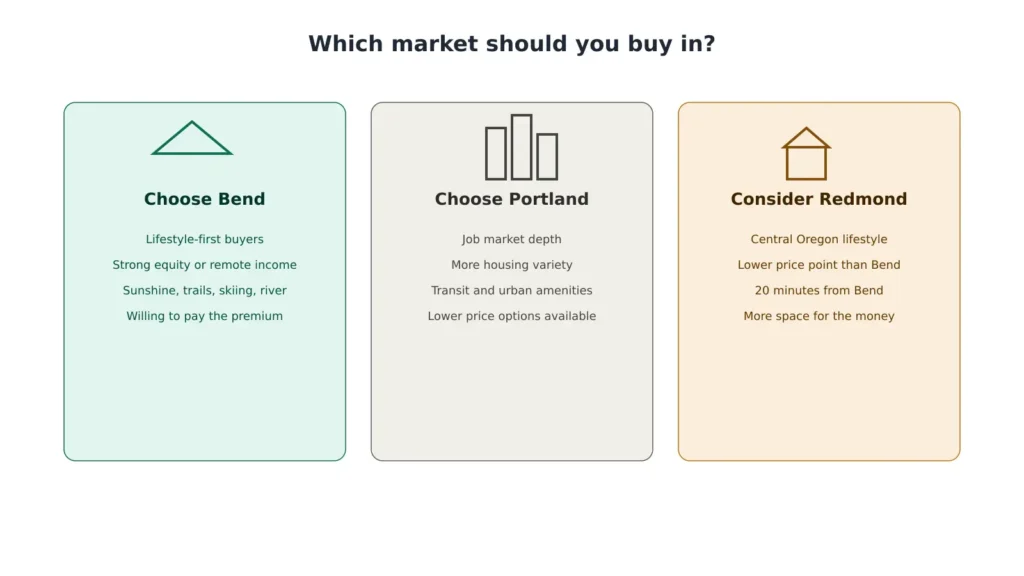
Choose Bend if your priority is lifestyle.
Bend is the better fit if you want sunshine, trails, skiing, mountain biking, the Deschutes River, a smaller city feel, breweries, outdoor access, and a pace of life that feels more connected to recreation than commuting.
Bend also makes sense if you have strong equity, remote income, or a budget that lets you buy the neighborhood you actually want.
The caution is price. Do not move to Bend expecting Portland affordability. Move to Bend because the lifestyle is worth the premium.
Choose Portland If: Job Market and Housing Variety Priority
Choose Portland if job market depth, housing variety, public transit, cultural amenities, restaurants, arts, and urban access matter more.
Portland offers more employers, more neighborhoods, more property types, more rentals, and more ways to find a home below Bend’s typical price point.
For buyers whose career depends on local opportunities, Portland may be the safer long-term market.
Consider Redmond If: Budget-Conscious, Central Oregon Lifestyle
Consider Redmond if you want Central Oregon but Bend pricing is too tight.
Redmond is about 20 minutes north of Bend and often offers more home for the money. Buyers may get a newer home, more space, a larger lot, or a lower monthly payment while still staying close to Central Oregon recreation and the Redmond airport.
For Portland buyers who want Central Oregon lifestyle but do not need a Bend address, Redmond deserves serious consideration.
Frequently Asked Questions
Yes. In 2026, Bend is generally more expensive than Portland to buy a home. Bend’s median price is commonly in the low-to-mid $700Ks or higher depending on data source and property type, while Portland’s median sale price is commonly around the low-to-mid $500Ks.
Bend prices passed Portland because Bend is a smaller, lifestyle-driven market with limited supply, land constraints, strong Westside demand, remote-work migration, and high demand from relocating buyers. Portland has a larger and more varied housing stock, which gives buyers more price options across the metro.
Portland is usually cheaper for buying a home at the median price level. Bend is typically more expensive, especially in Westside and lifestyle neighborhoods. However, the better choice depends on lifestyle goals, job needs, housing type, and whether nearby areas like Redmond are part of the search.
Buy in Bend if you are lifestyle-first, want Central Oregon recreation, and can afford the premium without becoming house-poor. Buy in Portland if you need a deeper job market, more housing variety, stronger transit, and broader urban amenities. Consider Redmond if you want Central Oregon but need more value.
Bend has cooled compared with the most aggressive pandemic-era market. Inventory is higher, days on market are longer in some local reporting, and buyers have more negotiating room. But Bend remains expensive, and desirable neighborhoods still hold strong demand.
For many buyers, Portland offers better price variety and a lower median home price than Bend. But value depends on what you want. Portland may be a better financial value, while Bend may be a better lifestyle value for buyers who prioritize outdoor access and a smaller Central Oregon pace.
Ready to Take the Next Step?
Compare Bend and Portland homes side by side. Search current Bend listings by price, neighborhood, and lifestyle fit.
Request a Portland-to-Bend buyer strategy review before you start touring homes.