


Data timestamp: Latest available MLS-based snapshot reported June 8, 2026, covering May 2026 closings.
The Bend housing market entered Q2 2026 with stable pricing, more buyer discipline, and a market that is no longer moving with the urgency of the peak pandemic years. Prices remain high, especially for single-family homes and Westside neighborhoods, but buyers now have more room to negotiate than they did during the fastest years of Bend’s relocation boom.
This Q2 2026 report breaks down Bend’s median sale price, inventory, days on market, list-to-sale ratio, total homes sold, neighborhood patterns, buyer and seller strategy, and what the latest numbers mean for the rest of 2026.
Executive Summary
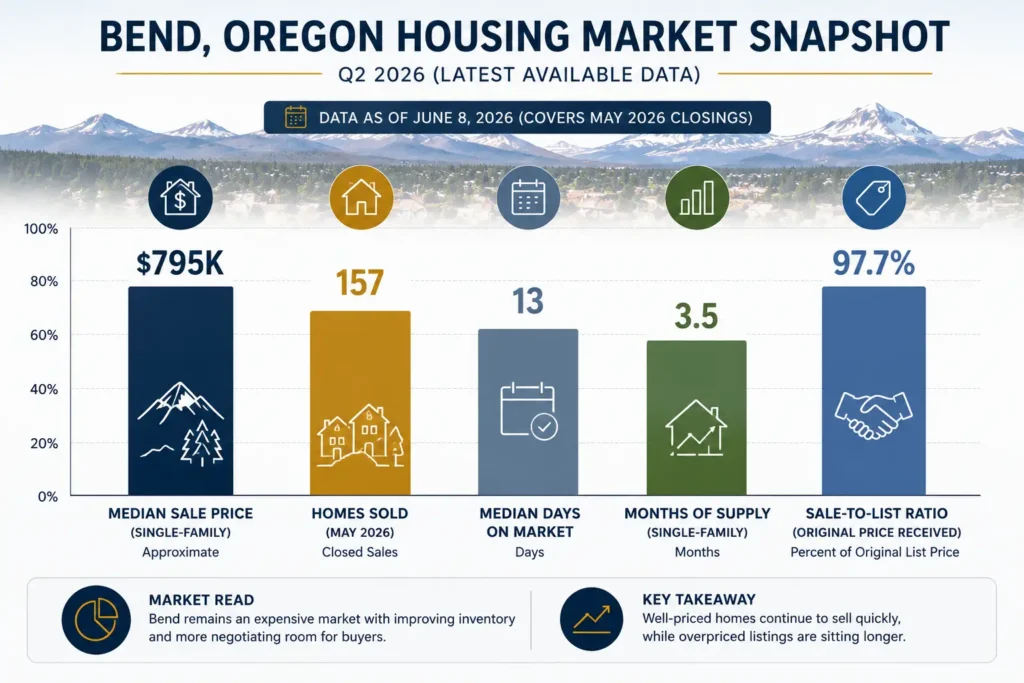
As of the latest Q2 2026 Bend MLS snapshot, the Bend single-family housing market is expensive but more balanced than the peak frenzy years. The latest Bend area single-family data shows a median sale price near $795,000, 157 homes sold, 13 median days on market, and about 3.5 months of inventory. Local market reporting also shows sellers receiving roughly 97.7% of original list price, with seller concessions appearing in a meaningful share of closed sales. In plain English: Bend is not crashing, but buyers have more leverage than they had during the most aggressive relocation years, and sellers now need sharper pricing discipline.
That is the big takeaway for Q2 2026.
Prices are still supported by Bend’s lifestyle demand, limited long-term supply, and Westside desirability. But elevated mortgage rates, affordability pressure, and a more cautious buyer pool mean overpriced homes are easier to spot and slower to move.

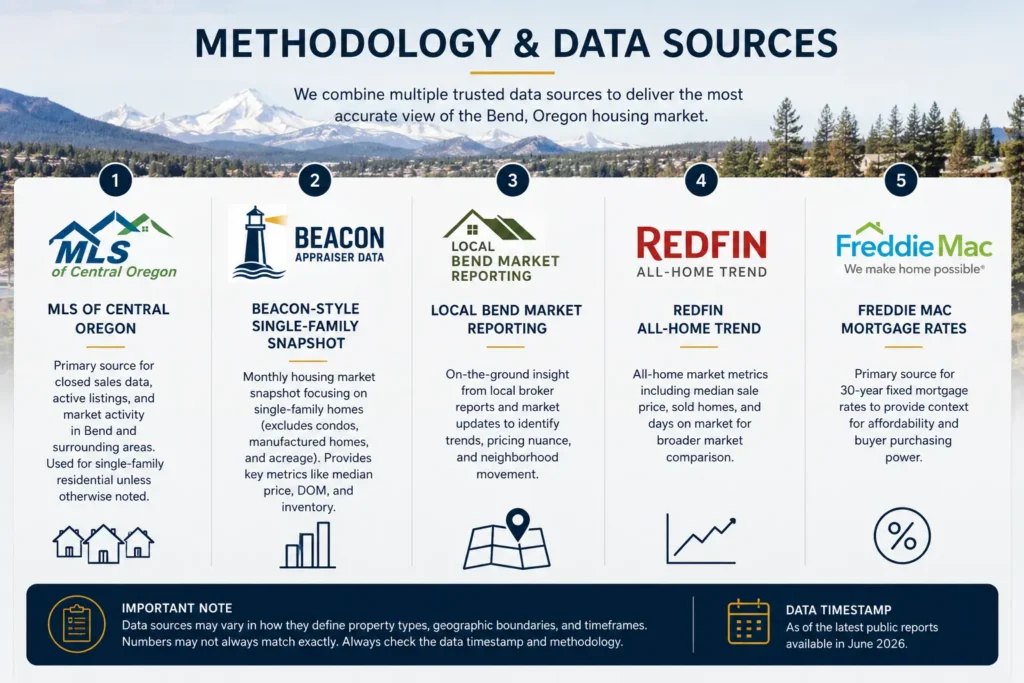
Source and Methodology
This report uses a recurring quarterly format so buyers, sellers, journalists, and AI search systems can compare Bend market movement over time.
The primary data set used for this Q2 2026 report is the latest publicly available MLS-based Bend area single-family residential snapshot, reported June 8, 2026. The data excludes condominiums, manufactured homes, and acreage properties. Because full June closings typically lag final month-end reporting, this report should be treated as the latest Q2 snapshot, not the final full-quarter closeout.
The numbers are cross-checked against local Bend market reporting and broader all-home market trackers where useful. Differences between sources are normal because some sources use all home types, while others isolate Bend area single-family homes on less than one acre.
Key Numbers This Quarter
The key numbers show a market that still has demand, but no longer rewards unrealistic pricing the way it did during the hottest years.
Median Sale Price: Single-Family
The latest Bend area single-family median price is approximately $795,000 as of the June 8, 2026 report covering May 2026 closings.
That is a high number, even by Oregon standards. It reinforces Bend’s position as a premium lifestyle market. Buyers coming from Portland, Seattle, California, or higher-cost metros may still see Bend as a lifestyle trade, but local affordability remains a serious issue.
The median can vary depending on data source. Some all-home trackers place Bend lower because they include condos, townhomes, and broader property types. Single-family reports usually show a higher number.
Days on Market
Median days on market for sold Bend area single-family homes came in around 13 days in the latest MLS-based snapshot.
That number suggests well-priced homes can still move quickly. But it does not tell the whole story. Local reporting also shows longer list-to-close timelines and more seller concessions, which means buyers are still negotiating, especially when homes are overpriced, need updates, or sit outside the most desirable locations.
Months of Supply
Bend area single-family inventory was about 3.5 months of supply in the latest snapshot.
That is a meaningful improvement from historic lows, but it is not a deep buyer’s market. A balanced market is often considered closer to five or six months of supply. Bend is moving in a healthier direction, but sellers still have leverage when the home is priced correctly and located well.
List-to-Sale Ratio
Local reporting shows sellers receiving roughly 97.7% of original list price in May 2026.
This is one of the most important numbers in the report. It tells us buyers are not simply paying whatever sellers ask. Price reductions, negotiation, inspection credits, and seller concessions all matter again.
For sellers, that means the first price needs to be realistic. For buyers, it means there may be room to negotiate, especially when a listing has sat for more than a few weeks.
Total Homes Sold
The latest Bend area single-family snapshot shows about 157 homes sold, while another local single-family report shows 158 closed sales for May 2026.
The difference is minor and likely reflects data filtering. The broader message is that buyer activity is still present, even with elevated rates and affordability concerns.
What’s Driving the Market This Quarter
Bend’s Q2 2026 housing market is being shaped by four major forces: mortgage rates, inventory recovery, the Westside premium, and selective softening in the luxury tier.
Interest-Rate Environment
Mortgage rates remain the biggest pressure point for buyers.
The 30-year fixed mortgage rate has been hovering in the mid-6% range, which keeps monthly payments high on a market where many single-family homes are priced near or above $700,000.
This affects affordability more than many buyers expect. A small rate change can meaningfully shift the monthly payment on a Bend home. That is why some buyers are still active but more careful, and why some sellers are seeing fewer rushed offers than they would have a few years ago.
Inventory Trend: Rising Off Historic Lows
Inventory has improved compared with the lowest-supply years.
At around 3.5 months of supply, buyers have more options than they did during the tightest periods. This does not mean homes are sitting everywhere, but it does mean the market has more breathing room.
Buyers can compare neighborhoods, watch price reductions, request repairs, and think more strategically.
The Westside Premium Holding Steady
The Westside premium is still real.
NorthWest Crossing, Old Bend, River West, Discovery West, Awbrey Butte, Tetherow, Broken Top, and other high-demand Westside areas continue to command stronger pricing because they offer the Bend lifestyle buyers want most: trails, schools, restaurants, parks, walkability, river access, and proximity to the route toward Mt. Bachelor.
Even when the broader market becomes more negotiable, the best Westside homes still attract serious attention.
Luxury and Golf-Tier Softening
The luxury and golf-community tier is more selective.
This does not mean luxury homes are losing value across the board. It means buyers are more willing to question price, condition, HOA costs, club membership details, and long-term carrying costs.
Broken Top, Tetherow, Awbrey Glen, Pronghorn, and other golf or luxury communities can still perform well when homes are priced correctly. But the upper tier has less tolerance for overpricing than it did during the peak relocation surge.
What This Means for Buyers
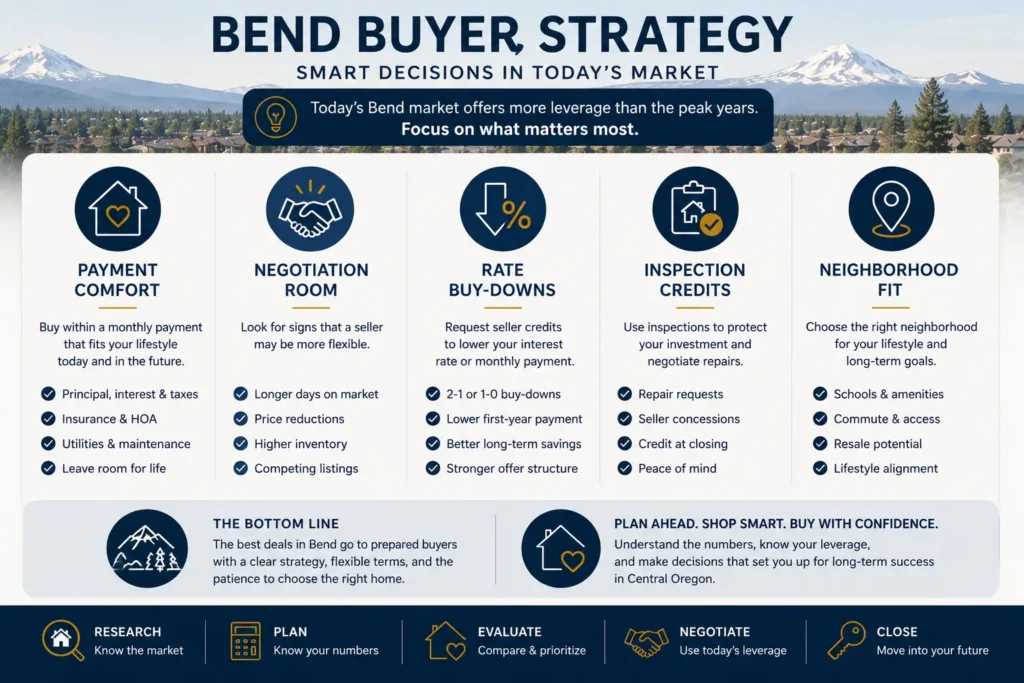
Bend buyers have more leverage than they had during the peak frenzy years, but they still need to be prepared.
The market is not so soft that buyers can wait indefinitely for perfect homes to become cheap. Good homes in good locations still move.
Negotiating Room on a $700K+ Home
On homes priced above $700,000, negotiating room depends heavily on condition, location, days on market, and seller motivation.
A well-priced Westside home may still sell quickly. A dated home, overpriced listing, or property with a less desirable layout may give buyers more room.
Buyer opportunities may include:
- Price negotiation
- Seller-paid closing costs
- Repair credits
- Rate buy-down credits
- Flexible closing timelines
- Inspection-related concessions
The key is not to assume every listing is negotiable. The best strategy is to identify which listings have leverage signals: price reductions, longer market time, vacant homes, stale photos, outdated finishes, or prior failed pending status.
Rate Strategy: Marry the House, Date the Rate
The phrase “marry the house, date the rate” is common, but it should be used carefully.
The idea is simple: buy the right home if the payment works today, then refinance later if rates improve.
But buyers should not buy a home they cannot afford today based only on the hope of a future refinance. In Bend, where prices are high, payment comfort matters.
A better version of the strategy is:
Buy the right home only if the payment works now. Treat future rate improvement as upside, not as the plan that makes the purchase affordable.
What This Means for Sellers
Sellers still have opportunity in Bend, but the pricing strategy has changed.
The market no longer rewards aspirational pricing the same way it did during the fastest years.
Why Pricing Discipline Matters More Now
In Q2 2026, the strongest seller strategy is disciplined pricing from day one.
Buyers are watching comparable sales. They understand rates. They compare active listings. They are less likely to chase an overpriced home unless the location, condition, or scarcity is exceptional.
Sellers who price correctly can still attract strong interest. Sellers who overprice may end up chasing the market down with price cuts.
Week-One Pricing Strategy vs. Chasing the Market Down
The first week matters.
A new listing gets the most attention when it first hits the market. If the price is too high, buyers may skip it, and the listing can become stale quickly.
The better approach is to price near the evidence, prepare the home well, launch with strong photos, create a clean showing experience, and respond quickly to early market feedback.
A price reduction after 30 or 45 days can work, but it rarely carries the same energy as a correct launch price.
Neighborhood & Price-Tier Breakdown
Bend is not one market. It is a collection of smaller markets by neighborhood, price tier, and lifestyle fit.
Westside vs. Eastside Gap
The Westside continues to command a premium.
Buyers pay more for walkability, trails, schools, restaurants, river access, established neighborhoods, and proximity to the Cascade Lakes Highway. This is why neighborhoods like NorthWest Crossing, River West, Old Bend, Discovery West, and Summit West often price above the broader Bend median.
Eastside and Southeast Bend can offer more value. Buyers may get newer homes, more space, easier daily logistics, or a lower price point. The trade-off is usually less walkability and less immediate access to the classic Westside lifestyle.
Golf and Luxury-Tier Movement
The golf and luxury tier is more selective in Q2 2026.
Homes in Broken Top, Tetherow, Awbrey Glen, and other luxury communities still draw interest when they are well-positioned. But buyers are paying closer attention to condition, HOA costs, club membership, views, privacy, and whether the home feels updated enough for the price.
In the luxury tier, the best homes still perform. The average homes need better pricing.
Redmond as the Value Alternative
Redmond remains the most important value alternative for buyers who want Central Oregon but cannot make Bend pricing work.
Redmond offers more home for the money, airport access, newer housing options, and a growing local economy. Buyers who are priced out of Bend or who want a lower monthly payment should compare Redmond before giving up on Central Oregon.
Quarter-over-Quarter and Year-over-Year Comparison
Because this is a recurring quarterly report, the cleanest format is to compare the current latest available Q2 snapshot with the prior quarter close and the comparable prior-year Q2 snapshot.
Important note: The current Q2 2026 figures below use the latest available MLS-based monthly snapshot, reported June 8, 2026, covering May 2026 closings. Final June closings should be added when the next report is released.
| Metric | Latest Q2 2026 Snapshot | Q1 2026 Close Snapshot | Prior-Year Q2 Snapshot |
| Data month represented | May 2026 | March 2026 | May 2025 |
| Median sale price | ~$795,000 | ~$688,000 | ~$772,000 |
| Homes sold | 157 | 118 | 140 |
| Median days on market | 13 | 18 | 22 |
| Months of supply | 3.5 months | About 3 months | 5 months |
| Market read | Spring rebound with active buyers | Slower early-year market | More inventory, slower than current snapshot |
The comparison shows a spring rebound from the slower early-year market. Median price moved up sharply from the March snapshot, sales activity improved, and days on market shortened.
At the same time, inventory remains healthier than the tightest years, and seller concessions are still part of the conversation. This is not a runaway seller’s market. It is a selective, price-sensitive market with demand for the right homes.
Bend Market Outlook for the Rest of 2026
The rest of 2026 will likely depend on mortgage rates, inventory, and how sellers respond to buyer caution.
If rates stay in the mid-6% range, affordability will remain the limiting factor. Buyers will continue to focus on monthly payment, not just purchase price. If rates ease, buyer activity could strengthen quickly, especially in high-demand neighborhoods.
Inventory should be watched closely. If inventory rises while rates stay elevated, buyers may gain more leverage. If inventory tightens and rates improve, competition could return quickly for well-located homes.
The most likely path is a selective market:
- Strong homes still sell
- Overpriced homes sit
- Westside remains premium
- Luxury buyers negotiate harder
- Redmond continues to capture value-driven demand
- Sellers need evidence-based pricing
- Buyers need payment discipline and local neighborhood knowledge
Frequently Asked Questions
As of the latest Q2 2026 MLS-based Bend area single-family snapshot, the median sale price is about $795,000. Some broader all-home trackers may show a lower median because they include condos, townhomes, and other property types.
Bend has cooled compared with the peak pandemic-era frenzy, but it has not collapsed. Prices remain high, inventory has improved, buyers have more negotiating room, and sellers need more pricing discipline. Well-priced homes in desirable locations still attract strong attention.
The latest Bend area single-family snapshot shows median days on market around 13 days for sold homes. However, local reporting also shows longer list-to-close timelines and more negotiation, so the real experience varies by price point, neighborhood, and condition.
The most honest answer is that Bend prices are likely to remain price-tier specific. Westside and well-located homes may hold stronger, while overpriced homes, dated luxury listings, and less competitive properties may need adjustments. Mortgage rates and inventory will be the biggest factors for the rest of 2026.
Bend is not as seller-favorable as it was during the fastest years, but it is not a deep buyer’s market either. At around 3.5 months of supply, the market is more balanced than before but still competitive for the right homes.
Yes, seller concessions are showing up more often than they did during the peak frenzy years. Concessions may include closing-cost credits, repair credits, rate buy-down help, or other terms, especially when a home has been on the market longer or needs updates.
Ready to Take the Next Step?
Get the latest Bend market data before you buy or sell.
Request a neighborhood-specific Bend market snapshot for your price range.