


The Bend, Oregon housing market remains expensive in 2026, but it is more balanced than the peak frenzy years. Current market data shows Bend home prices still sitting well above many Oregon markets, while inventory, days on market, and seller concessions give buyers more room to negotiate than they had during the fastest relocation boom years.
This page is the main hub for Bend housing market reports, Central Oregon real estate trends, quarterly data studies, buyer guidance, seller strategy, and side-by-side market comparisons.
Introduction: The Honest Source on the Bend Housing Market
The Bend housing market is easy to oversimplify.
Some headlines say prices are down. Others say Bend is still expensive. Some data sources show homes moving quickly. Others show longer days on market and more negotiation. All of those can be true at the same time depending on the data source, property type, price tier, and neighborhood.
That is why this hub exists.
The goal is to explain the Bend Oregon housing market in plain English, using current data and local interpretation, so buyers and sellers can understand what the numbers actually mean.
What This Hub Covers and How Often It Updates
This market reports hub covers:
- Bend median home prices
- Single-family market trends
- Inventory and months of supply
- Days on market
- List-to-sale ratios
- Seller concessions
- Buyer and seller leverage
- Westside vs. Eastside pricing
- Luxury and golf-community trends
- Redmond and nearby Central Oregon comparisons
- Bend vs. Portland and Bend vs. Seattle housing comparisons
- Quarterly and monthly market reports
This hub should be updated monthly, with deeper quarterly reports added as separate market-report pages. The structure should stay consistent over time so readers, search engines, and AI answer engines can recognize it as the main recurring market resource.

Who This Is For
This hub is for four main groups.
First, buyers who want to know whether now is a good time to buy in Bend.
Second, sellers who need realistic pricing guidance before listing.
Third, relocation buyers comparing Bend with Portland, Seattle, California, or other high-cost markets.
Fourth, journalists, past clients, and market watchers who want a clear, local explanation of Bend home prices and Central Oregon real estate trends.
The Bend Housing Market Right Now: Live Snapshot
The current Bend market is best described as expensive, selective, and more balanced than the peak pandemic-era market.
Prices are still high, especially for single-family homes and Westside neighborhoods. But buyers are no longer accepting every seller’s number without question. Inventory has improved from historic lows, and sellers now need to price with evidence, not optimism.
Answer-First Data Box: Median Price, DOM, Months of Supply, List-to-Sale Ratio
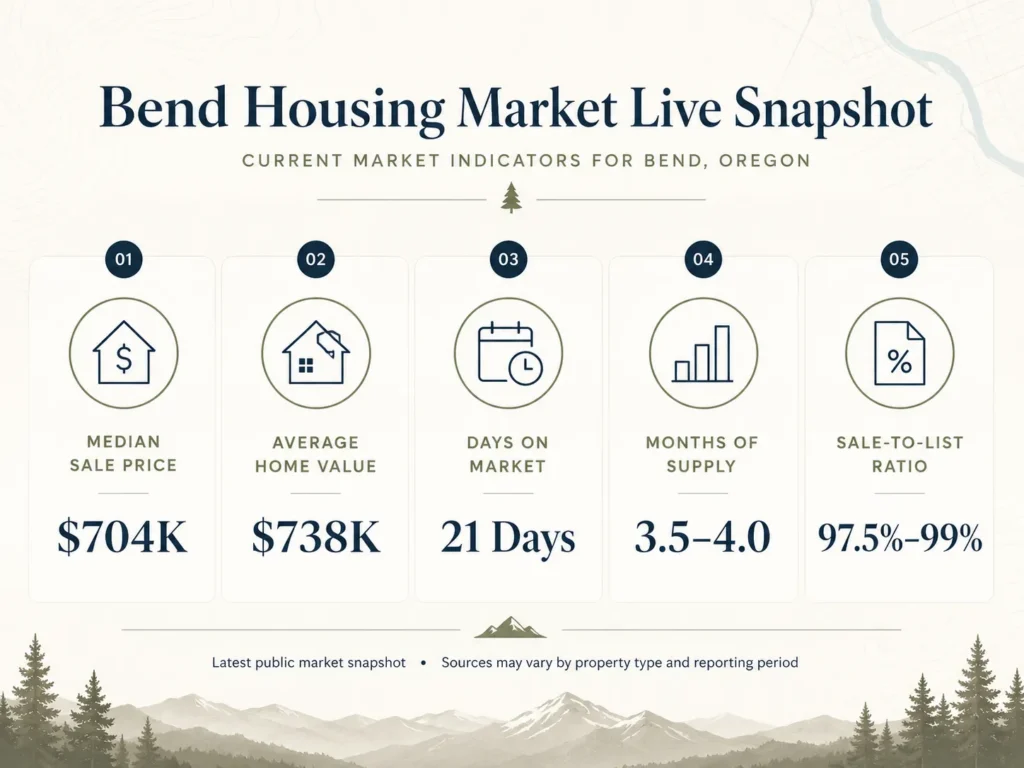
Live Bend Housing Market Snapshot
| Metric | Current Snapshot |
|---|---|
| Data timestamp | Latest public May/June 2026 market snapshots |
| Bend median sale price, all-home tracker | Around $704K |
| Bend average home value | Around $738K |
| Bend single-family median sale price | Around $792K to $795K |
| Days on market | Around 13 to 21 days in faster trackers, longer in broader market-time reporting |
| Months of supply | Around 3.5 to 4 months in local single-family reporting |
| List-to-sale ratio | Around 97.5% to 99% in local reporting |
| Market read | Not a crash, not a frenzy, more selective and price-sensitive |
Use this snapshot as a market temperature check, not a final valuation for a specific home.
A Westside Bend home, an Eastside Bend home, a Tetherow luxury home, a Redmond new construction home, and a River West cottage can all behave differently. The numbers are helpful, but the property-level context matters more when you are actually buying or selling.
What Actually Moves the Bend Housing Market
Bend does not move like a typical mid-sized city.
It is a lifestyle market, a remote-work destination, a retirement destination, a second-home market, and a local family market all at once. That mix creates unusual pressure on housing supply and pricing.
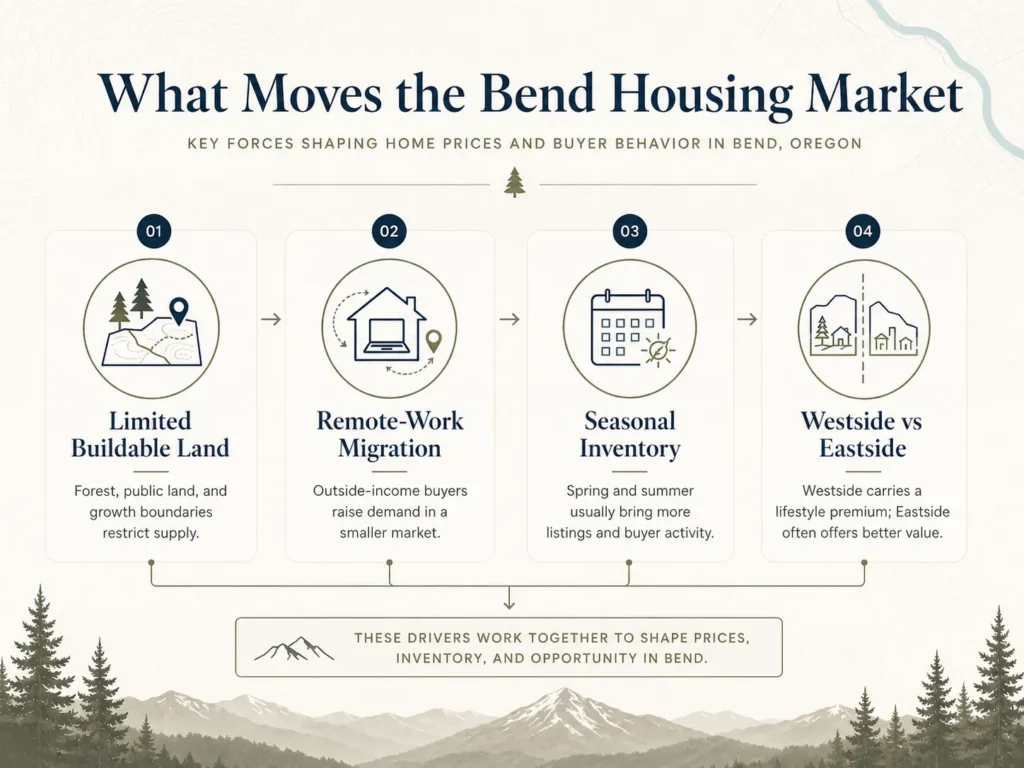
Limited Buildable Land: Forest and BLM Boundaries
Bend is constrained by geography, public land, and Oregon’s land-use planning system.
The city cannot simply sprawl in every direction without planning approvals, infrastructure, and urban growth boundary changes. Bend’s 2016 UGB expansion added thousands of acres, but new supply takes time. Roads, sewer, water, permitting, affordability requirements, and actual construction all slow the process.
This matters because demand can arrive faster than supply.
A buyer can decide to move to Bend this month. A new neighborhood can take years.
That timing mismatch supports pricing, especially in established neighborhoods where there is no easy way to create more land.
Remote-Work Migration and Outside-Income Buyers
Remote work changed Bend’s market.
Buyers from Seattle, Portland, California, the Bay Area, Los Angeles, San Diego, Austin, Denver, and other higher-income markets have been able to bring outside salaries into a smaller local housing market.
That does not mean every buyer is from out of town. Local buyers are very much part of the market. But outside-income buyers can affect pricing because their budget may not be tied to local wage levels.
This is one reason Bend can feel expensive compared with the local job market.
Seasonal Buying Patterns: Spring and Summer Inventory Build
Bend is seasonal.
Spring and early summer often bring more listings, more relocation activity, and more buyer movement. Families want to move before the school year. Sellers want better weather and stronger showing conditions. Second-home buyers often shop around recreation seasons.
Fall and winter can be quieter, though serious buyers remain active.
For buyers, spring can mean more options but more competition. Winter can mean less inventory but more motivated sellers.
The Westside and Eastside Price Divide Explained
Bend’s simplest pricing divide is Westside versus Eastside.
Westside Bend usually costs more because it offers stronger lifestyle access: trails, restaurants, parks, schools, the Deschutes River, downtown, the Old Mill District, and the route toward Mt. Bachelor.
Eastside and Southeast Bend often offer better value, newer homes, more practical layouts, and easier daily errands.
This does not mean one side is better. It means buyers are paying for different things.
Westside usually sells lifestyle. Eastside often sells value and practicality.
How to Read a Housing Market Report: Plain-English Glossary
Market reports can feel confusing because every source uses slightly different definitions.
This glossary explains the numbers that matter most.
What Is Median Sale Price?
Median sale price is the middle sale price in a group of homes.
If 101 homes sold, the median is the price of the 51st home when all sales are lined up from lowest to highest.
Median price is often more useful than average price because one very expensive sale can pull the average higher. In Bend, this matters because luxury homes, golf-community homes, and view properties can distort averages quickly.
For most buyers, median price gives a cleaner picture of the market center.
What Is Average Sale Price?
Average sale price is the total dollar volume divided by the number of homes sold.
It can be useful, but it is more sensitive to high-end sales. If several luxury homes close in Tetherow, Broken Top, or Awbrey Butte, the average price can jump even if the typical buyer experience has not changed much.
Use average price carefully in Bend because the luxury tier can distort the number.
What Is Days on Market?
Days on market, often called DOM, measures how long a listing is active before going under contract or selling, depending on the data source.
A low DOM number usually means buyer demand is strong or inventory is limited. A rising DOM number may mean buyers are becoming more selective, sellers are overpricing, or affordability is creating friction.
In Bend, DOM should always be read by price tier. A well-priced Westside home may move quickly while an overpriced luxury home sits.
What Is Months of Supply?
Months of supply estimates how long it would take to sell the current inventory if no new homes were listed.
A lower number means tighter inventory. A higher number means buyers have more options.
As a broad rule:
- Under 3 months is seller-favorable
- 3 to 5 months is more balanced
- 5 to 6 months is closer to balanced
- Above 6 months can become buyer-favorable
Bend has moved off the extreme lows, but it is still not deeply oversupplied.
What Is List-to-Sale Ratio?
List-to-sale ratio compares the final sale price to the list price.
If a home lists at $800,000 and sells for $784,000, the sale-to-list ratio is 98%.
This number helps show negotiating power. A lower ratio may mean buyers are negotiating more. A ratio above 100% can indicate bidding pressure or underpricing strategy.
In Bend, list-to-sale ratio is especially useful when paired with days on market and price reductions.
All Market Reports & Data Studies: Index
This section should become the permanent index for every Bend market report and comparison study published under this hub.
As new monthly and quarterly reports are published, add them here in reverse chronological order.
Current Reports
Report | Type | What It Covers |
|---|---|---|
| Bend, Oregon Housing Market Report: Q2 2026 | Quarterly report | Median price, inventory, DOM, buyer and seller strategy |
| Bend vs. Portland Housing Market: 2026 Comparison | Data study | Price reversal, inventory, affordability, buyer fit |
| Bend vs. Seattle Housing Market: 2026 Comparison | Data study | Price gap, competition, Seattle equity transfer |
| Central Oregon Cost of Living Guide | Pillar | Bend, Redmond, Sisters, Sunriver, Tumalo, La Pine |
| Bend vs. Portland Cost of Living | Comparison | Housing, rent, taxes, daily costs |
| Moving from Portland to Bend | Relocation cluster | Lifestyle, housing, cost, transition guidance |
| Moving from Seattle to Bend | Relocation cluster | Housing, taxes, climate, lifestyle comparison |
Future Report Template
Each new report should include:
- Data timestamp
- Median sale price
- Days on market
- Months of supply
- List-to-sale ratio
- Homes sold
- Buyer implications
- Seller implications
- Neighborhood and price-tier breakdown
- Methodology note
- FAQ
Keeping the same structure each quarter makes the data easier to compare and easier for AI systems to parse.
Buying in the Current Market
Buying in Bend in 2026 requires patience, preparation, and clear neighborhood priorities.
The market is more negotiable than it was during the peak frenzy years, but good homes are not sitting forever.
What Today’s Conditions Mean for Buyers
Today’s Bend buyers have more options than they had during the tightest market years.
That means you may be able to compare homes, negotiate repairs, ask for credits, request rate-buydown help, or wait for a better fit. But leverage depends heavily on the home.
A stale listing with price reductions gives you more room. A clean, well-priced Westside home may still attract strong interest.
Buyers should focus on:
- Monthly payment comfort
- Neighborhood fit
- Property condition
- Resale strength
- Inspection findings
- Seller motivation
- Days on market
- Price reduction history
Do not assume every Bend listing is overpriced. Do not assume every listing is a deal. The market is selective.
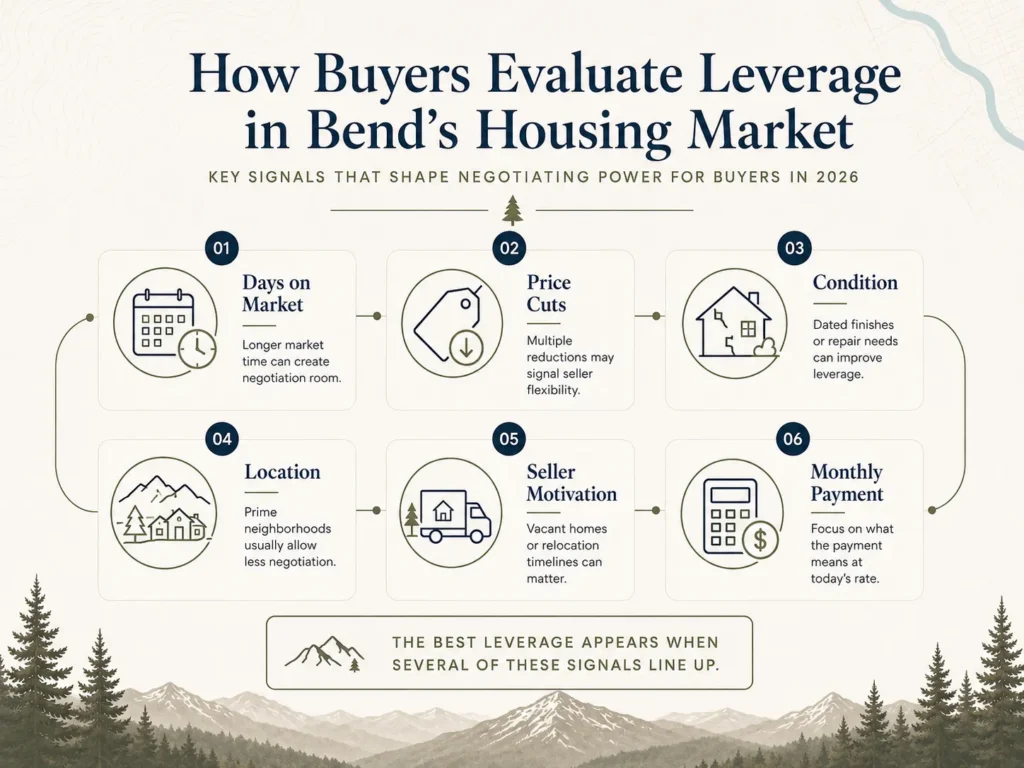
Negotiating Leverage Explained
Negotiating leverage usually appears when a listing has one or more pressure points.
Examples include:
- Longer days on market
- Multiple price reductions
- Vacant home
- Dated finishes
- Inspection concerns
- Overpriced original list price
- Less desirable location
- Seller relocation deadline
- Larger luxury property with smaller buyer pool
In the current market, buyers may have room to negotiate on price, repairs, closing costs, rate buydowns, or possession timing.
But the best homes still require a strong strategy. A weak offer on a strong listing may simply lose.
Selling in the Current Market
Selling in Bend still offers opportunity, but the strategy has changed.
The market is no longer forgiving of unrealistic pricing.
Pricing Strategy in a Rebalancing Market
The best sellers in 2026 are disciplined from day one.
They price close to evidence, prepare the home properly, launch with strong photography, and respond quickly to buyer feedback.
The weakest sellers anchor to peak-era expectations. They overprice, miss the first wave of buyer attention, reduce later, and sometimes end up selling for less than they could have with a stronger launch strategy.
In a rebalancing market, the first two weeks matter.
A correct price can create urgency. An inflated price can create silence.
Realistic Days-on-Market Expectations
Days on market expectations should be set by price tier and neighborhood.
A well-priced home in NorthWest Crossing, River West, Old Bend, or another high-demand area may move quickly. A luxury home, golf-community property, or larger custom home may need more time, especially if the buyer pool is smaller.
Sellers should not panic if a home does not sell in three days. But they should pay attention to showing activity, online engagement, feedback, and competing listings.
If the market is speaking, listen early.
Neighborhood and Price-Tier Insights
A Bend market report is incomplete without neighborhood context.
The citywide median does not tell the full story.
Westside Bend
Westside Bend usually carries the strongest lifestyle premium.
Buyers pay more for access to trails, downtown, the Deschutes River, schools, parks, restaurants, breweries, and the route toward Mt. Bachelor.
NorthWest Crossing, Old Bend, River West, Discovery West, and Summit West are examples of areas where lifestyle demand can support pricing above broader city averages.
Eastside and Southeast Bend
Eastside and Southeast Bend often provide more practical value.
Buyers may find newer homes, more space, better garage options, and lower price points than premium Westside neighborhoods.
These areas can be strong fits for families, local buyers, and relocation buyers who want Bend but do not need the highest-priced lifestyle pocket.
Golf and Luxury Tier
The golf and luxury tier is more selective.
Broken Top, Tetherow, Awbrey Glen, Pronghorn, Brasada Ranch, and other luxury communities still have strong appeal, but buyers are more careful about condition, HOA fees, club membership, resale strength, and carrying costs.
In this tier, pricing precision matters more than ever.
Redmond as the Value Alternative
Redmond remains the most important nearby alternative for buyers priced out of Bend.
It offers more home for the money, airport access, newer housing options, and a growing local economy. For buyers who want Central Oregon but need a more manageable monthly payment, Redmond should be part of the conversation.
Data Sources and Methodology
This hub should include a visible methodology note because market data can vary by source.
Where the Data Comes From
This hub may reference:
- MLS of Central Oregon market data
- Beacon-style local market reporting
- Local Bend brokerage market updates
- Redfin market data
- Zillow home value data
- Realtor.com inventory data
- Freddie Mac mortgage-rate data
- City of Bend housing and growth data
Each source may define the market differently. One report may include only single-family homes on less than one acre. Another may include condos, townhomes, manufactured homes, or broader all-home data.
That is why numbers may not always match exactly.
Why Numbers Can Differ
A Bend median price can change depending on:
- Property type included
- Geographic boundary
- Single-family vs. all homes
- Acreage exclusions
- Monthly vs. quarterly timeframe
- Closed sales vs. active listings
- List price vs. sale price
- New construction treatment
- Data update date
For serious buying or selling decisions, use the public numbers as a directional guide, then request a property-specific or neighborhood-specific market analysis.
Frequently Asked Questions
It can be a good time to buy in Bend if the payment works, the property fits your long-term needs, and you have a clear neighborhood strategy. Buyers have more negotiating room than they had during the peak frenzy years, but Bend is still expensive. The right answer depends on your budget, timeline, mortgage rate, and whether you are buying for lifestyle, investment, relocation, or long-term family use.
Bend is more balanced than it was during the hottest market years, but it is not a deep buyer’s market. Inventory has improved, sellers are negotiating more, and overpriced homes can sit. But well-priced homes in desirable areas still attract serious buyers. The market is best described as selective, price-sensitive, and neighborhood-dependent.
This hub should be updated monthly, with deeper quarterly reports added as separate pages. The live snapshot should include an “as of” date every time it is refreshed so readers know exactly how current the data is.
The data should come from MLS-based local market reports, Redfin, Zillow, Realtor.com, Freddie Mac mortgage-rate data, and City of Bend housing and growth resources. Because each source uses different filters, the hub should clearly state whether a figure reflects all homes, single-family homes, active listings, closed sales, or a specific monthly/quarterly period.
Current 2026 public sources show Bend home prices in different ranges depending on methodology. All-home trackers may show the median sale price around the low $700Ks, while local single-family market reports can show median prices closer to the high $700Ks or around $790K. Always check the date and property type behind the number.
Bend has cooled compared with the peak pandemic-era market, but it has not collapsed. The market is more selective, buyers have more negotiating room, and sellers need better pricing discipline. At the same time, Bend remains expensive because of lifestyle demand, limited supply, and strong interest in Westside and Central Oregon homes.
The most likely answer is price-tier specific movement, not one simple direction. Well-located homes may hold stronger, especially in premium neighborhoods. Overpriced homes, dated homes, and certain luxury listings may need reductions. Mortgage rates, inventory, and buyer confidence will shape the rest of 2026.
Ready to Take the Next Step?
Get the latest Bend housing market numbers before you buy or sell. Request a neighborhood-specific Bend market snapshot for your price range.