


For families moving to Bend, schools often shape the home search as much as price, neighborhood, commute, or square footage. A home may look perfect online, but if the assigned school, commute route, transportation options, or enrollment timing do not fit your family, the move can become more complicated than expected.
This updated guide is not just a list of “best schools.” It is designed to help relocating families understand how to evaluate Bend, Oregon, schools before buying a home. That means looking at attendance boundaries, enrollment steps, school programs, transportation, neighborhood fit, and the lifestyle around each area.
Bend is served primarily by Bend-La Pine Schools, one of Oregon’s largest school districts. The district states that it has 33 schools across Bend, Sunriver, and La Pine and serves about 16,700 students. It also identifies itself as the 6th largest school district in Oregon.
For parents relocating from California, Seattle, Portland, or other larger metro areas, the biggest takeaway is simple: do not choose a home based only on school reputation or a map screenshot. Verify the assigned school for the exact address, review the enrollment process, and make sure the neighborhood supports your family’s daily routine.
Quick Answer
Bend can be a strong fit for relocating families because it offers public schools, charter and alternative programs, private options, outdoor recreation, parks, youth sports, and family-friendly neighborhoods. The most important step before buying a home is verifying the exact school boundary for the property address. Bend-La Pine Schools states that students are enrolled at the neighborhood school assigned to their home address, and a residential address within district boundaries is required to register.
Are Bend schools good for relocating families?
Many relocating families find Bend appealing because schools are supported by an active community, and the city offers a strong family lifestyle outside the classroom. Parents often value Bend for its parks, trails, youth activities, skiing, biking, and neighborhood feel.
However, “good school” means different things to different families. Some parents prioritize academic programs. Others care more about class environment, sports, arts, special education support, commute time, or a smooth social transition.
The best approach is to evaluate schools based on your child’s needs, not only online ratings.

What district serves Bend?
Most Bend families are served by Bend-La Pine Schools. The district covers schools in Bend as well as nearby areas such as Sunriver and La Pine. Families considering homes outside Bend city limits should confirm whether the home is still within Bend-La Pine Schools or another district.
Because boundaries can be specific, always verify by exact address.
What should parents verify before buying?
Before making an offer, parents should verify:
- Assigned to elementary, middle, and high school
- Enrollment requirements
- Transportation options
- School capacity or waitlist concerns
- Charter or choice program timelines
- Private school availability
- Commute time during morning drop-off
- Future boundary or district changes
This prevents surprises after closing.
Bend-La Pine Schools Overview
Bend-La Pine Schools is the main public school district serving Bend families. For relocation buyers, the district matters because school assignments are tied to residential address, and the school boundary can directly influence a family’s home search.
District coverage
Bend-La Pine Schools serves Bend and several surrounding communities. This broader district coverage is important because families may compare homes in Bend, Sunriver-area communities, Tumalo, Deschutes River Woods, Three Rivers, or La Pine and assume they all work the same way.
They do not.
Each address should be checked individually before making a housing decision.
School levels
Families should think beyond the current grade level of their children. A home that works for elementary school may have a different middle school or high school path later.
Review:
- Elementary school assignment
- Middle school assignment
- High school assignment
- Feeder pattern
- Transportation options
- Program availability at each level
This is especially important for families planning to stay in Bend long term.
Attendance boundaries
Attendance boundaries are one of the most important details in a Bend family home search. Bend-La Pine Schools explains that it uses attendance boundaries and that students are enrolled at the neighborhood school assigned to the home address.
This means two homes in the same general neighborhood may not always have the same assigned school. A few streets can matter.
Why boundaries matter in real estate
School boundaries affect real estate decisions because they influence daily routines, commute patterns, and buyer demand. Homes assigned to certain schools or located near desirable programs may attract more attention from family buyers.
Parents should not rely only on listing remarks. Instead, verify the school assignment directly through the district’s current attendance tools or enrollment office.
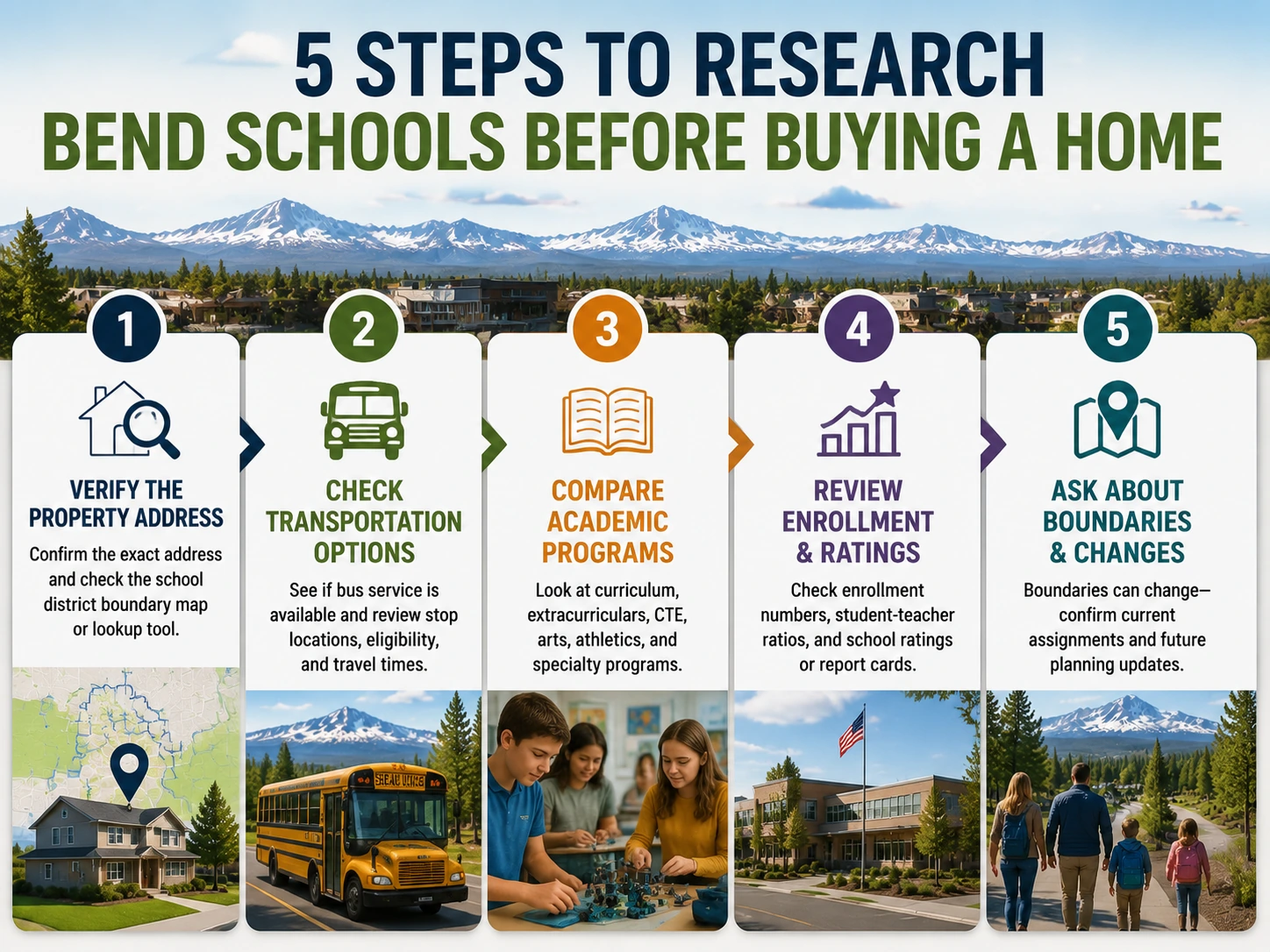
How to Research Schools Before Buying a Home
Researching schools before buying is more than checking online reviews. Families should combine official district information, school visits, commute testing, program review, and local neighborhood understanding.
Verify the exact school boundary
This is the most important step.
Use the exact property address to confirm the assigned schools. Do this before writing an offer, not after closing.
Parents should verify:
- Assigned elementary school
- Assigned middle school
- Assigned high school
- Whether the home is inside district boundaries
- Whether any transfer process applies
Bend-La Pine’s enrollment information directs families to use its online student enrollment system for new students or updates, and the district posts enrollment information by school year.
Review transportation options
A school may be highly regarded, but if daily transportation is difficult, the routine may not work for your family.
Consider:
- Bus availability
- Walking or biking routes
- Morning traffic
- Winter road conditions
- Drop-off and pickup patterns
- After-school activity transportation
For working parents, transportation can matter as much as the school itself.
Compare programs, not just ratings
Online school ratings can provide a starting point, but they do not tell the full story.
Look deeper at:
- Academic programs
- Arts and music
- STEM opportunities
- Language options
- Special education support
- Advanced coursework
- Counseling support
- Sports and clubs
- School culture
A school with the right program fit may be better for your child than a school with a slightly higher rating.
Ask about enrollment capacity
Some programs or schools may have capacity limits. Families should ask whether the assigned school has space, what documents are needed, and whether any choice or charter programs require separate applications.
If you are relocating mid-year, ask about timing and transition support.
Consider future boundary changes
School boundaries can change as communities grow. Bend has experienced significant growth, and families should understand that boundaries may be reviewed or adjusted over time.
This does not mean you should avoid buying in a particular area. It means you should make decisions with flexibility and understand that school assignments are not always permanent.
Public Schools in Bend
Public schools are the starting point for most relocating families. The best fit depends on your address, your child’s grade level, and the programs that matter to your family.
Elementary school considerations
Elementary school often shapes a child’s earliest Bend experience. Parents should consider proximity, classroom environment, after-school care, walking routes, and how easily their child can make friends nearby.
Questions to ask include:
- How close is the school to the home?
- Is bus service available?
- Are after-school programs offered?
- What is the school culture like?
- Are there neighborhood friends nearby?
- How does the school support new students?
For families relocating from out of state, social transition is often just as important as academics.
Middle school considerations
Middle school brings different priorities. Families may care more about programs, electives, sports, clubs, student support, and peer environment.
Review:
- Electives
- Music and arts
- Athletics
- Counseling support
- Academic placement
- Commute time
- After-school activities
Middle school can be a major adjustment for relocating children, so visiting the school when possible can help.
High school considerations
High school decisions often involve academics, college preparation, sports, arts, social fit, and extracurricular activities.
Parents should evaluate:
- Advanced courses
- Career and technical programs
- Athletics
- Arts and music
- College counseling
- Graduation pathways
- Clubs and leadership opportunities
- Transportation for activities
Families with older students should research high school fit before choosing a home, especially if the student is already involved in specific programs or sports.
Sports, clubs, and extracurriculars
Bend families often value activities beyond the classroom. Sports, outdoor recreation, music, arts, clubs, and community programs all help students build friendships and feel connected after a move.
This is one reason neighborhood fit matters. Living near parks, fields, trails, schools, or recreation centers can make family life easier.
Charter, Magnet, and Alternative Programs
Bend families may also explore charter, magnet, or alternative programs depending on their child’s learning style and family priorities. These options can be attractive, but they often require more planning than neighborhood school enrollment.
Charter school options
Charter schools may offer different instructional models, school cultures, or program focuses. Families should research admission processes, application timelines, transportation, and grade availability.
Do not assume that living near a charter school guarantees enrollment.
Project-based learning
Some families look for project-based or experiential learning options. These programs may appeal to students who thrive with hands-on work, collaboration, and real-world problem solving.
Parents should evaluate whether the program matches the child’s personality and academic needs.
Application timelines
Choice, charter, and alternative programs may have deadlines that do not align with your moving timeline. Families relocating in summer or mid-year should check dates early.
Bend-La Pine Schools notes that its Area Change Request process is used when parents request attendance at a neighborhood school outside their current attendance area.
Enrollment limitations
Some programs may have limited seats. If demand exceeds available space, admission may depend on process, timing, or other district rules.
Families should have a backup plan tied to their assigned neighborhood school.
Private School Options
Private schools can be part of the decision process for families who want smaller environments, faith-based education, specialized instruction, or an alternative to public school assignment.
Independent schools
Independent schools may offer smaller class settings, distinct educational philosophies, and broader flexibility in curriculum design. Families should compare tuition, program style, admissions process, and commute.
Faith-based schools
Faith-based schools may appeal to families looking for religious instruction alongside academics. Parents should review grade levels served, curriculum, culture, and extracurricular offerings.
Preschool and early education
Families with younger children should research preschool and childcare early. Availability can be limited, especially for families moving during the school year or needing full-day care.
Preschool decisions may also influence where families prefer to live because daily drop-off routines matter.
Tuition and waitlist considerations
Private school costs vary. Families should ask about:
- Tuition
- Fees
- Admissions timeline
- Waitlists
- Financial aid
- Transportation
- Extended care
- Grade-level openings
Do not wait until after purchasing a home to begin this research.
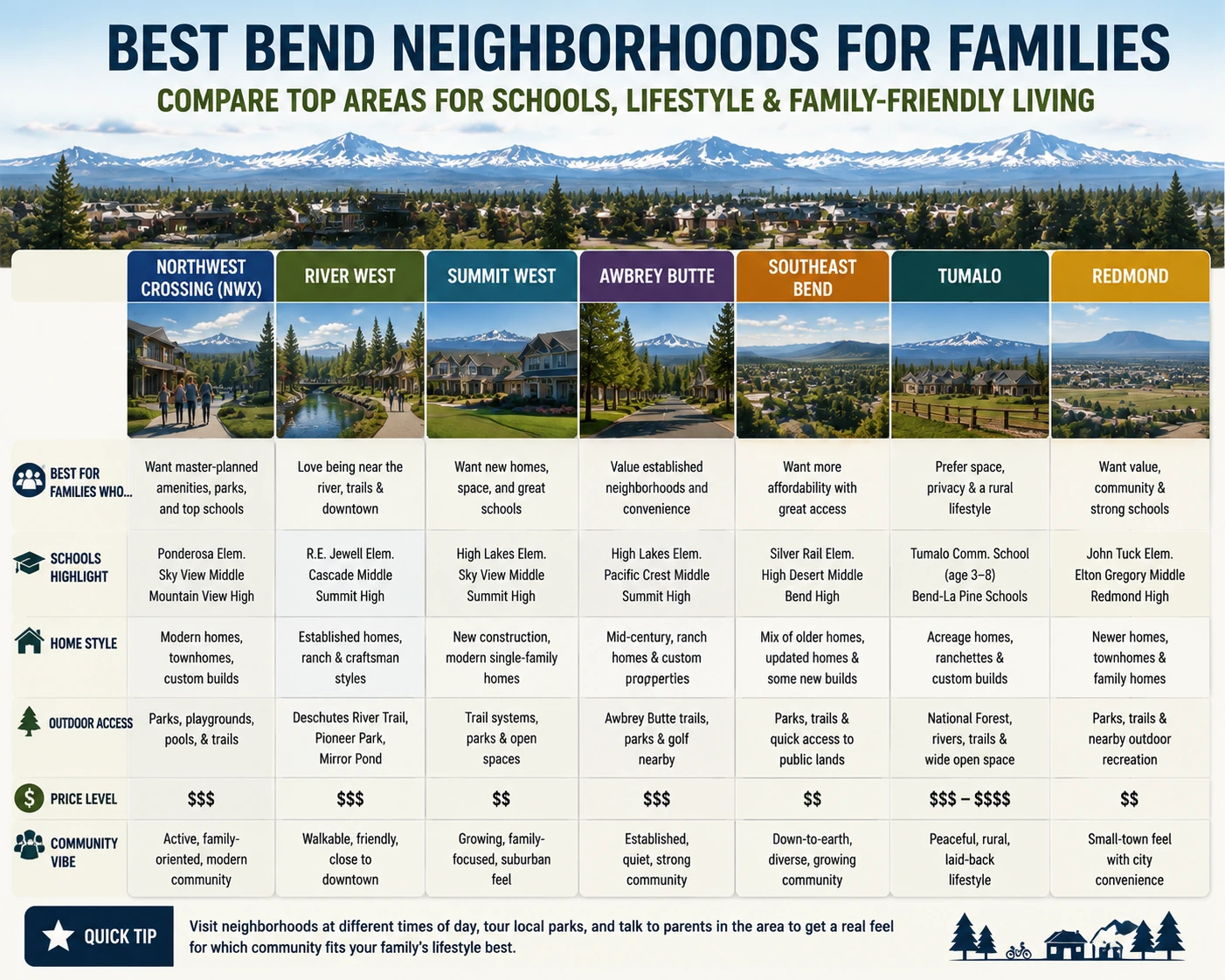
Best Bend Neighborhoods for Families
The best family neighborhood is not only the one with the most popular school. It is the neighborhood that supports your child’s routine, your commute, your budget, and your preferred lifestyle.
NorthWest Crossing
NorthWest Crossing is one of Bend’s most popular family areas because of its walkable design, parks, community events, restaurants, cafés, and newer homes. Families often like the neighborhood feel and access to the Westside amenities.
Best for families wanting walkability, community design, and a polished neighborhood setting.
River West
River West appeals to families who want access to downtown, the Deschutes River, parks, restaurants, and westside Bend culture. Homes vary from older properties to updated residences.
Best for families wanting walkability, character, and central Bend access.
Summit West
Summit West is a strong westside option for families who want residential streets, access to schools, parks, trails, and proximity to recreation. It can offer a quieter feel than more urban westside neighborhoods.
Best for families wanting westside convenience with a more residential atmosphere.
Awbrey Butte
Awbrey Butte appeals to families seeking larger homes, views, privacy, and an established luxury feel. It is less walkable than some westside neighborhoods but offers space and quiet streets.
Best for families wanting views, privacy, and larger homes.
Southeast Bend
Southeast Bend can appeal to families seeking newer homes, parks, relative value, and practical access to schools and daily services. It may offer more attainable options than some westside areas.
Best for families wanting newer housing and practical daily routines.
Tumalo
Tumalo is a strong fit for families wanting acreage, horse properties, outdoor space, and a rural lifestyle near Bend. School assignments should be verified carefully by address.
Best for families wanting land, privacy, and room to grow.
Redmond as a nearby alternative
Redmond may appeal to families who want more value, new construction, airport access, and a growing community near Bend. It can be a practical alternative for buyers priced out of Bend or wanting a different pace.
Best for families wanting affordability and Central Oregon access.
Matching Neighborhoods With School Priorities
Families often start by asking, “What is the best school?” A better question is, “Which neighborhood and school combination fits our family?”
Best for walkability
Families who want walkability may prefer:
- NorthWest Crossing
- River West
- Old Bend
- Downtown-adjacent areas
These areas can reduce driving and make daily life easier for kids and parents.
Best for larger homes
Families needing more space may consider:
- Awbrey Butte
- Summit West
- Southeast Bend
- Tumalo
- Select Redmond neighborhoods
Larger homes can be especially important for remote-working parents, multi-child families, and households needing guest space.
Best for outdoor access
Outdoor-focused families often consider:
- Westside Bend
- River West
- NorthWest Crossing
- Tetherow-area neighborhoods
- Tumalo
- Three Rivers or Sunriver-area communities
Trail access, bike routes, parks, and winter recreation can become part of family life.
Best for luxury buyers
Luxury family buyers may compare:
- Awbrey Butte
- Broken Top
- Tetherow
- NorthWest Crossing
- Tumalo
- Pronghorn / Juniper Preserve
The right fit depends on whether the family wants walkability, golf, views, acreage, or resort amenities.
Best for acreage buyers
Families who want room for animals, shops, gardens, or outdoor storage may prefer:
- Tumalo
- Rural Bend
- Rural Redmond
- Sisters-area acreage
- Select properties near Deschutes River Woods or Three Rivers
Acreage can be excellent for families, but school commute, utilities, wells, septic systems, and internet access should be reviewed carefully.
Best for affordability
Families seeking better value may compare:
- Southeast Bend
- Northeast Bend
- Redmond
- Prineville
- La Pine
- Select Central Oregon communities outside Bend
Affordability should be balanced with commute, schools, activities, and lifestyle expectations.
Moving to Bend With Kids
Moving with children requires more than choosing a house. Families need to plan enrollment, social transition, activities, healthcare, and daily routines.
Enrollment documents
Families should prepare documents early. Requirements can vary, but commonly requested items may include proof of residence, birth certificate or identity documents, immunization records, prior school records, and parent or guardian information.
Because requirements can change, use the district’s current enrollment instructions before submitting paperwork.
Timing your move
The easiest time to move is often before the school year begins, but that is not always possible. If moving mid-year, contact the school as early as possible to ask about placement, records, class schedules, and transition support.
School-year transition tips
Children often need time to adjust socially. Helpful steps include:
- Visiting the school before the first day
- Joining sports or clubs early
- Exploring neighborhood parks
- Attending local events
- Connecting with other families
- Keeping routines consistent during the move
A smooth transition often depends on social connections as much as academics.
After-school care
After-school care can be important for working parents. Availability may vary, so ask about programs before moving.
Consider:
- School-based care
- Recreation programs
- Private childcare
- Youth sports
- Clubs
- Transportation after activities
Youth sports and activities
Bend offers many youth activities tied to its outdoor lifestyle. Families may find options for soccer, baseball, mountain biking, skiing, snowboarding, swimming, climbing, music, arts, and community recreation.
These activities help children settle in and build friendships.
Family Lifestyle Beyond the Classroom
One of Bend’s biggest advantages for families is what happens outside school hours. The city’s outdoor lifestyle can become part of a child’s daily experience.
Parks
Bend has many parks, playgrounds, sports fields, and open spaces. Families often choose neighborhoods based on access to parks and safe places to play.
Trails
Trails are part of daily life in Bend. Walking, biking, running, and dog walking are common family activities.
Neighborhoods with easy trail access can be especially appealing for active families.
Libraries
Libraries and community programs support family life by offering reading programs, events, study spaces, and activities for children of different ages.
Recreation programs
Local recreation programs can help children find activities quickly after moving. Sports, camps, outdoor programs, and after-school activities are important for family integration.
Skiing, biking, and outdoor activities
Many families move to Bend because they want their children to grow up skiing, biking, hiking, camping, fishing, or spending more time outdoors.
This lifestyle is one of the biggest differences between Bend and larger metro areas.
Questions Parents Should Ask Before Making an Offer
Before making an offer on a home, parents should ask direct school-related questions. These questions can help prevent frustration later.
Which school is assigned to this address?
Always verify the assigned elementary, middle, and high school using the exact address. Do not rely only on listing data or assumptions.
Is transportation available?
Ask whether bus service is available and how long the route may take. Also test the drive during school drop-off and pickup times.
Are there capacity concerns?
Ask whether the school or program has enrollment limitations. This is especially important for families moving mid-year or considering choice programs.
Are boundaries expected to change?
Ask whether there are any known boundary discussions or recent changes that may affect the property. Boundaries can shift as communities grow.
What programs does the school offer?
Ask about programs that matter to your child, including arts, music, advanced academics, special education, language support, athletics, clubs, and counseling.
Frequently Asked Questions
Most Bend students attend schools in Bend-La Pine Schools, which serves Bend and nearby communities, including Sunriver and La Pine. Families should verify the exact school assignment by property address before buying.
Many relocating families are satisfied with Bend public schools, but the best fit depends on the student, assigned school, programs, commute, and family priorities. Parents should compare programs and visit schools when possible instead of relying only on ratings.
Popular family neighborhoods include NorthWest Crossing, River West, Summit West, Awbrey Butte, Southeast Bend, and Tumalo. Redmond can also be a strong nearby alternative for families seeking more value.
Yes, Bend has private school options, including independent and faith-based schools. Families should research admissions, tuition, waitlists, grade levels, and commute before purchasing a home.
Yes. Attendance boundaries can change as communities grow and school capacity needs shift. Families should verify current assignments and ask about any known boundary discussions before making a home purchase.
No. Ratings can be a useful starting point, but they do not show the full picture. Families should also consider programs, commute, school culture, extracurriculars, transportation, and their child’s individual needs.
Yes, Bend can be a strong fit for California families who want outdoor recreation, less congestion, strong neighborhood life, and a smaller-city environment. The biggest adjustments are weather, housing costs, and fewer big-city services.
Redmond can be a practical alternative for families who want more affordability, airport access, and a growing community near Bend. Families should compare school assignments, commute, housing options, and activity access before deciding.
Final Thoughts
For relocating families, choosing a Bend home is not only about bedrooms, price, or neighborhood style. School boundaries, enrollment timing, transportation, programs, and daily routines all matter.
The best school decision starts with the exact property address. From there, families should compare assigned schools, research program fit, understand transportation, and choose a neighborhood that supports life beyond the classroom.
Bend can be an excellent place for families who value outdoor recreation, strong community life, and a smaller-city environment. The key is doing the school research before you buy, not after you move.