


Moving from California to Bend is not just a change of address. For many people, it changes how they spend their time, how they use their home, how they think about weather, and what they expect from a community.
A traditional relocation guide can tell you how far Bend is from Los Angeles, San Francisco, or San Diego. This playbook goes deeper. It is written for California homeowners, remote workers, retirees, and families who are already seriously considering Bend and want to understand what daily life may feel like after the move.
Bend can be an excellent fit for people who want outdoor access, less congestion, more space, and a strong Central Oregon lifestyle. But it is not the right fit for every California mover. Housing is still expensive, winters require adjustment, local wages can be lower than California salaries, and Bend operates more like a small city than a major metro area.
This guide explains what changes most after leaving California, what surprises people, how housing expectations shift, what neighborhoods fit different buyer profiles, and what California homeowners should do before selling and relocating.
Quick Answer
Moving from California to Bend is still worth it for many people in 2026, especially if they want a slower pace of life, better outdoor access, less traffic, and a smaller city environment. The best fit is usually a remote worker, retiree, outdoor-focused buyer, or homeowner using California equity to purchase in Central Oregon.
Is Bend still worth it for Californians in 2026?
For many Californians, yes. Bend continues to offer a strong lifestyle upgrade compared with large California metros. Residents often gain easier access to trails, skiing, rivers, golf, mountain biking, and a more relaxed daily routine.
However, Bend should not be viewed as a cheap alternative. Housing costs remain high by Oregon standards, and many buyers are surprised by how competitive desirable neighborhoods can be. The move makes the most sense when buyers are seeking lifestyle value, not only lower expenses.
What changes most after the move?
The biggest changes are usually daily pace, driving time, weather, housing expectations, and access to nature.
Many former Californians notice:
- Shorter daily errands
- Less traffic frustration
- More time outdoors
- A stronger seasonal rhythm
- Smaller-city services
- More dependence on winter preparation
- A different relationship with home and land
Life in Bend often feels more intentional. People spend more time skiing, hiking, biking, walking dogs, hosting friends, or enjoying their neighborhood rather than sitting in traffic or moving between dense commercial areas.
Who is the best fit for Bend?
Bend is often a strong fit for:
- Remote workers with stable income
- California homeowners with strong home equity
- Retirees seeking an active outdoor lifestyle
- Families who value schools, parks, and recreation
- Golfers and outdoor enthusiasts
- Buyers who want a smaller city with premium lifestyle amenities
It may be a harder fit for buyers who need big-city services, frequent nightlife, very mild winters, lower housing costs, or a large local job market.

What Californians Notice First After Moving to Bend
The first few months after moving to Bend can feel refreshing, but also revealing. Many Californians love the cleaner air, easier drives, and immediate outdoor access. At the same time, they may need time to adjust to a smaller service market, colder winters, and a community where lifestyle often matters more than speed or convenience.
Slower pace of life
Bend moves at a different rhythm than most California metros. People are still busy, but the pace feels less compressed. Daily life often includes more time outside, more casual interactions, and less urgency around traffic, parking, and long commutes.
This slower pace appeals to people who want more breathing room. It can feel like a major lifestyle upgrade for buyers leaving Los Angeles, the Bay Area, Orange County, or San Diego.
Less traffic and congestion
Traffic exists in Bend, especially during commute times, weekends, and busy tourism seasons. But compared with California’s larger metro areas, daily driving is usually far less stressful.
Former Californians often notice:
- Shorter grocery trips
- Easier school drop-offs
- Less freeway dependence
- More predictable errands
- Better access to trails and parks
That said, Bend has grown, and some roads feel busier than longtime residents remember. Buyers should not expect a tiny mountain town with no traffic. Bend is a growing city with seasonal congestion, especially near popular corridors.
Smaller-city convenience
Bend offers strong everyday amenities, but it is still much smaller than major California metro areas. You will find good restaurants, breweries, medical care, shopping, gyms, schools, and recreation programs, but you may not have the same depth of options found in Los Angeles, San Francisco, or San Diego.
Specialty medical appointments, niche retail, major entertainment, or direct international flights may require a trip to Portland, Seattle, or another larger market.
More outdoor access
This is where Bend stands out most.
Residents can access trails, rivers, parks, golf, skiing, mountain biking, paddleboarding, fly fishing, and hiking without planning a major trip. Outdoor recreation becomes part of weekly life rather than something saved for vacation.
For many California movers, this is the biggest reason the move feels worth it.
Fewer big-city services
The trade-off is that Bend does not offer everything a major California city offers. There are fewer luxury retail options, fewer large concert venues, fewer direct flights, and fewer specialized professional services.
Some buyers love the simplicity. Others miss the variety.
This is why expectations matter. Bend is not a smaller version of San Francisco or Los Angeles. It is a lifestyle-driven Central Oregon city with its own identity.
California vs Bend Lifestyle Shift
The biggest relocation adjustment is not always financial. It is often the lifestyle shift. California movers are not simply choosing a different housing market. They are choosing a different daily experience.
From urban density to high-desert living
Bend has a high-desert setting with pine forests, volcanic landscapes, dry air, and wide-open skies. The environment feels very different from coastal California, Silicon Valley, Los Angeles, or Orange County.
Instead of dense neighborhoods and large freeway systems, Bend offers:
- Lower-density residential areas
- More natural space
- Trail-focused living
- High-desert scenery
- Mountain views
- Seasonal weather patterns
This appeals strongly to people who want more space and less intensity.
From long commutes to shorter daily routines
Many Californians are used to building their lives around traffic. Bend often allows people to reclaim that time.
Shorter routines may include:
- Faster school drop-offs
- Easier grocery trips
- More time for morning walks
- Lunch breaks on nearby trails
- Afternoon skiing or biking
- Less daily stress around driving
Remote workers especially benefit because they can combine professional income with a lifestyle that supports more personal time.
From coastal weather to four-season climate
Bend has four distinct seasons. Californians moving from coastal areas should expect a major weather adjustment.
Winters include snow, ice, freezing temperatures, and darker mornings. Summers are dry and sunny. Spring can be unpredictable. Fall is one of the most beautiful seasons in Central Oregon.
People who enjoy seasonal variety usually adapt well. Those who strongly prefer mild coastal weather may need time to adjust.
From city entertainment to outdoor recreation
California offers museums, major sports, concerts, fine dining, nightlife, beaches, and large cultural scene. Bend offers a different kind of entertainment base.
Here, lifestyle often revolves around:
- Skiing
- Hiking
- Golf
- Breweries
- Trail running
- Mountain biking
- River recreation
- Farmers markets
- Local events
- Outdoor patios
Bend has excellent restaurants and breweries, but its strongest lifestyle advantage is outdoor access.

Housing Expectations for California Buyers
Housing is one of the biggest reasons Californians look at Bend, but it is also one of the areas where expectations need to be realistic.
Many buyers arrive with strong equity from California, but they quickly learn that Bend’s most desirable neighborhoods are competitive and expensive.
What California equity can buy in Bend?
California homeowners selling in high-cost markets may find that their equity gives them strong buying power in Bend. Depending on their previous market, they may be able to purchase:
- A larger single-family home
- A home with mountain views
- A newer property
- A golf community home
- A home with a dedicated office
- A larger lot
- A luxury property with outdoor living
- Acreage outside Bend
Buyers coming from the Bay Area, coastal Southern California, or parts of Los Angeles often feel they can get more lifestyle value for their money in Bend.
Why Bend still feels expensive
Even though Bend may be more affordable than many California metros, it is still one of Oregon’s more expensive housing markets.
Buyers are often surprised by:
- High demand for westside neighborhoods
- Premium pricing for mountain views
- Strong competition for updated homes
- Limited inventory in luxury communities
- High prices for acreage near Bend
- Resort-community fees and HOA costs
The key is to compare Bend not only to California, but also to your income, lifestyle goals, and total monthly budget.
Larger homes, more space, and better views
For many California buyers, Bend’s biggest housing advantage is not only price. It is the lifestyle that comes with the property.
Common upgrades include:
- More storage for bikes, skis, and outdoor gear
- Larger garages
- Home offices
- Bigger yards
- Outdoor kitchens or patios
- Mountain or forest views
- More privacy
- Access to trails or golf
This is especially appealing for remote workers, families, and buyers leaving dense urban neighborhoods.
When renting first makes sense
Renting before buying can be smart if you are unsure which Bend neighborhood fits your lifestyle.
This is especially true if you are deciding between:
- Westside Bend vs Eastside Bend
- Bend vs Redmond
- Luxury neighborhood vs acreage
- Walkable lifestyle vs privacy
- Golf community vs traditional neighborhood
- Full-time residence vs second home
Renting gives you time to understand traffic patterns, school boundaries, winter driving, trail access, and neighborhood personality before committing.
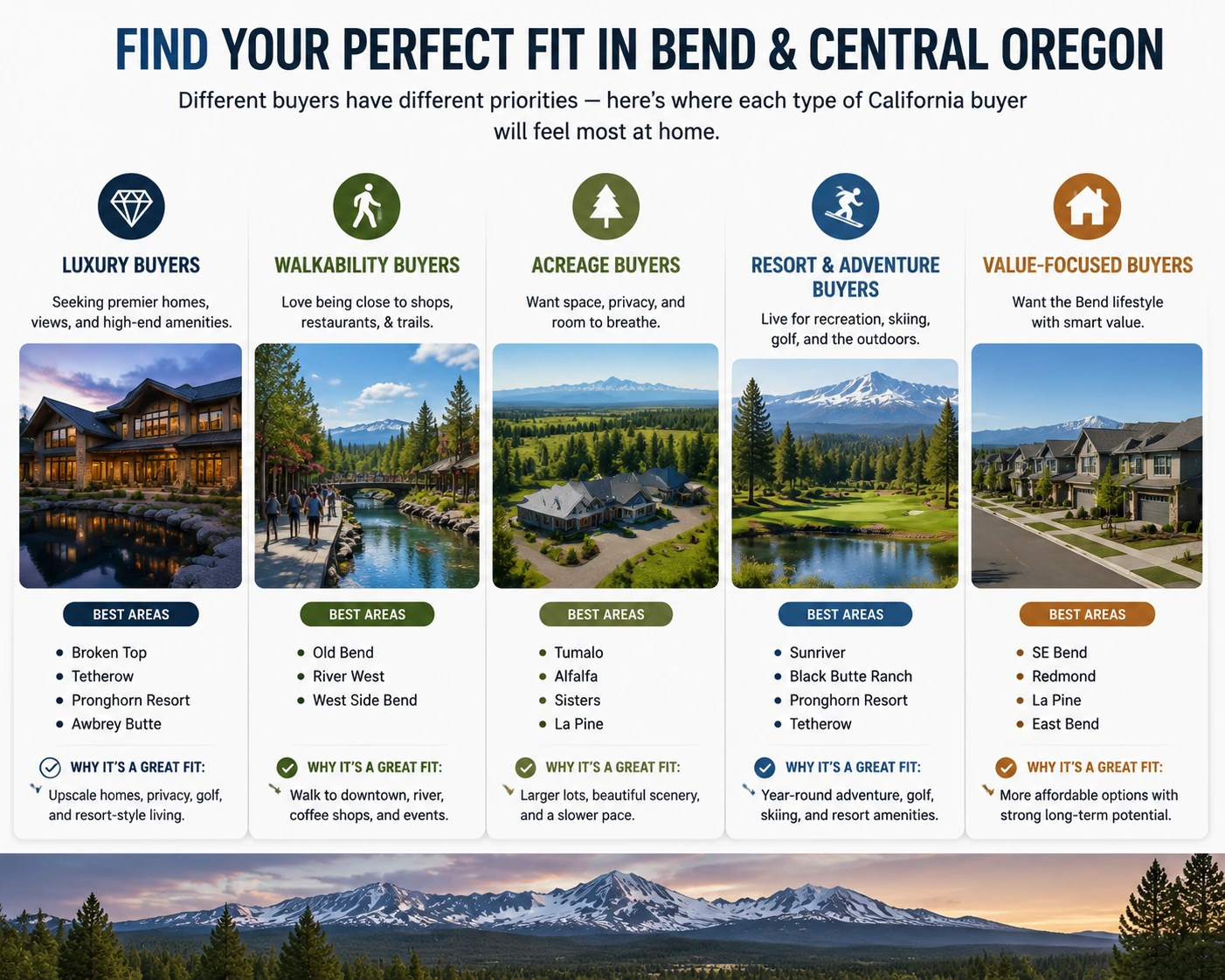
Best Bend Areas by California Buyer Type
California buyers do not all want the same thing. Some want luxury and views. Some want walkability. Others want acreage, privacy, or resort living. Matching the neighborhood to the buyer profile is one of the most important steps in the relocation process.
For luxury buyers: Awbrey Butte, Tetherow, Broken Top
Luxury buyers often focus on Bend’s premium neighborhoods and golf communities.
Awbrey Butte is ideal for buyers wanting views, privacy, larger homes, and an established residential feel.
Tetherow appeals to buyers who want modern architecture, golf, resort energy, and access to Mt. Bachelor.
Broken Top works well for buyers seeking a gated golf community, mature landscaping, and private club surroundings.
For walkability: River West, Old Bend, Northwest Crossing
Buyers leaving walkable California neighborhoods may prefer Bend areas with restaurants, parks, breweries, and daily conveniences nearby.
River West offers access to downtown, the Deschutes River, parks, and westside restaurants.
Old Bend provides historic charm and strong proximity to downtown and the Old Mill District.
NorthWest Crossing offers a planned village-style environment with schools, parks, cafés, and community events.
These neighborhoods are often strong fits for families, professionals, and buyers who want Bend convenience without relying on long drives.
For acreage: Tumalo
Tumalo is one of the best fits for California buyers who want land, privacy, horse properties, custom homes, or mountain views.
Buyers choose Tumalo for:
- Acreage
- Rural atmosphere
- Horse-friendly properties
- Space for workshops or RVs
- Mountain views
- Short drive to Bend
It is a strong fit for people leaving dense suburban or urban California markets who want more breathing room.
For resort living: Pronghorn and Three Rivers
Some California buyers want a vacation-home or resort-style experience.
Pronghorn / Juniper Preserve offers golf, wellness, resort amenities, high-desert scenery, and second-home appeal.
Three Rivers appeals to buyers seeking forest living, river access, Sunriver proximity, and recreation-focused ownership.
These areas are especially attractive for second-home buyers, retirees, golfers, and investors evaluating lifestyle properties.
For better value: Redmond and nearby communities
Not every California buyer needs to live in Bend.
Redmond, Prineville, Sisters-area communities, and other Central Oregon locations may offer better value depending on goals and budget.
Redmond is especially worth considering for buyers who want:
- More affordable housing than Bend
- Airport access
- New construction
- A growing downtown
- Shorter commute to North Bend
- Proximity to Smith Rock and Eagle Crest
Financial Changes After Leaving California
Financial changes are one of the biggest reasons Californians consider Oregon, but the picture is not as simple as “Bend is cheaper.” Some costs may go down, some may stay similar, and others may surprise you.
No Oregon sales tax
One of Oregon’s clearest advantages is the lack of statewide sales tax. This can make a meaningful difference when buying furniture, appliances, outdoor gear, electronics, and home improvement materials.
For California movers furnishing a new home, the difference can feel noticeable.
Oregon income tax realities
Oregon does have state income tax, and higher-income households should plan carefully. While some Californians may save compared with California’s highest brackets, others may find the difference smaller than expected.
Remote workers, business owners, retirees, and households with investment income should consult a tax advisor before moving.
Property tax expectations
Property taxes work differently in Oregon than in California. California homeowners used to long-term Proposition 13 protections may need to understand how Oregon property assessments and tax limits work.
Before buying, review:
- Current annual taxes
- Assessed value
- Real market value
- Special assessments
- HOA dues
- Local district fees
The purchase price is only one part of the monthly cost.
Insurance and utility differences
Insurance and utilities can change after moving.
Buyers should consider:
- Homeowners insurance
- Wildfire-related insurance questions
- Winter heating costs
- Irrigation costs
- Snow removal
- Septic and well maintenance for rural properties
- HOA or resort fees
A luxury home in Tetherow, acreage in Tumalo, and a townhome in Bend will all have very different ownership costs.
Vehicle, registration, and daily spending changes
Transportation costs often decrease because daily driving is less intense than in California metros. However, most Bend residents still need a vehicle.
New residents should budget for:
- Winter tires
- All-wheel drive or proper winter equipment
- Vehicle registration changes
- Fuel
- Parking in busy areas
- Maintenance from winter conditions
The savings usually come from driving fewer stressful miles, not from eliminating car ownership entirely.
Climate Adjustments Californians Should Expect
The weather is one of the biggest lifestyle adjustments after leaving California. Bend’s climate is beautiful, sunny, and dry, but it is not coastal.
Snow and winter driving
Winter in Bend requires preparation. Snow may not be constant all season, but it is common enough that new residents should take it seriously.
Californians should prepare for:
- Snowy mornings
- Icy roads
- Winter tires
- Driveway shoveling
- Garage storage
- School delays
- Mountain pass conditions
Winter becomes much easier when you have the right equipment and expectations.
Wildfire smoke season
Wildfire smoke can affect Central Oregon during parts of the summer and early fall. Some years are mild, while others bring more noticeable smoke.
New residents should consider:
- Air filters
- Indoor air quality
- HVAC maintenance
- Outdoor activity flexibility
- Health needs for children or seniors
This is not unique to Bend, but it is part of living in the western U.S.
Dry summers
Bend summers are sunny, warm, and dry. Many Californians love the low humidity, but they may need to adjust to high-desert dryness.
Expect:
- Dry skin
- Irrigation needs
- Cooler evenings
- Strong sun exposure
- Fire-conscious landscaping
Outdoor living is excellent in summer, but water and fire awareness matter.
High-desert temperature swings
Bend can have warm days and cool nights, especially in spring and fall. Layering becomes part of daily life.
The high-desert climate can feel refreshing for people leaving humid or coastal areas, but it requires more seasonal planning.
Outdoor lifestyle by season
Each season offers something different:
- Winter: skiing, snowboarding, snowshoeing
- Spring: hiking, biking, river walks
- Summer: paddleboarding, golf, camping, concerts
- Fall: trail running, mountain views, cooler weather
For outdoor-focused buyers, the seasonal rhythm is one of Bend’s biggest advantages.
Moving Timeline for California Homeowners
California homeowners often need a more careful timeline than renters because they may be selling a home, transferring equity, coordinating tax planning, and deciding whether to buy before or after arriving.
6 months before moving
Start with the major decisions.
Focus on:
- Choosing Bend vs Redmond or nearby communities
- Reviewing your California home value
- Speaking with a tax advisor
- Exploring Bend neighborhoods
- Estimating your purchase budget
- Understanding school needs
- Researching winter and climate differences
- Creating a moving budget
This is also the right time to visit Bend during a season you have not experienced before, especially winter.
90 days before moving
At this stage, your plan should become more specific.
Tasks include:
- Interviewing a local Bend real estate professional
- Preparing your California home for sale
- Getting a mortgage pre-approval
- Comparing neighborhoods
- Reviewing school boundaries
- Checking internet requirements
- Deciding whether to rent or buy first
- Planning temporary housing if needed
If you are selling in California and buying in Bend, the timing of both transactions matters.
30 days before moving
The final month is about execution.
Focus on:
- Finalizing moving logistics
- Transferring utilities
- Scheduling inspections
- Reviewing HOA documents
- Confirming school enrollment requirements
- Preparing vehicles for Oregon weather
- Updating insurance
- Planning your first few weeks in Bend
Remote workers should confirm internet setup before move-in.
First 30 days in Bend
The first month is about settling in.
Prioritize:
- Registering vehicles
- Updating driver’s licenses
- Setting up local medical care
- Learning winter road routes
- Exploring nearby parks and trails
- Meeting neighbors
- Testing daily commute patterns
- Visiting schools and activities
- Trying local restaurants and breweries
The goal is not just to unpack. It is to start building a real life in Bend.
Common Mistakes California Buyers Make
Many California buyers make the same mistakes when relocating to Bend. Avoiding them can make the move smoother and protect your long-term satisfaction.
Assuming Bend is inexpensive
Bend may be less expensive than parts of California, but it is not cheap. Buyers who assume they will automatically save money can be surprised by home prices, utility costs, winter needs, and HOA fees.
Use a full monthly budget, not just a home-price comparison.
Underestimating winter
Winter is manageable, but it is real. Buyers should understand snow removal, winter tires, icy roads, heating costs, and seasonal driving.
A home that feels perfect in July may feel different in January.
Buying before understanding neighborhoods
Bend neighborhoods vary significantly. River West, Awbrey Butte, Tetherow, Tumalo, NorthWest Crossing, and eastside Bend all offer different lifestyles.
Do not buy only because a home looks good online. Understand the neighborhood first.
Ignoring school boundaries
Families should never assume a home is assigned to a preferred school based on general location. School boundaries can be specific and may change.
Always verify the exact address before making an offer.
Not checking internet access
Remote workers should verify internet service at the exact property address. This matters especially for rural properties, acreage homes, and communities outside Bend city limits.
Overlooking HOA and rental rules
HOA rules can affect remodeling, rentals, parking, landscaping, and exterior changes. Resort communities and golf neighborhoods may have additional membership or rental restrictions.
Review documents carefully before closing.
Is Bend the Right Fit?
Bend is a great fit for many California movers, but not everyone. The best way to decide is to compare the lifestyle you want with the lifestyle Bend actually offers.
Best fit for remote workers
Remote workers often benefit from Bend because they can keep a high income while enjoying a better lifestyle. The combination of home office space, outdoor recreation, and shorter daily routines is powerful.
Best-fit areas may include:
- NorthWest Crossing
- River West
- Awbrey Butte
- Tetherow
- Tumalo
- Redmond for better value
Best fit for retirees
Retirees often appreciate Bend’s recreation, healthcare access, golf communities, and active lifestyle.
Strong options include:
- Broken Top
- Bend Golf Club area
- Awbrey Butte
- Tetherow
- Pronghorn
- Eagle Crest near Redmond
Best fit for families
Families often focus on schools, parks, safety, space, and neighborhood feel.
Popular options may include:
- NorthWest Crossing
- Summit West
- River West
- Southeast Bend
- Awbrey Butte
- Tumalo
- Redmond for affordability
Best fit for outdoor-focused buyers
Outdoor-focused buyers may find Bend especially rewarding.
Strong areas include:
- Westside Bend
- Tetherow
- River West
- Three Rivers
- Tumalo
- Sunriver-area communities
- NorthWest Crossing
Not ideal for every California mover
Bend may not be ideal if you need:
- A large metro job market
- Extensive nightlife
- Major-city cultural amenities
- Very mild winters
- Low home prices
- Walkability everywhere
- Frequent direct flights
- Immediate access to specialized services
The happiest movers understand the trade-offs before arriving.
Frequently Asked Questions
Bend is usually cheaper than expensive California markets such as the Bay Area, Los Angeles, Orange County, and San Diego, especially for housing and sales tax. However, Bend is still expensive compared with many U.S. cities and many parts of Oregon. The savings depend on where in California you are moving from, your income, and the type of home you buy.
Californians often move to Bend for outdoor recreation, smaller-city living, less traffic, remote work flexibility, mountain access, golf, and a more relaxed lifestyle. Many also want more space than they could afford in coastal California markets.
The biggest adjustment is usually the combination of winter weather, smaller-city services, and a slower pace of life. Many people love these changes, but they require realistic expectations.
Renting first can be smart if you are not sure which neighborhood fits your lifestyle. It gives you time to compare Westside Bend, Eastside Bend, Redmond, Tumalo, golf communities, and resort-style areas before purchasing.
Popular choices include Awbrey Butte, Tetherow, Broken Top, Northwest Crossing, River West, Old Bend, Tumalo, and Bend’s westside neighborhoods. Redmond and Three Rivers may also appeal depending on budget and lifestyle.
Yes, Bend can be a strong fit for families who value schools, parks, recreation, safety, and community life. Families should verify school boundaries, childcare availability, and commute patterns before purchasing.
Bend offers more restaurants, trails, amenities, and premium neighborhoods, while Redmond often offers better housing value, airport access, and new construction options. The better choice depends on budget, lifestyle, commute, and neighborhood preferences.
Final Thoughts
Moving from California to Bend can be a smart and rewarding decision, but it works best when buyers understand what they are gaining and what they are giving up.
Bend offers outdoor access, less congestion, strong lifestyle appeal, and a community that feels very different from California’s major metro areas. But it also brings winter weather, high housing costs, a smaller job market, and fewer big-city services.
The most successful California movers do not treat Bend as a cheaper version of California. They see it as a different lifestyle entirely.
If your goals include more time outside, a smaller city, a strong sense of place, and a home that supports how you actually want to live, Bend may be an excellent fit. If your expectations are built around big-city convenience, year-round mild weather, or low housing costs, it is worth comparing nearby Central Oregon communities before making the move.