


California is a big state – comparing Bend to “California” as a whole flattens a lot of real variation between, say, the Bay Area and the Central Valley. Still, after helping enough California families through this exact move, I’ve seen the same patterns hold consistently enough to be genuinely useful. Here’s the honest breakdown, numbers included.
For a detailed local budget breakdown, review the complete cost of living in Bend, Oregon guide.
Is Bend Cheaper Than California?
The short answer: generally yes, but it depends heavily on which California market you’re leaving and how the tax math works out for your specific income. Housing is where the comparison is least ambiguous – Bend runs meaningfully below most major California metros. Taxes are more nuanced than either state’s reputation suggests, and day-to-day costs land somewhere in the middle, driven by Bend’s geographic isolation rather than any single expensive category.
If you’re coming from the Bay Area or coastal Southern California, the housing savings alone will likely dominate your budget picture. If you’re coming from a more affordable inland California city, the gap narrows considerably – and the tax picture becomes the more important variable in your decision.
| Category | Bend, Oregon | California (general) |
| Cost-of-living index | ~134 (national avg = 100) | Historically well above national average statewide, higher still in coastal metros |
| Median home price | $725,000–$749,000 | Varies enormously – often higher in coastal/major metro markets, sometimes lower inland |
| State income tax (top rate) | 9.9% | 13.3% |
| State sales tax | None | ~7.25% statewide, higher with local add-ons |
Figures reflect early-to-mid 2026 data and should be re-verified against current sources at publish time.
Overall Cost of Living Comparison
The overall pattern is straightforward even though the details get nuanced fast: Bend runs about 34% above the national average on cost of living, driven almost entirely by housing. California’s statewide average has historically run higher still, and coastal metro areas push that figure considerably further above the national baseline.
What surprises a lot of California transplants is that once you strip housing out of the picture, the gap narrows. Bend’s utilities, groceries, and healthcare costs are only modestly above the national average – not dramatically different from what many mid-tier California cities already charge. Housing is doing almost all the work in this comparison, on both sides.

The Tax Question: More Nuanced Than It Looks
This is where most relocation guides oversimplify, so I want to slow down and get this right, because the “Oregon has no sales tax” headline hides a more complicated – and honestly more interesting – story.
California’s 13.3% Top Rate Only Applies Above $1M
California’s income tax system is famously steep at the top: a 13.3% marginal rate (including the additional 1% Mental Health Services Tax that kicks in above $1 million). But that number only bites earners with seven-figure incomes. Below that threshold, California’s brackets are actually fairly moderate and spread out – the state uses nine brackets ranging from 1% to 12.3% before that final surtax layer.
Oregon’s Bracket Structure Hits Middle Incomes Harder
Oregon’s headline top rate of 9.9% looks tame by comparison – until you see where that rate actually starts. Oregon has only four brackets: 4.75% on the first $4,050 of taxable income, 6.75% from $4,050–$10,200, 8.75% from just $10,200 all the way up to $125,000, and 9.9% above that. In other words, most working Oregonians are paying close to the top marginal rate well before they’re anywhere near “high earner” territory. Oregon’s standard deduction is also unusually low (around $2,420 for single filers), which pushes more of your income into taxable territory than you might expect coming from California’s larger deduction.
The Counterintuitive Result for $50K–$400K Earners
Put those two structures side by side, and you get a result that catches almost every California mover off guard: for most earners between roughly $50,000 and $400,000, California’s effective income tax is often actually lower than Oregon’s – not higher, despite Oregon’s reputation as the tax-friendly alternative. Oregon’s advantage really shows up at the very top of the income scale, where California’s 13.3% rate starts to bite hard and Oregon’s flat 9.9% ceiling starts to look comparatively attractive.
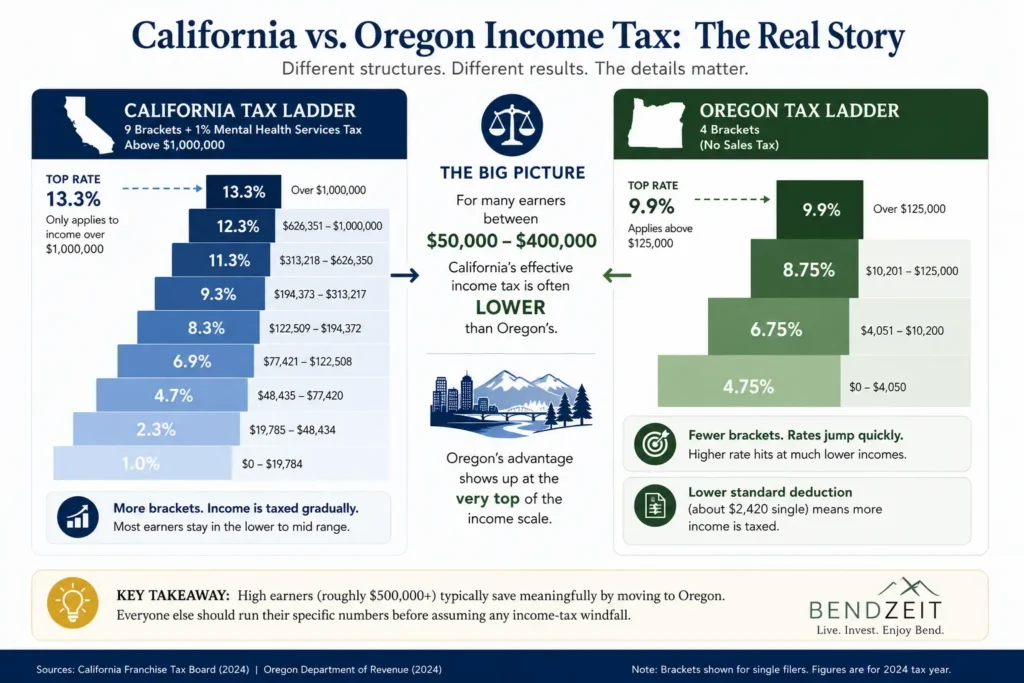
A rough way to think about it: high earners (roughly $500,000+) typically save meaningfully by moving to Oregon. Everyone else should run their specific numbers before assuming any income-tax windfall.
Sales Tax Comparison and the $40K-Purchase Example
Where Oregon has an unambiguous advantage is sales tax – because it simply doesn’t have one. California charges 7.25% statewide, and many cities and counties add local rates on top of that, often pushing combined rates well above 9% in parts of the state.
Here’s where that matters in real dollars: buy a $40,000 car in California, and you’ll pay $3,000 or more in sales tax on top of the purchase price. In Oregon, you pay zero. Zoom out to a full year of spending – a household spending roughly $50,000 annually on taxable goods (furniture, vehicles, electronics, everyday retail) saves somewhere in the $2,000–$4,000 range purely from Oregon’s lack of a sales tax.
Where This Nets Out
Putting the income tax and sales tax pieces together, here’s the honest bottom line by household type:
- High earners (roughly $500,000+ income): Oregon typically wins, often by a meaningful margin, because California’s 13.3% top bracket starts to dominate the comparison.
- Big spenders regardless of income: Oregon’s sales-tax-free structure helps disproportionately – the more you spend on taxable goods, the more this advantage compounds.
- Moderate earners who don’t spend heavily: the comparison is genuinely close, and some households may see little net tax benefit from the move, or could even pay somewhat more overall in Oregon than they did in California.
Don’t move from California to Oregon expecting automatic tax savings. Run your specific numbers – income level, spending habits, and filing status all matter – or better yet, talk to a CPA who handles multi-state moves before you assume this decision pays for itself in tax savings alone.
Housing: Where Oregon’s Advantage Is Clearest
This is the category where the comparison stops being nuanced and starts being obvious.
California Metro Price Levels vs. Bend’s Median
Bend’s median single-family home price currently sits in the $725,000–$749,000 range. That’s a genuinely high number by national standards – Bend is not a “cheap” Oregon town. But set it against what a comparable home costs in the Bay Area, coastal Southern California, or even many inland California metros, and the gap is often dramatic. Buyers coming from these markets frequently find that Bend, despite being one of Oregon’s more expensive cities, still represents a significant step down in absolute housing cost.
Buyers can review current prices, inventory, and sales activity in the Bend housing market reports hub.
Built-In Equity for Sellers from Major CA Markets
For sellers, this dynamic works in your favor directly. If you’re selling a home in a major California market and buying in Bend, the price differential often translates into meaningful built-in equity – money that can go toward a larger down payment, eliminate a mortgage altogether, or fund the kind of Central Oregon lifestyle upgrade (more land, a view lot, proximity to trails) that would be financially out of reach in most California markets at a comparable price point.
Historically, statewide cost-of-living comparisons have consistently shown California’s overall average annual cost of living running notably above Oregon’s, and housing has always been the primary driver of that gap – not groceries, healthcare, or day-to-day spending.
CONVERSION CTA – mid-article button/box “Curious what your California home equity actually buys in Bend?” → Get a free home valuation and browse current Bend listings [link to BendButteProperties.com valuation + IDX search]
Everyday Costs: Utilities, Groceries, Transportation
Bend’s Isolation-Driven Cost Premium
Bend sits in a genuinely isolated pocket of Central Oregon – surrounded by national forest and BLM land, with goods traveling a long way to reach store shelves. That isolation shows up as a modest but real premium: groceries run roughly 2% above the national average, and combined utilities for a mid-sized home typically land in the $180–$250/month range, with summer lawn-watering sometimes pushing the water bill alone above $100. Transportation means budgeting for a car – Bend is not a walkable, transit-rich city the way parts of California are.
California’s Regional Cost Variation
California’s everyday costs vary too widely by region to state a single number honestly. Coastal and major-metro grocery, utility, and transportation costs generally run above the national average as well – in many cases comparably high to Bend’s, or higher, depending on the specific city. Inland and more rural California markets often look closer to Bend’s cost structure than the state’s reputation would suggest.
The practical takeaway: day-to-day costs are not where this decision gets made. Housing and taxes are the two categories that will actually move your budget.
What This Means for a Typical California Household
Bringing all of this together, here’s the three-part reality for a household moving from a major California market to Bend:
Housing: Expect meaningfully lower costs in most cases, especially if you’re coming from a coastal or major-metro California market. This is the clearest, most consistent advantage of the move.
Taxes: Expect a genuinely mixed picture that requires your own math. Don’t assume automatic savings – Oregon’s income tax structure hits middle earners harder than California’s below the $1M threshold, while Oregon’s lack of sales tax helps everyone, especially big spenders.
Day-to-day costs: Expect modestly higher costs than the U.S. national average in Bend, due to geographic isolation – but likely comparable to or even lower than many California cities, depending on where you’re coming from.
If you’re weighing this move primarily as a financial decision, run the full picture – not just the housing number, and not just the “no sales tax” headline – before you commit.
Frequently Asked Questions
Generally yes on overall cost of living, primarily driven by lower housing costs – though the tax comparison is genuinely mixed and depends on your specific income and spending habits. Households moving from major coastal California metros typically see the largest savings; those coming from more affordable inland California cities will see a smaller gap.
Not automatically. Oregon has no sales tax, which is a real advantage for big spenders regardless of income. But for most earners between $50,000 and $400,000, California’s effective income tax is often actually lower than Oregon’s, because Oregon’s higher brackets start at much lower income levels. High earners above roughly $500,000 typically do save more in Oregon.
It depends heavily on which California market you’re leaving, but sellers from most major California metros typically find meaningful built-in equity when buying in Bend, even at Bend’s relatively high in-state price point of $725,000–$749,000.
Not necessarily – run your specific numbers first. Many California-to-Oregon moves make more financial sense based on housing cost savings and lifestyle than on tax savings specifically, and some moderate-income households may see little net tax benefit at all.
Ready to Run Your Own Numbers?
Every California-to-Bend move looks different depending on where you’re coming from, your income, and your spending habits. The housing savings are usually real and significant – the tax picture deserves a closer look before you assume it’s automatically in your favor.