


Seattle and Bend are both expensive housing markets, but they behave very differently.
Seattle is a major tech-driven metro with deep employment, intense neighborhood-level price swings, and a market that still moves quickly when homes are priced correctly. Bend is smaller, lifestyle-driven, and expensive by Oregon standards, but buyers usually get a calmer pace, more negotiating room, and better access to outdoor living.
For Seattle homeowners thinking about Bend, the headline number matters:
As of mid-2026, Seattle’s median sale price is roughly $175,000 higher than Bend’s when comparing Redfin’s three-month citywide median sale prices. Seattle is around $879K, while Bend is around $704K. Some local Bend single-family snapshots place Bend closer to $725K, but Seattle still carries a meaningful price premium.
That price gap matters. But the bigger difference may be competition.
Seattle buyers are still making decisions fast. Bend buyers usually have more time, more room to negotiate, and more ability to compare neighborhoods before writing an offer.
Quick Answer: Is Bend Cheaper Than Seattle?
Yes, Bend is generally cheaper than Seattle for buying a home in 2026, but it is not cheap.
Bend vs. Seattle Home Price Gap
Using Redfin’s three-month median sale price data ending May 2026, Seattle’s median sale price is about $879,000, while Bend’s is about $704,000. That puts Seattle roughly $175,000 higher than Bend on a citywide median basis.
If you use a local Bend single-family snapshot closer to $725,000, Seattle is still roughly $154,000 higher.
That is the direct answer.
Bend is cheaper than Seattle on median home price, but it is not an affordability bargain. Bend is still a premium lifestyle market, especially for Westside neighborhoods, newer homes, river access, trail access, and walkable communities like NorthWest Crossing, River West, and Old Bend.
The real advantage for Seattle buyers is not just lower price. It is the combination of lower median pricing, slower pace, and more negotiating room.
Median Home Price Comparison
A Bend vs Seattle housing market comparison needs to separate the headline median from the buyer experience.
Seattle’s median is higher, but the city has major neighborhood variance. Bend’s median is lower, but its most desirable neighborhoods can still feel expensive quickly.

Bend Pricing Breakdown
Bend’s 2026 housing market is no longer the frantic pandemic-era market, but it is still expensive.
Citywide data places Bend’s median sale price in the low $700Ks, with local single-family reports often around the mid-$700Ks depending on month, property type, and data source.
The key point is that Bend pricing is highly neighborhood-sensitive.
Westside Bend usually commands a premium. NorthWest Crossing, Old Bend, River West, Discovery West, Tetherow, Broken Top, and Awbrey Butte can all price above the citywide median. Eastside Bend, Southeast Bend, and nearby Redmond may offer more value.
For Seattle buyers, this means Bend may feel more affordable at the citywide level but still competitive if the target is a high-demand lifestyle neighborhood.
Seattle Pricing Breakdown
Seattle’s citywide median is higher than Bend’s, and the market has a wider range of neighborhood pricing.
Capitol Hill, Queen Anne, Madison Park, Ballard, Wallingford, Laurelhurst, Fremont, West Seattle, and other neighborhoods all behave differently. A condo-heavy area, a townhome-heavy area, and a luxury single-family pocket can produce very different pricing.
Seattle’s broad median does not tell the whole story. A buyer comparing a Seattle condo to a Bend single-family home is not making the same comparison as a buyer selling a Madison Park home and looking at Westside Bend.
The most accurate comparison is property type to property type and neighborhood to neighborhood.
Bend vs. Seattle Housing Market Snapshot
Market Snapshot: Bend vs Seattle, Mid-2026
| Metric | Bend, Oregon | Seattle, Washington |
| Median sale price | ~$704K Redfin / ~$725K local single-family snapshot | ~$879K Redfin citywide |
| Price gap | Seattle roughly $154K–$175K higher | Higher citywide median |
| Days on market | ~21 days Redfin / 64–66 days local single-family snapshot | ~10–11 days in fast-moving trackers |
| Average offers | ~1 offer | ~3 offers |
| Sale-to-list ratio | ~98–99% in local Bend reporting | Around 100.8% in Seattle local reporting |
| Months of supply | ~3.5–4 months in Bend local reporting | ~3.4 months in Seattle local reporting |
| Market feel | Competitive but more negotiable | Faster and more intense |
The numbers tell a useful story.
Seattle is more expensive and faster. Bend is still competitive, but more negotiable.
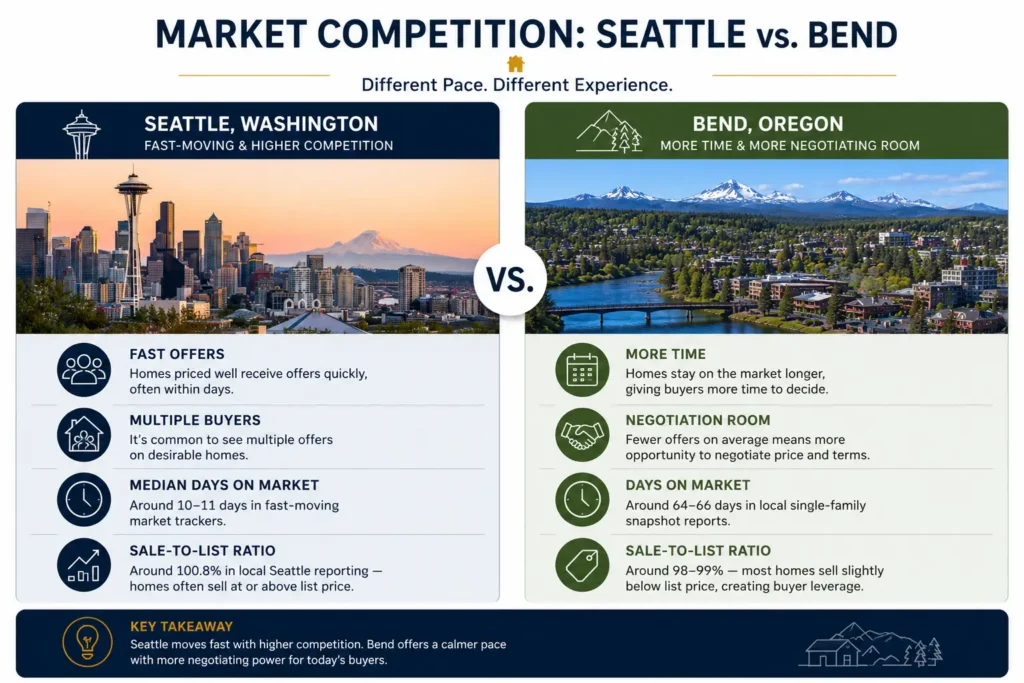
Competition & Speed of Sale
Price matters, but speed matters too.
Seattle buyers often have to decide quickly. Bend buyers usually have more time to think, inspect, negotiate, and compare.
Seattle’s Competitive Dynamics
Seattle remains a very competitive market even as parts of the broader housing market have cooled.
Homes can still sell in around 10–11 days in citywide tracking, with multiple offers still showing up for well-priced homes. Some Seattle market reports show homes selling at or slightly above list price on average, with resale homes performing especially strongly.
That does not mean every Seattle listing gets a bidding war. Overpriced homes can sit. Condos can behave differently than single-family homes. Some segments have cooled.
But compared with Bend, Seattle still tends to move faster, especially for desirable single-family homes in strong neighborhoods.
Bend’s Buyer-Friendly Pace
Bend is competitive, but the experience is different.
Redfin’s all-home tracker shows Bend homes selling in around 21 days, while local single-family market reporting shows a more buyer-friendly picture with median days on market around 64–66 days in May 2026.
That difference usually comes down to data set, property type, timing, and whether you are looking at cumulative listing history or faster-moving segments.
From a buyer’s perspective, the takeaway is clear: Bend often gives buyers more room to breathe than Seattle.
A well-priced Westside Bend home can still move quickly. But the overall Bend market is more negotiable than Seattle’s tightest segments.
Why Less Competition Matters as Much as Lower Price
For Seattle movers, the biggest Bend advantage may not be the lower median price.
It may be the lower pressure.
In Seattle, a buyer may need to waive contingencies, move quickly, compete against multiple offers, and make decisions before fully processing the trade-offs.
In Bend, buyers often have more time to evaluate property condition, negotiate credits, compare neighborhoods, and understand the lifestyle fit before writing an aggressive offer.
That matters because relocating is not just a financial decision. It is a life decision.
Buying the wrong home in the wrong Bend neighborhood because you rushed can be more expensive than paying a slightly higher price for the right fit.
What Your Seattle Home Equity Buys in Bend
Seattle equity can be powerful in Bend.
That is one reason many Puget Sound homeowners seriously consider Central Oregon. A Seattle home sale can create a strong down payment, reduce monthly payment pressure, or allow a buyer to target a better Bend neighborhood than a first-time local buyer could.
Illustrative Equity-Transfer Example
Here is a simple example.
Suppose a Seattle homeowner sells for $879,000, near the citywide median.
If they have 40% equity after selling costs and payoff, they may be working with roughly $350,000 before final transaction costs and tax considerations. If they use that toward a $725,000 Bend home, the loan amount could be much lower than it would be for a buyer entering with a smaller down payment.
That changes the monthly payment.
It also changes the offer strategy. A buyer with strong Seattle equity may be able to write a cleaner offer, compete better on desirable homes, or keep more monthly budget available for renovations, travel, or lifestyle.
This is why Seattle sellers can be strong Bend buyers.
Realistic Upgrade Tier
But Seattle equity does not guarantee a mansion in Bend.
A $725K Bend budget may buy a solid single-family home, depending on neighborhood, size, age, and condition. It may not buy a premium Westside home, large lot, mountain views, luxury finishes, or a top-tier golf-community property.
A larger budget may open doors to NorthWest Crossing, River West, Old Bend, Discovery West, Awbrey Butte, Broken Top, or Tetherow, but those markets can move well above Bend’s citywide median.
A realistic Seattle-to-Bend trade-up may look like:
- More sunshine and outdoor access
- More privacy than many Seattle neighborhoods
- Easier access to trails, skiing, and rivers
- Better negotiating room
- Possibly more garage, gear, or outdoor storage
- A smaller market with less daily traffic pressure
But the trade-up is not always square footage. Often, it is lifestyle.
Neighborhood-Level Nuance
Citywide medians are useful, but they can hide a lot.
That is especially true in Seattle.
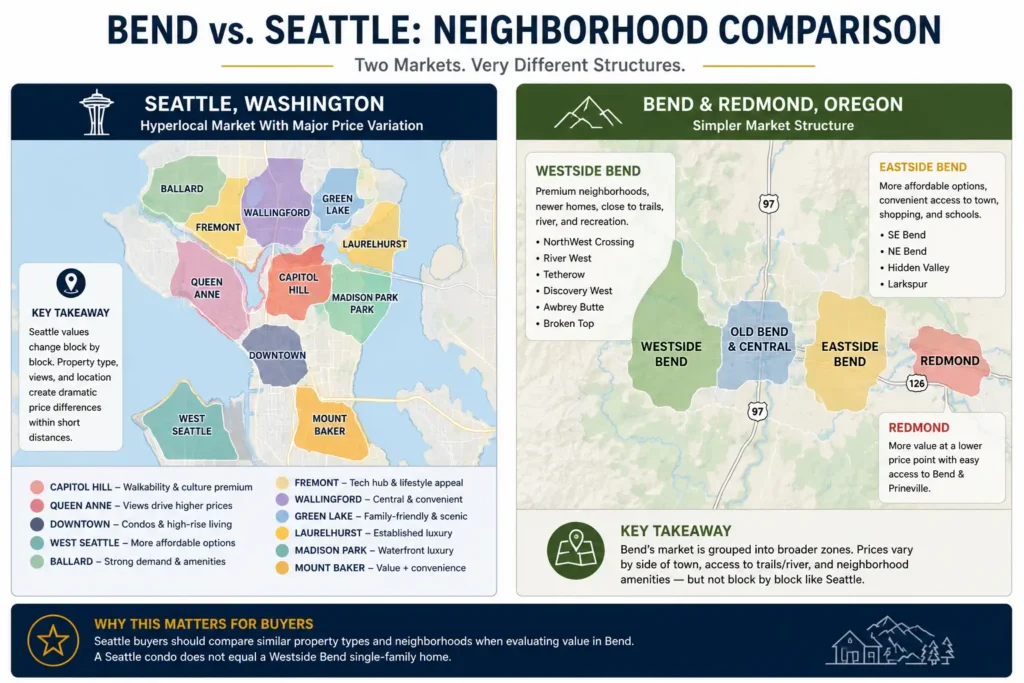
Seattle’s Hyperlocal Price Swings
Seattle has major neighborhood-level variation.
Capitol Hill, Queen Anne, and Madison Park all sit within the same city, but their pricing and buyer profiles can be very different. Capitol Hill has a mix of condos, townhomes, and single-family homes. Queen Anne has premium single-family pockets, views, and classic Seattle architecture. Madison Park can move into a much higher luxury tier because of Lake Washington access, prestige, and limited supply.
Recent Redfin neighborhood data shows how wide the spread can be:
| Seattle Neighborhood | Recent 2026 Median Sale Price | Market Feel |
| Capitol Hill | ~$965K | Urban, mixed product, very competitive |
| Queen Anne | ~$1.04M | Premium, view-oriented, established |
| Madison Park | ~$2.49M | Luxury, limited, fast-moving |
That is why “Seattle vs Bend” is too broad unless you know what part of Seattle you are comparing.
A seller leaving Madison Park and buying in Bend may experience a very different equity position than a condo owner leaving Capitol Hill.
Bend’s More Predictable Westside/Eastside Structure
Bend also has neighborhood variation, but it is usually easier to understand.
The biggest dividing line is the Parkway.
Westside Bend generally costs more because it offers walkability, trail access, restaurants, established neighborhoods, schools, and proximity to downtown, the river, and the route toward Mt. Bachelor.
Eastside and Southeast Bend usually offer better value, newer homes, more space, and a more practical price point, but less walkability.
Nearby Redmond can offer even more affordability and space.
So while Seattle’s market can feel hyperlocal block by block, Bend’s structure is more readable:
Westside equals lifestyle premium. Eastside and Southeast Bend equal better value. Redmond equals the strongest nearby affordability play.
For relocating Seattle buyers, that makes the Bend search easier to organize.
Buyer Takeaways: Bend vs Seattle in 2026
If you are comparing the Bend vs Seattle housing market, do not focus only on median price.
The better question is what kind of buying experience and lifestyle you want after closing.
Bend May Be Better If You Want
Bend may be the better fit if you want more sunshine, easier access to outdoor recreation, a smaller city feel, more negotiating room, and a housing search that gives you more time to evaluate options.
It may also fit if your Seattle equity gives you enough buying power to target the Bend neighborhoods that match your lifestyle.
Seattle May Be Better If You Need
Seattle may still be the better fit if you need a deeper job market, major airport access, dense urban amenities, more public transit, a larger restaurant and arts scene, or a broader range of property types.
Seattle is expensive, but it offers metro depth that Bend cannot match.
The Honest Broker Take
Bend is not simply “cheap Seattle.”
It is a different market with a different lifestyle promise.
For Seattle buyers, Bend can offer a lower median price, more room to negotiate, and a cleaner path into outdoor living. But desirable Bend homes are still expensive, and the best neighborhoods carry real premiums.
The strongest Seattle-to-Bend buyers are the ones who know exactly what they are buying: not just a house, but a different daily life.
Frequently Asked Questions
Yes, Bend is generally cheaper than Seattle for homebuyers in 2026. Redfin’s three-month median sale price data shows Seattle around $879K and Bend around $704K, a gap of roughly $175K. Using a local Bend single-family snapshot closer to $725K, Seattle is still about $154K higher.
Bend is still competitive, but Seattle generally moves faster. Seattle homes often sell in around 10–11 days and can sell at or above list price. Bend’s all-home data can show faster movement, but local single-family reporting points to a more buyer-friendly pace with longer days on market, sale-to-list ratios around 98–99%, and more negotiating room.
A Seattle home sale can give buyers strong purchasing power in Bend, especially if they have meaningful equity. It may allow for a larger down payment, lower loan amount, better offer terms, or access to stronger Bend neighborhoods. However, premium Westside Bend homes, luxury communities, and view properties can still move well above the citywide median.
Bend is a good alternative for buyers who want more sunshine, outdoor access, a smaller city, less intense competition, and a lifestyle centered around trails, skiing, rivers, and Central Oregon recreation. It may not be the best alternative if you need Seattle’s job market, public transit, airport access, cultural depth, or urban amenities.
Ready to Take the Next Step?
Compare Bend and Seattle homes side by side. Search current Bend listings by price, neighborhood, and lifestyle fit.
Request a Seattle-to-Bend equity review before you start touring homes.