


Bend Golf Club holds a special place in Central Oregon’s golf story. Long before modern resort communities, destination golf trips, and high-desert luxury developments became part of the region’s identity, Bend Golf Club helped introduce private golf culture to a growing mountain town.
This article is not a real estate guide and should not be treated as a replacement for the Bend Golf & Country Club community page. Instead, it focuses on the history of Bend Golf Club, its course identity, its traditional private-club character, and why that heritage still matters to golfers, members, nearby homeowners, and buyers comparing Bend’s golf communities.
Founded in the 1920s, Bend Golf Club reflects a different era of golf design and community life. It was built around tradition, membership, social connection, mature course character, and a long-term relationship with Bend’s residential growth. In a region now known for resort golf, modern architecture, and destination communities, Bend Golf Club remains one of the most important historic golf institutions in Central Oregon.
Quick Answer
Bend Golf Club is historically important because it represents Central Oregon’s original private golf tradition. The club’s inaugural rounds were played on May 3, 1925, and the original course began as nine holes on land donated by Brooks-Scanlon Lumber Company.
Why is Bend Golf Club historically important?
Bend Golf Club is important because it helped establish golf as part of Bend’s recreational and social identity nearly a century ago. Before Bend became widely known for luxury resort communities, destination golf trips, and lifestyle-driven relocation, the club provided a private golf setting for local members and families.
Its history gives it a sense of continuity that newer communities cannot recreate quickly. Mature trees, traditional course corridors, older fairway routing, and long-standing membership culture all contribute to its identity.
How is it different from newer golf communities?
Bend Golf Club differs from newer golf communities because it feels more traditional, local, and established. Modern communities such as Tetherow, Pronghorn / Juniper Preserve, and Eagle Crest often emphasize resort amenities, second-home ownership, destination travel, or modern architecture.
Bend Golf Club’s appeal is different. It is rooted in:
- Private club heritage
- Traditional golf culture
- Mature landscaping
- Established residential surroundings
- Long-term membership identity
- Classic course character
Why does history matter to nearby home buyers?
History matters because older private clubs often create a sense of stability and place. Buyers near Bend Golf Club may be attracted to mature surroundings, established neighborhoods, private club culture, and a less resort-oriented lifestyle.
For some buyers, club history adds confidence. It suggests that the area has long-term appeal, community identity, and a proven role in Bend’s residential landscape.

Bend’s Early Golf Culture
Golf became part of Bend’s recreation identity during a period when the city was still closely tied to timber, local business growth, and outdoor life. In that setting, Bend Golf Club helped introduce a formal private-club experience that connected sport, social life, and community status.
How golf became part of Bend’s recreation identity
Bend has always been shaped by outdoor recreation. Before the city became a relocation destination, it was already tied to rivers, forests, mountain access, and open land. Golf fit naturally into that culture because it offered recreation, social connection, and a reason to enjoy Central Oregon’s landscape in a structured setting.
The early golf experience in Bend was not about resort tourism. It was about local membership, community gathering, and creating a recreational institution that could grow with the city.
Central Oregon’s outdoor lifestyle roots
Central Oregon’s outdoor lifestyle did not appear overnight. It developed through decades of local recreation, public land access, mountain culture, and community investment.
Bend Golf Club became part of that story by offering a formal private sporting environment alongside the region’s broader outdoor identity. For residents who valued both social connection and recreation, the club provided a place where those priorities met.
Why private clubs helped shape local community life
Private clubs often played an important role in smaller communities because they created a consistent gathering place. They were not only places to play golf. They hosted events, supported friendships, connected families, and helped establish social traditions.
That private-club culture is part of what separates Bend Golf Club from purely public courses or resort-style destinations.
The Origins of Bend Golf Club
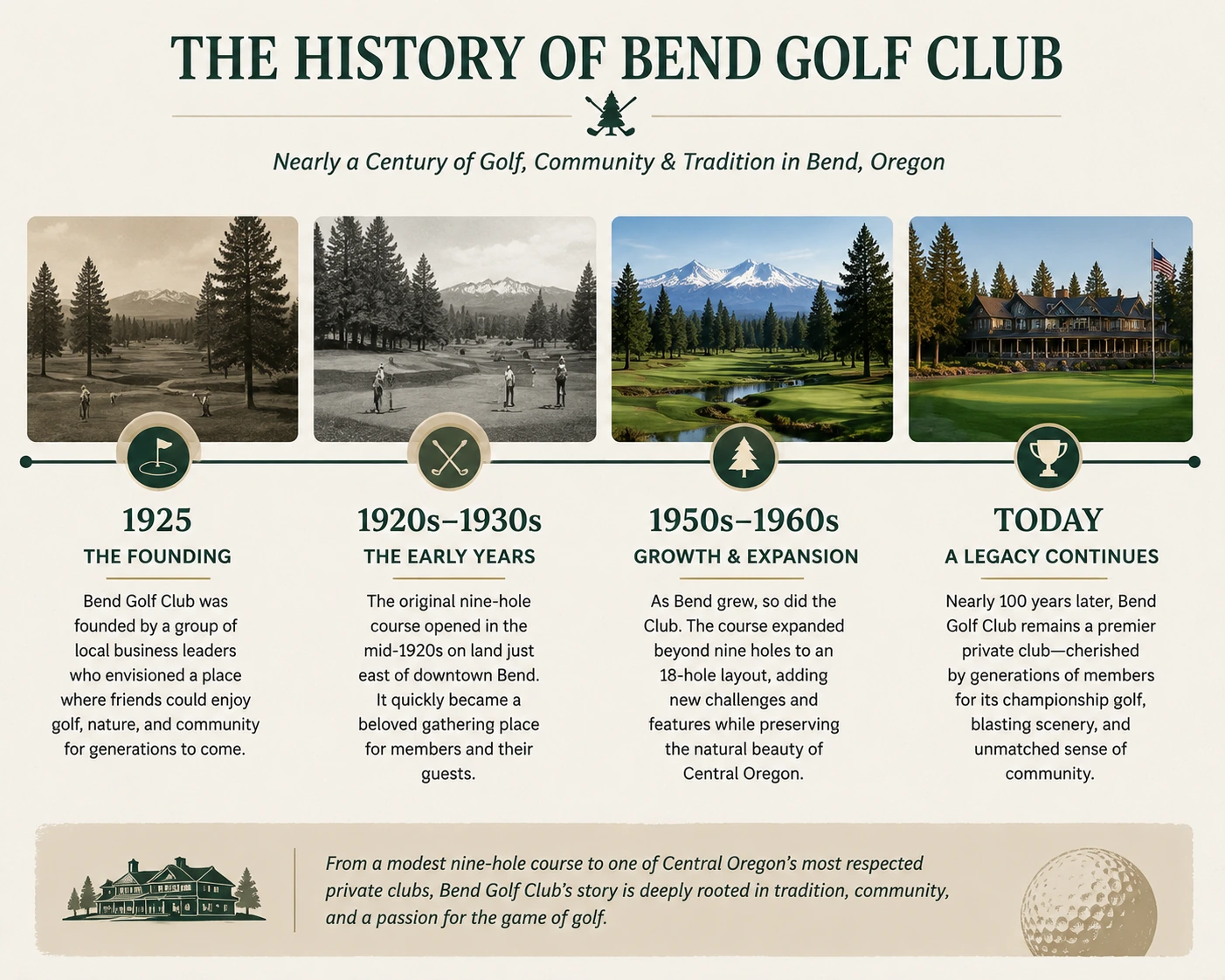
The origins of Bend Golf Club reach back to the 1920s, when Bend was still developing its identity as a Central Oregon community. The club’s early years are important because they show how golf became embedded in local life before the modern growth wave transformed the region.
Founding era
Bend Golf Club’s inaugural rounds were played on May 3, 1925. According to the club’s official history, Joe Hixon recorded the low score that day with a 10-over-par 44. The course initially consisted of nine holes built on 250 acres south of Bend, donated by Brooks-Scanlon Lumber Company.
That origin story connects the club directly to Bend’s early economic and land-development history. It also reflects the role local institutions played in shaping recreation and community life.
Early course development
The first nine holes are widely associated with H. Chandler Egan, a major figure in Pacific Northwest golf architecture. Bend Golf Club’s early course identity was shaped by traditional golf design principles, practical land use, and the limitations of early Central Oregon course construction.
Later, the club expanded into a full 18-hole layout. Oregon Golf Beat reported that Chandler Egan designed the first nine holes, which opened in 1925, while Bob Baldock and Son designed the second nine, opened in 1973.
Original golf setting
The original setting was very different from today’s polished golf environments. Early golf in Central Oregon was more rugged, more local, and more connected to available land and community effort.
That history gives Bend Golf Club a different personality than newer resort courses. It was not created first as a destination product. It developed as a local club with deep community roots.
Growth alongside Bend’s residential expansion
As Bend grew, the club’s surroundings also evolved. What began as a course outside the core of town became part of Bend’s broader residential fabric.
This is one reason the area around Bend Golf Club feels different from newer golf communities. The course and nearby neighborhoods matured together over time, creating a more established environment.
Course Design and Character
Bend Golf Club’s design character is central to its historic identity. While modern resort courses often emphasize dramatic high-desert visuals, destination branding, or championship scale, Bend Golf Club offers a more traditional playing experience.
Classic course layout
Traditional courses often rely on strategy, routing, tree placement, angles, and green complexes rather than only dramatic scenery. Bend Golf Club’s layout reflects this older style of golf experience.
Golfers may notice that the course asks for thoughtful shot placement, consistency, and course management. That type of design creates a different rhythm than many newer resort layouts.
Mature trees and traditional fairways
One of the defining visual features of older private clubs is mature landscaping. Tree-lined fairways, established turf, and long-developed course corridors help create a sense of permanence.
Mature course environments are difficult to duplicate quickly. Newer communities can build impressive amenities, but they cannot instantly create the feeling of a course that has aged with its community.
How the course differs from high-desert resort golf
High-desert resort golf in Central Oregon often features lava rock, wide views, dramatic bunkering, natural scrub, and large-scale visual impact. Bend Golf Club feels more classic and traditional by comparison.
That does not make one better than the other. It simply means they serve different golfers.
Bend Golf Club appeals to players who appreciate:
- Private club pace
- Mature fairways
- Traditional design
- Established routing
- Local membership culture
- A course with history
Why Do Older Golf Courses Feel Different to Play?
Older courses often feel different because they were shaped by earlier design values. They may be more walkable, more strategic, and more connected to the natural evolution of the site.
They also tend to carry emotional value for members who have played there for years or generations. For many golfers, that continuity is part of the experience.
Private Club Heritage
Private club heritage is one of Bend Golf Club’s most important assets. Its identity is not only based on fairways and greens. It also comes from membership culture, social life, family use, and continuity across generations.
Membership culture
Membership culture gives a private club its personality. Golfers do not simply arrive, play, and leave. They often build relationships through leagues, tournaments, dinners, junior programs, athletic activities, and regular social interaction.
At historic clubs, this culture becomes part of the institution’s value.
Multi-generational appeal
Older private clubs often hold multi-generational appeal. Families may have long-standing relationships with the club, and younger members may grow up using the course, pool, tennis courts, or dining facilities.
This type of continuity can be difficult for newer communities to reproduce quickly.
Social traditions
Private clubs often develop traditions around tournaments, seasonal events, member gatherings, holiday celebrations, and family activities. These traditions help create a sense of belonging beyond the golf course itself.
For buyers considering homes nearby, this social identity can matter. They may be drawn not only to golf, but to a community lifestyle.
Athletic and family identity
Bend Golf Club’s modern identity includes more than golf. The club’s amenities have evolved to include athletic and family-focused facilities, helping it remain relevant for households that want broader recreation.
This matters because today’s private club buyers often want more than a course. They want a place that supports fitness, social life, family use, and year-round activity.
Bend Golf Club’s Role in Central Oregon Golf
Bend Golf Club helped shape the region’s golf identity long before Central Oregon became known for destination golf. Its role is important because it represents the local, private-club foundation that came before modern golf tourism.
How it influenced the regional golf scene
As one of the region’s earliest private golf institutions, Bend Golf Club helped establish golf as a serious part of Central Oregon life. It gave local golfers a home course, a membership structure, and a social setting centered around the game.
That foundation helped make golf part of the area’s broader recreation culture.
How Does Bend Golf Club Differ From Destination Resort Golf?
Destination resort golf is designed to attract visitors, second-home owners, and travelers. Bend Golf Club’s identity is more local and membership-based.
Resort golf often emphasizes:
- Visitor experience
- Vacation ownership
- Dramatic scenery
- Lodging and hospitality
- Destination branding
Bend Golf Club emphasizes:
- Membership tradition
- Established course character
- Local community
- Private-club continuity
- Long-term relationships
Connection to Bend’s long-term recreation culture
Bend’s recreation culture is broad. It includes skiing, hiking, biking, fly fishing, climbing, paddling, trail running, and golf. Bend Golf Club is part of that long-term pattern of outdoor and athletic life.
Its historic role helps connect Bend’s early recreation identity with its modern lifestyle reputation.
How the Club Has Evolved
Historic clubs survive by balancing tradition with modernization. Bend Golf Club’s long-term relevance comes from preserving its private-club identity while continuing to serve modern members.
Facility improvements
Over time, clubs must update facilities to meet changing expectations. Golfers and families today expect more than a simple clubhouse and course.
Facility improvements help historic clubs remain competitive while keeping their original identity intact.
Athletic amenities
Modern private clubs increasingly include broader athletic amenities. These may support tennis, fitness, swimming, indoor training, and year-round activity.
This evolution is important because families and retirees often want a club that supports multiple interests, not only golf.
Dining and social spaces
Dining and social spaces help extend a club’s value beyond the course. They create a setting for post-round meals, family dinners, events, and member gatherings.
For many members, the clubhouse is where the club’s culture becomes visible.
Balancing tradition with modern member expectations
The strongest historic clubs do not abandon tradition. They update carefully while preserving the character that made the club meaningful in the first place.
For Bend Golf Club, that balance is part of its appeal. It remains historic, but not frozen in time.
Historic Club vs Modern Golf Communities
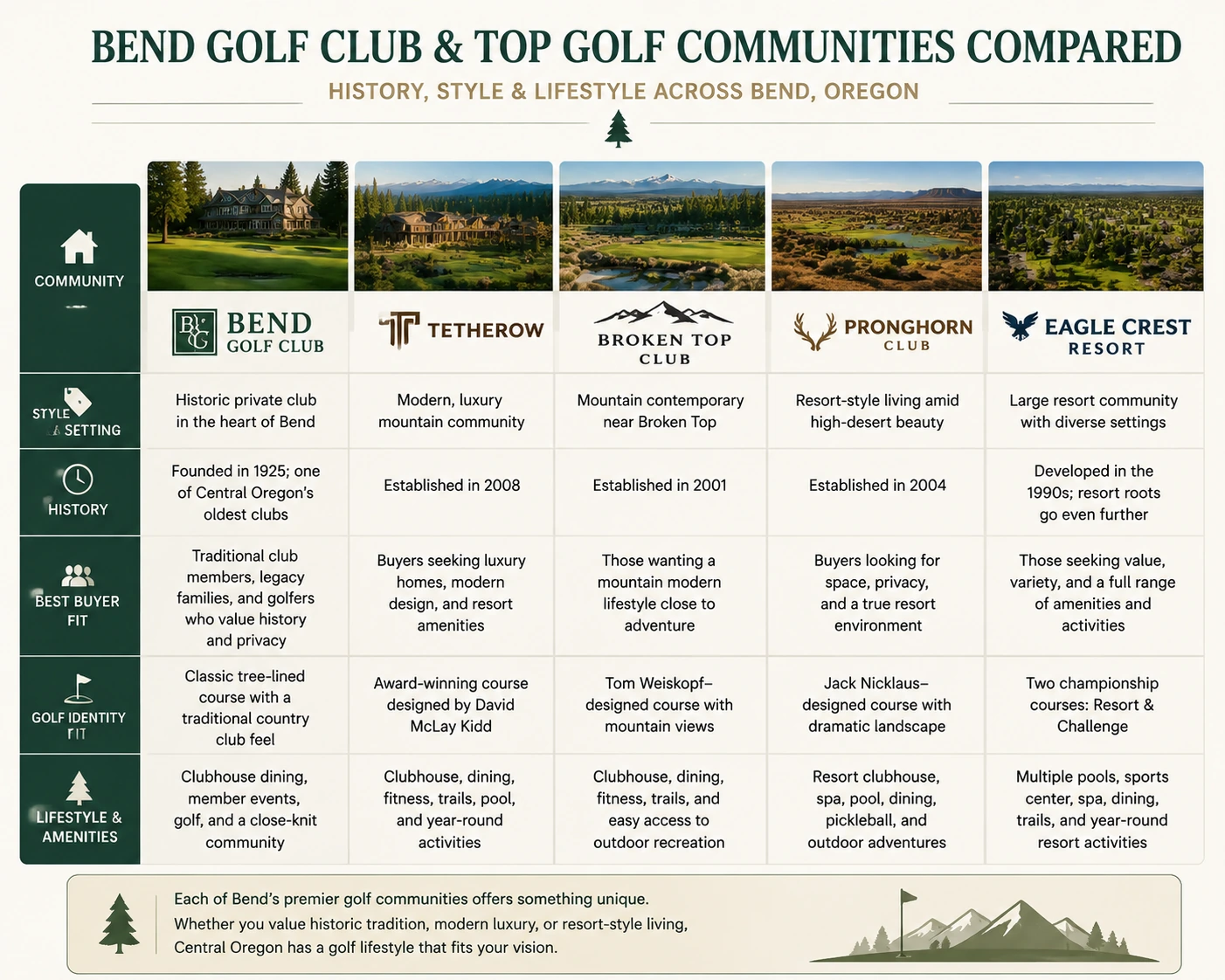
Bend Golf Club is best understood by comparing it with modern Central Oregon golf communities. Each has a different purpose, buyer profile, and lifestyle.
Bend Golf Club vs Tetherow
Tetherow represents modern Bend golf and resort-style living. It is known for contemporary architecture, westside access, resort amenities, and proximity to the Mt. Bachelor corridor.
Bend Golf Club is more traditional and established. It appeals to buyers who prefer private club heritage over modern resort branding.
Choose Bend Golf Club for tradition and local club culture. Choose Tetherow for modern design, resort energy, and westside outdoor access.
Bend Golf Club vs Broken Top
Broken Top offers gated golf-community living with mature landscaping, privacy, and a polished residential setting. It has a more luxurious neighborhood feel.
Bend Golf Club is also private and established, but its identity is more historic and club-centered rather than gated-community focused.
Choose Bend Golf Club for historic private club tradition. Choose Broken Top for gated westside golf-community living.
Bend Golf Club vs Pronghorn
Pronghorn / Juniper Preserve offers destination resort luxury, high-desert scenery, championship golf, wellness amenities, and second-home appeal.
Bend Golf Club is more local, traditional, and residential in character.
Choose Bend Golf Club for Bend-based private club life. Choose Pronghorn for high-desert resort ownership.
Bend Golf Club vs Eagle Crest
Eagle Crest is a large resort community near Redmond with golf, pools, sports centers, townhomes, vacation homes, and full-time residences.
Bend Golf Club is smaller in feel, more traditional, and more focused on private club heritage inside Bend.
Choose Bend Golf Club for private club history. Choose Eagle Crest for broader resort amenities and Redmond-area value.
Why Historic Golf Clubs Matter in Real Estate
Even though this article is not a real estate guide, historic golf clubs can influence buyer perception and neighborhood value. They create a sense of place that can make nearby homes more attractive to certain buyers.
Established surroundings
Historic clubs are usually surrounded by more established residential areas. That can mean mature trees, older streets, stable neighborhoods, and a more lived-in feeling than newer resort developments.
Many buyers appreciate that sense of permanence.
Mature landscaping
Mature landscaping is one of the most visible benefits of older club environments. Large trees, established fairways, and long-developed course corridors can create a setting that newer communities cannot immediately replicate.
This can influence both lifestyle appeal and long-term buyer interest.
Neighborhood stability
Private clubs with long histories often contribute to neighborhood stability. Buyers may feel more confident purchasing near a club that has been part of the community for decades.
The presence of a historic club can help define the identity of nearby homes and streets.
Long-term buyer appeal
Historic golf clubs often attract buyers who value tradition, privacy, membership culture, and established surroundings. These buyers may include retirees, long-time locals, golfers, families, and relocation buyers looking for authenticity rather than resort branding.
Difference between club heritage and resort branding
Club heritage and resort branding are not the same.
A resort community may offer lodging, visitor amenities, modern marketing, and vacation ownership appeal. A historic private club offers tradition, membership identity, and long-term local presence.
Both can be valuable, but they attract different buyers.
Visiting, Joining, or Buying Nearby
Because Bend Golf Club is private, people interested in the club or nearby homes should research carefully before making assumptions.
What non-members should know
Non-members should understand that private clubs typically have access rules. Course play, dining, athletic amenities, events, and guest privileges may be limited to members and approved guests.
Anyone interested in the club should contact the club directly for current policies.
How to research membership
Membership details can change over time. Before buying nearby or assuming club access, prospective members should verify:
- Membership categories
- Initiation fees
- Monthly dues
- Waitlist status
- Family privileges
- Athletic access
- Guest policies
- Transfer rules
- Golf access details
Do not rely only on old listing descriptions or third-party information.
Why nearby homes appeal to private-club buyers
Homes near historic private clubs can appeal to buyers who want:
- Golf access nearby
- Established neighborhood character
- Mature landscaping
- Social opportunities
- A traditional Bend setting
- Convenience to city services
- Long-term residential stability
For some buyers, proximity to Bend Golf Club is part of the property’s lifestyle value.
Frequently Asked Questions
Bend Golf Club’s inaugural rounds were played on May 3, 1925. The original course began as nine holes built on land donated by Brooks-Scanlon Lumber Company.
Yes. Bend Golf Club is a private club. Prospective members should contact the club directly for current membership categories, availability, dues, initiation fees, and guest policies.
Many people search for “Bend Golf and Country Club,” but the official name commonly used today is Bend Golf Club. In real estate searches, both phrases may refer to the private golf club setting and nearby residential area.
Bend Golf Club is important because it helped establish private golf culture in Central Oregon. Its 1925 origins, traditional course character, and long-standing membership identity make it one of the region’s most meaningful golf institutions.
Yes. There are residential areas near Bend Golf Club, and some buyers specifically search for homes close to the club. Buyers should review the separate community and real estate guide for home types, prices, and ownership considerations.
Bend Golf Club is more historic and traditional. Tetherow offers a modern resort-style experience with contemporary architecture and westside outdoor access. Broken Top offers gated golf-community living with a polished residential feel.
Yes. Bend Golf Club has a more traditional private-club identity than newer resort-oriented golf communities. Its appeal comes from history, mature course character, membership culture, and long-term community presence.
Final Thoughts
Bend Golf Club is more than a golf course. It is part of Bend’s history, part of Central Oregon’s recreation story, and one of the region’s original private golf traditions.
In a market now filled with resort communities, luxury golf homes, vacation properties, and modern high-desert design, Bend Golf Club stands apart because of its age, continuity, and private-club character. Its value is not only in its course or amenities, but in the sense of place created over nearly a century of use.
This is why Bend Golf Club continues to matter in Central Oregon.